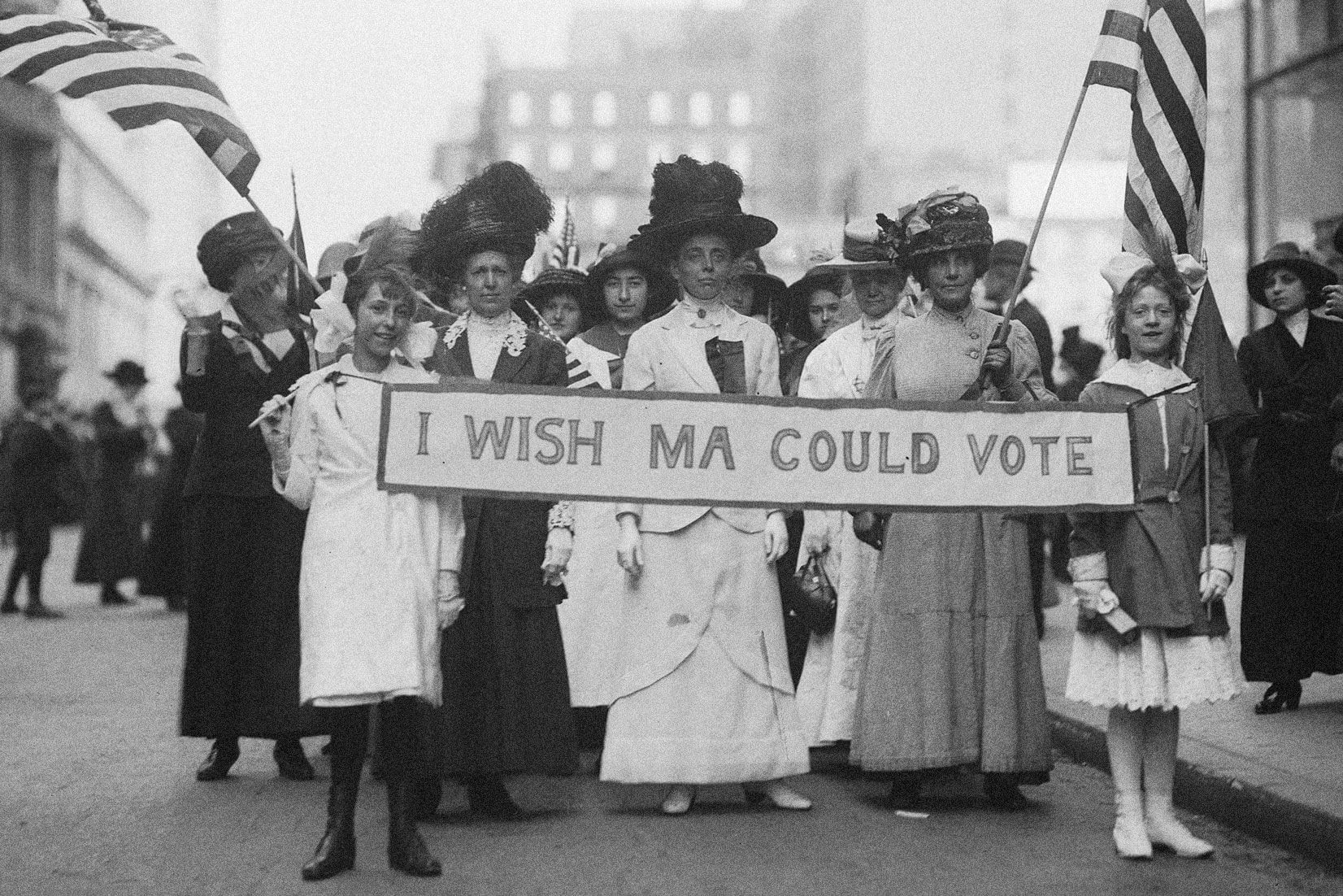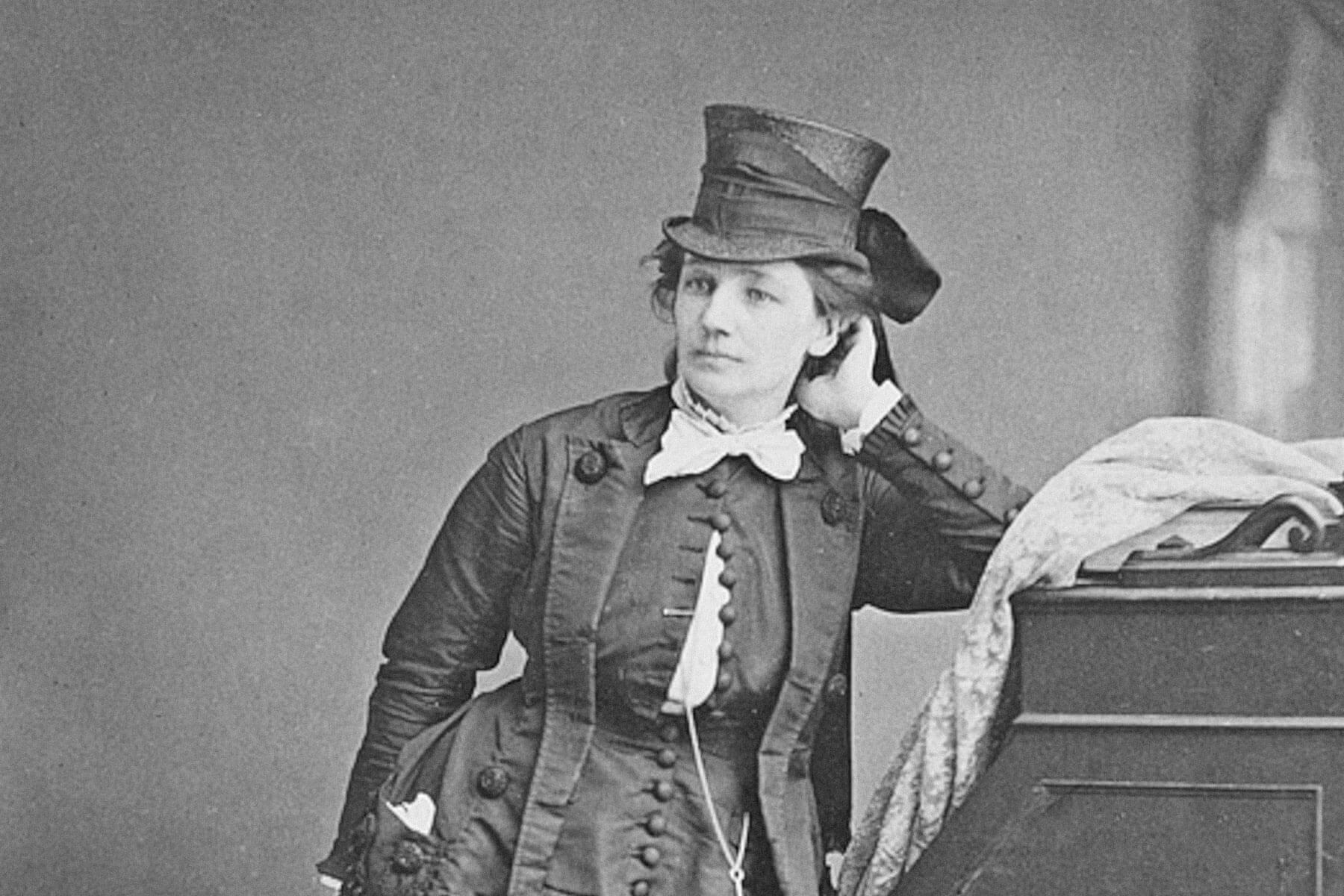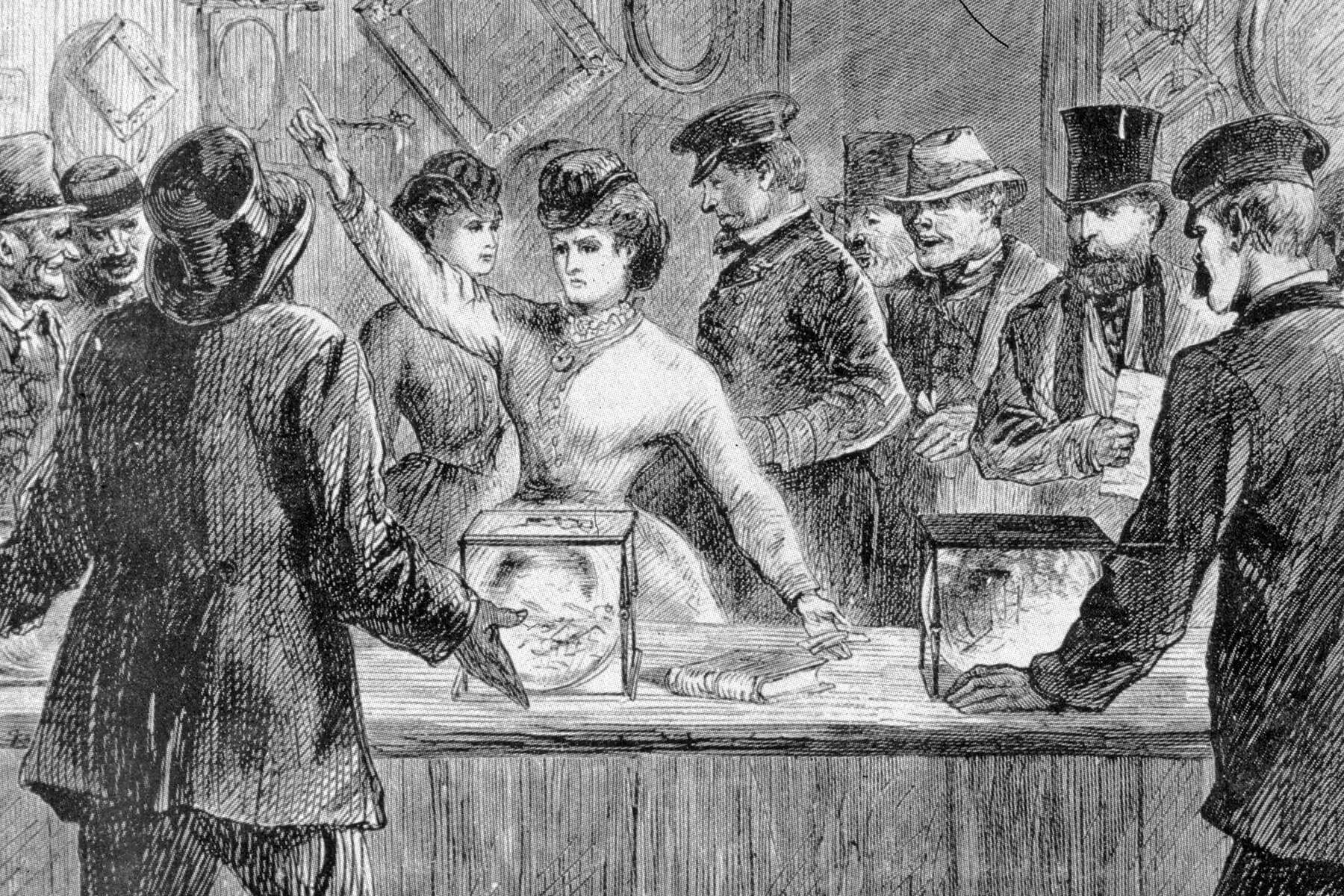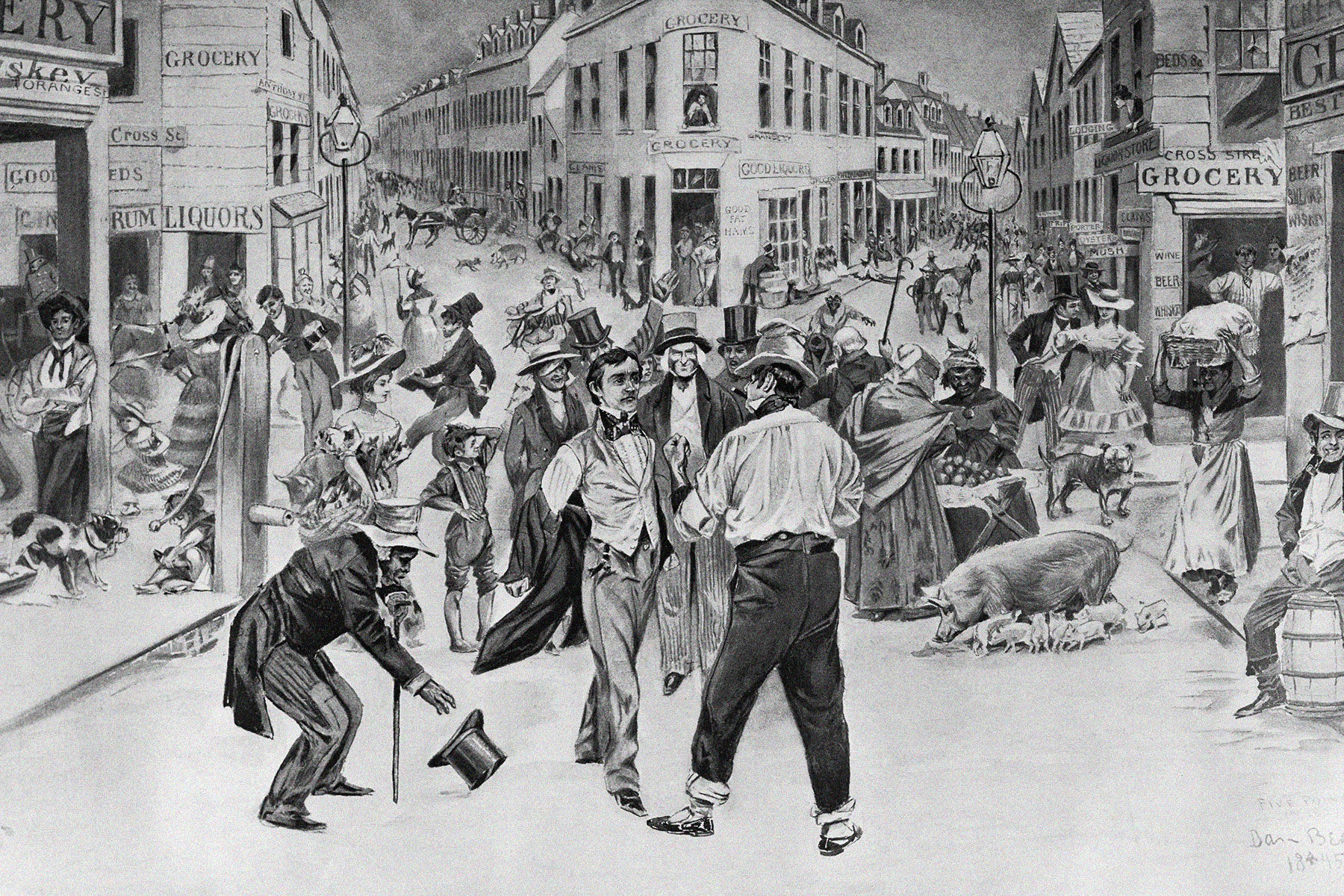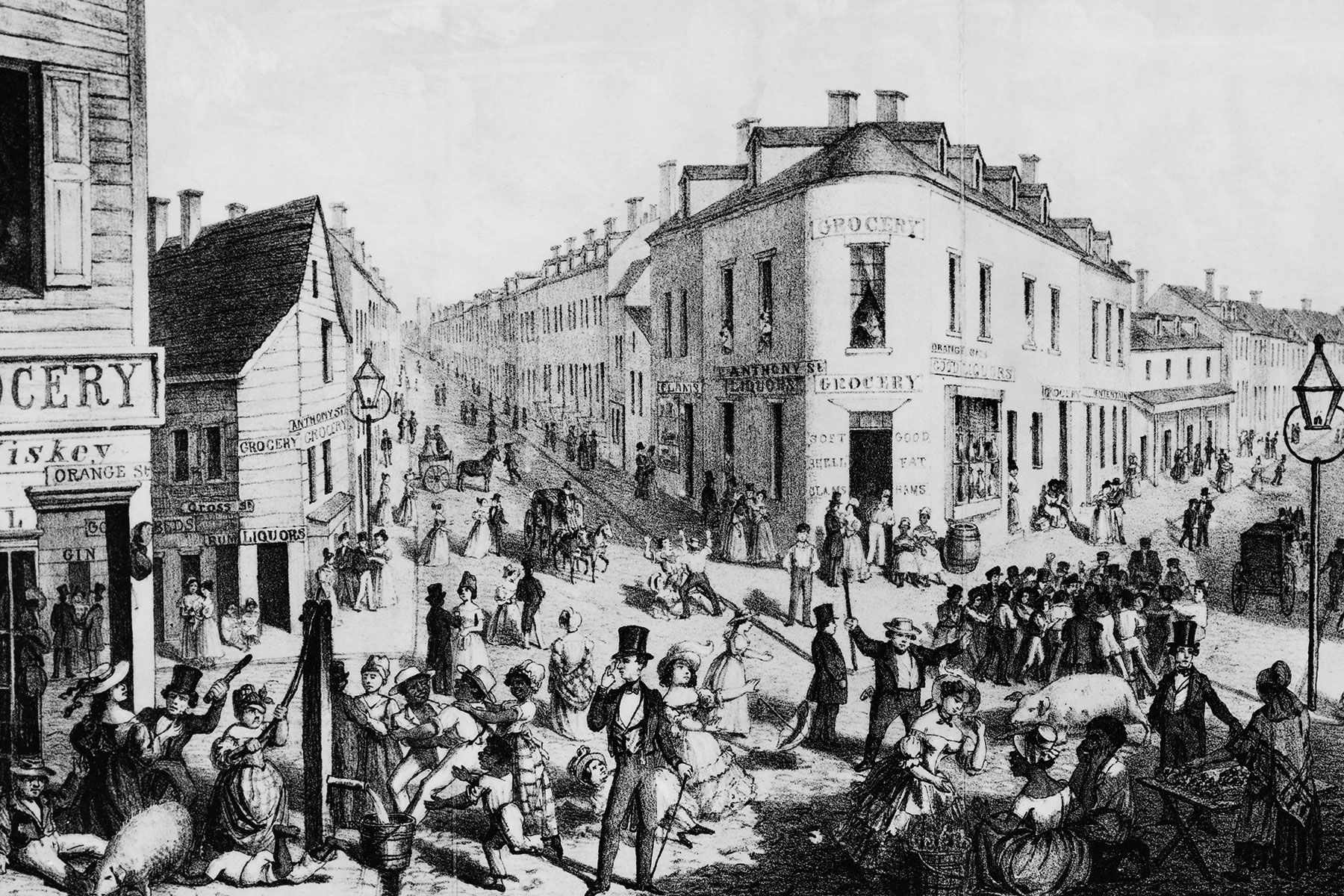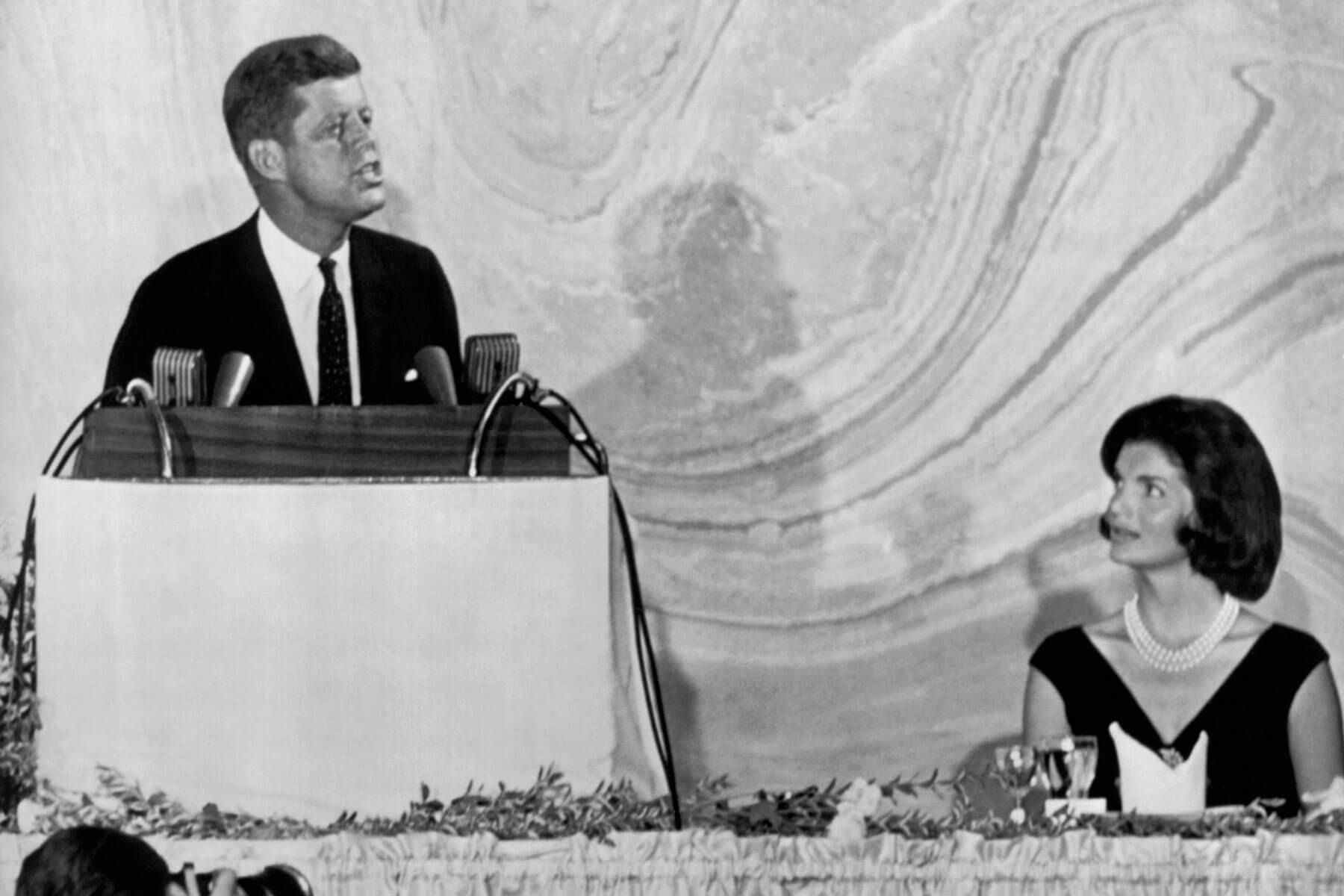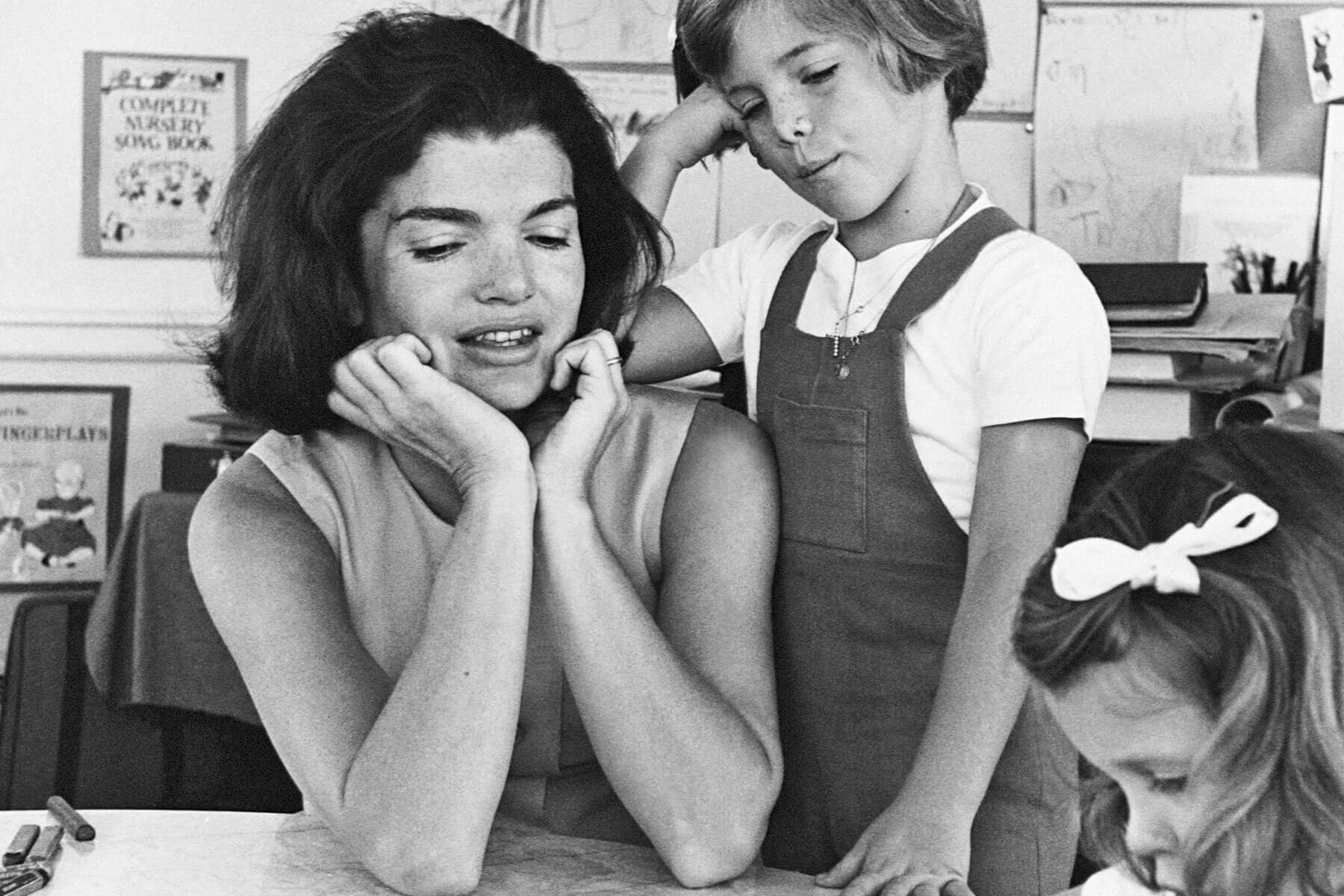


Born in 1838 in Homer, Ohio, Victoria Claflin Woodhull was an outspoken and controversial figure whose legacy as a trailblazer for women’s rights, gender equality, and sexual freedom endures to this day. Not only was she a suffragist and women’s rights advocate, but she also was the first woman to run for President of the United States — at a time when women still didn’t have the right to vote. What’s more, she and her sister, Tennessee (Tennie) Claflin, became the first female stockbrokers on Wall Street and founded a newspaper together.
Despite a tumultuous childhood and a first marriage at age 15 (to Canning Woodhull, a 28-year-old doctor with whom she had two children), Woodhull went on to carve her path in history by embracing unconventional beliefs, including spiritualism and free love, while advocating for the rights of women, laborers, and the poor. Her journey from her rural Ohio home to Wall Street and beyond is as unexpected as it is interesting. Here are five facts about America’s first female presidential candidate.
After divorcing Canning Woodhull, who was an alcoholic and a neglectful husband, Victoria Woodhull kept her married name and became a supporter of the free love movement. She endorsed the idea that decisions about romance and sexuality should be left to the individual, and that women should be able to choose when, or if, to marry. The movement also supported destigmatizing divorce in order to make it easier for women to leave abusive marriages, a goal that aligned with Woodhull’s desire to escape her own difficult first marriage. In 1871, Woodhull gave a speech at New York City’s Steinway Hall called “The Truth Shall Set You Free.” In it, she said, “I have an inalienable, constitutional, and natural right to love whom I may, to love as long or as short a period as I can; to change that love every day if I please, and with that right neither you nor any law you can frame have any right to interfere.”
Though she led a highly accomplished life, Woodhull received very little formal education as a child. Her father was a con man and the family made a living as traveling performers, selling homemade remedies and medicines and telling fortunes. During her marriage, Woodhull needed to earn money to supplement the household income and, in addition to more traditional jobs, she took work as a clairvoyant healer, claiming to be able to cure illness through a variety of natural and psychic remedies. It’s hard to know for sure how much of the business was an act and how much she really believed in her abilities; ever since childhood, Woodhull had claimed to be able to connect with dead spirits.
After her divorce, Woodhull continued to earn money telling fortunes and offering “magnetic healing,” often working and traveling with her sister Tennie. It was through her work as a healer during the Civil War that Woodhull met her second husband, James Harvey Blood, a Union Army veteran. While her marriage to Blood lasted only a few short years — “The grandest woman in the world went back on me,” Blood said after their divorce — another connection she made through her work as a clairvoyant, with railroad tycoon Cornelius Vanderbilt, yielded a literal treasure.
She Was the First Woman Stockbroker on Wall Street
Thanks to valuable stock tips from Vanderbilt, Woodhull and her sister were able to amass more than $700,000 (around $16 million today), which they used to start their brokerage firm, Woodhull, Claflin, and Company, in 1870. As the first financial firm on Wall Street owned and operated by women, the company was a shocking novelty, and the press took to calling the sisters the “Bewitching Brokers” and “Queens of Finance.” The sisters went on to found a newspaper,Woodhull and Claflin’s Weekly, which gave Woodhull another platform to support her causes of free love, political reform, and women’s rights. The paper also published the first English translation of Karl Marx’s Communist Manifesto.
Credit: PhotoQuest/ Archive Photos via Getty Images
Her Presidential Candidacy Boosted the Cause of Women’s Rights
Woodhull’s run for President in 1872, 50 years before women gained the right to vote, may have seemed like a publicity stunt to many. Lacking the financing to mount a proper campaign, she forged ahead anyway, running on the Equal Rights Party ticket. She campaigned on a platform of women’s suffrage, an eight-hour workday, welfare for the poor, the nationalization of railroads, the regulation of monopolies, and other reforms.
It was, in the end, a symbolic campaign more than anything. Woodhull’s chosen running mate, civil rights activist Frederick Douglass, never even acknowledged the nomination. Though Woodhull’s loss was all but a certainty, the fact that she hadn’t reached the minimum age of 35 required to run for President would have rendered her ineligible even if she had achieved a majority of the votes. Ultimately, the Woodhull-Douglass ticket received a negligible number of votes, and the race resulted in the reelection of incumbent President Ulysses S. Grant.
Even though she was technically ineligible to be elected President, Woodhull stands as the first woman to declare her interest in running for the highest office in the United States. But by the time the 1872 election ended, her radical beliefs and brash actions had started to impact her political reputation. Despite their initial support of Woodhull, women’s suffrage leaders, including Susan B. Anthony and Elizabeth Cady Stanton, began to distance themselves from her, signaling the end of Woodhull’s political aspirations. Twice-divorced and facing bankruptcy, Woodhull expatriated to England with her sister in 1877. The move may have been encouraged by the heirs of Cornelius Vanderbilt, who died the previous year. Woodhull built a new life for herself in England, where she married her third husband, banker John Biddulph Martin, and was generally welcomed into aristocratic society.
Woodhull spent the remainder of her life continuing to advocate for suffrage and women’s rights, but she distanced herself from spiritualism and the free love movement. From 1892 to 1901, she and her daughter, Zula, published the journalHumanitarian, which featured a progressive agenda that offered commentary on literature, culture, science, spirituality, and politics. Woodhull also promoted the popular Victorian-era idea of eugenics, selective reproduction designed to eliminate disabilities, diseases, and other traits in the human species. Her interest in what was then called “stirpiculture” likely came from the fact that her son, Byron, had profound developmental disabilities that she attributed to her husband’s alcoholism and her own age and inexperience. Today, however, the practice of eugenics is associated with Nazi Germany and racist beliefs, further complicating the legacy of this controversial activist.
Credit: Library of Congress/ Corbis Historical via Getty Images
Author Mark DeJoy
February 22, 2024
Love it?36
Despite being only one degree away from the presidency, the Vice President of the United States has long been viewed as an inauspicious position. John Adams called it “the most insignificant office that ever the invention of man contrived or his imagination conceived.” And when Theodore Roosevelt had a noisy chandelier removed from the White House, he ordered, “Take it to the office of the Vice President. He doesn’t have anything to do. It will keep him awake.”
But the Vice President is one step of succession away from the Oval Office, and that simple fact lends weight to the selection. That weight can, in turn, make for some surprising results. These are some of the more unexpected U.S. Vice Presidents to take office.
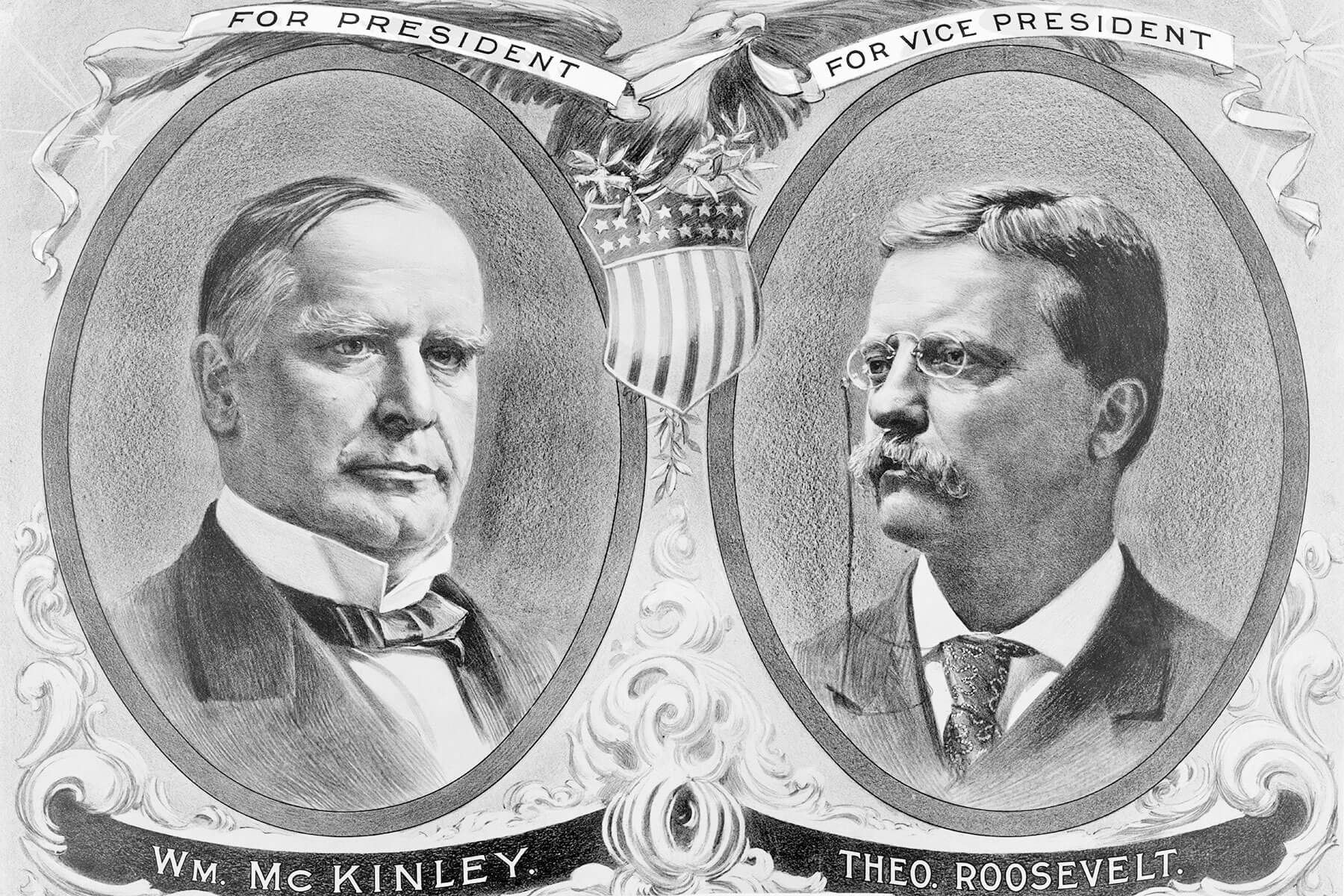
In 1899, in the months leading up to William McKinley’s 1900 reelection campaign, Vice President Garret Hobart began suffering from symptoms of a severe heart condition, including fainting spells. Though Republican Senator Mark Hanna tried to assure the public that “nothing but death or an earthquake can stop the re-nomination of Vice President Hobart,” the former seemed to be exactly the concern. Unfortunately, Hobart’s health worsened, and he died on November 21, 1899. And McKinley found himself unexpectedly looking for a running mate for reelection.
At the time, Theodore Roosevelt was serving his first year as governor of New York, and immediately emphasized a slate of reforms that put him at odds with the establishment in his own party. Republican Party bosses realized that they could effectively remove “that damned cowboy” (as Hanna referred to Roosevelt) from New York politics by nominating him as McKinley’s running mate. Roosevelt realized the political exile the vice presidency would entail, and argued against his nomination. Hanna, for his part, was vehemently opposed to the idea of Roosevelt as Vice President, at one point pleading, “Don’t any of you realize that there’s only one life between that madman and the presidency?”
The strangely aligned Roosevelt and Hanna were both unable to stem the tide, and the tally at the 1900 Republican National Convention concluded with 929 of a possible 930 votes in favor of Roosevelt as Vice President. The count was not unanimous only because there was one delegate who abstained from voting: Theodore Roosevelt himself. There was no choice but to accept the nomination, and party boss Thomas Platt quipped that he would attend McKinley’s second inauguration just “to see Theodore take the veil.” But Hanna’s warning would prove prescient just one year later, when McKinley was shot and killed, and Roosevelt assumed the presidency.
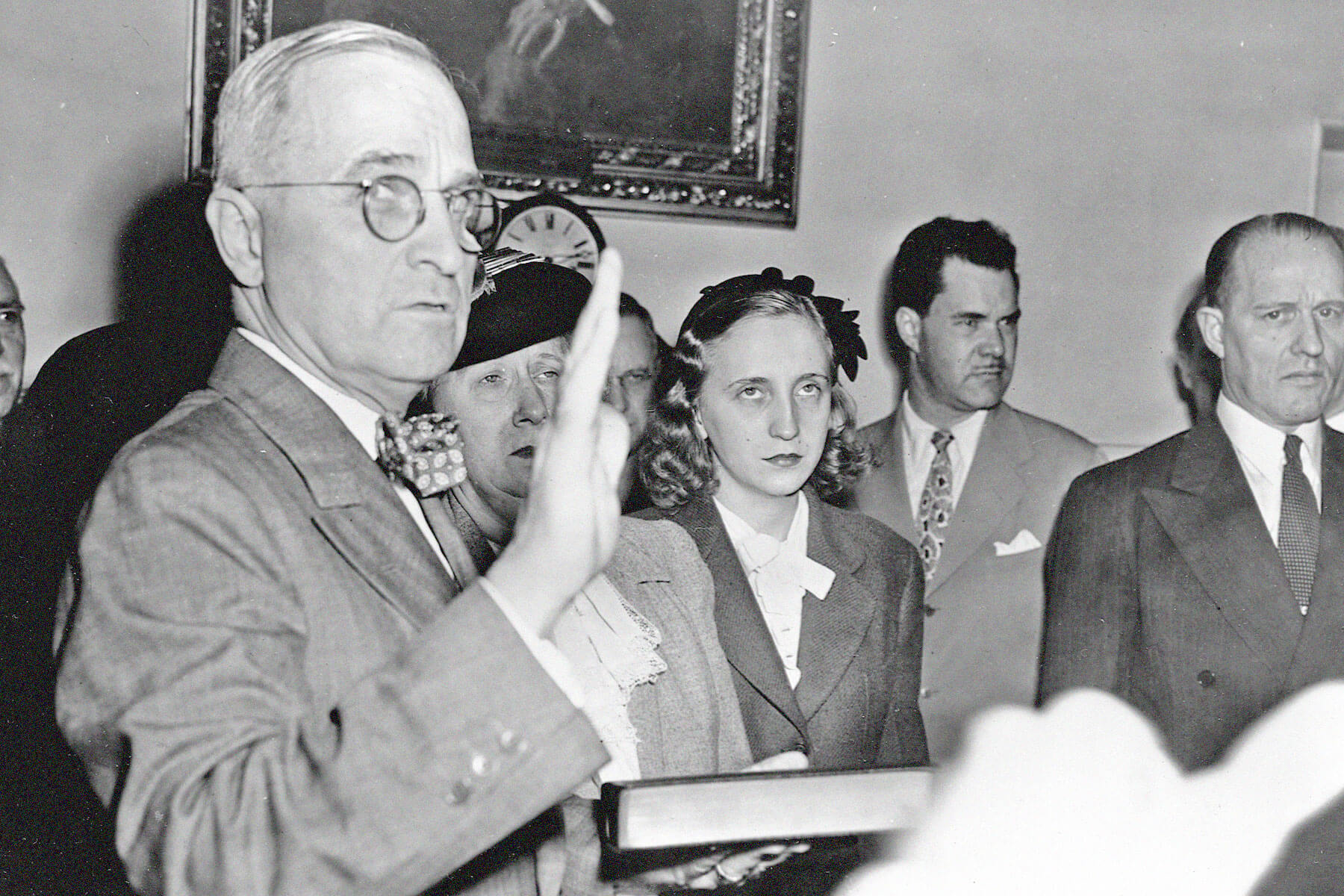
Harry Truman’s surprising presidential victory in 1948 is much more famous than his vice presidential candidacy in 1944, but Truman being chosen to replace incumbent Henry Wallace as President Franklin D. Roosevelt’s running mate was unexpected in its own right. It wasn’t that FDR changing his Vice President was unprecedented: Wallace himself had replaced two-term VP John Nance Garner for the 1940 election. But Wallace was well established within Roosevelt’s cabinet, having served as secretary of agriculture since 1933, and Roosevelt had even suggested that he wouldn’t run for a third term without Wallace on the ticket.
By 1944, though, FDR was in poor health, and Democratic Party leaders who had disagreed with his choice of Wallace as Vice President in 1940 argued more intently for a different running mate. Perhaps concerned himself about how Wallace’s friendship with Russian mystic Nicholas Roerich left the previous campaign vulnerable to political attack in the form of the infamous “guru letters,” Roosevelt refrained from naming a preferred running mate for 1944. Still, when the first ballot was cast at the Democratic National Convention, Wallace led the pack — though he didn’t secure the number of delegates needed to win the nomination. By the second ballot, Southern states switched their delegates to Truman, allowing him to snare a come-from-behind victory. Years later, Wallace claimed in an article for TIME magazine that the convention leaders had maneuvered the delegates’ switch in favor of their preferred candidate.
Advertisement
Advertisement
Credit: Buyenlarge/ Archive Photos via Getty Images
Andrew Johnson as Abraham Lincoln’s VP
Andrew Johnson might be the most surprising “balance-the-ticket” candidate in history, since he wasn’t even in the same party as the President he was running with. But in the midst of the Civil War, Abraham Lincoln wanted a running mate to represent unity, so he advocated for the Southern Democrat to join the ticket. Despite Lincoln’s popularity, the proposal was met with a level of opposition that is probably not very surprising. When told of Lincoln’s intention for the Republican Party to nominate Johnson, Pennsylvania Congressman Thaddeus Stevens protested, “Can't you get a candidate for Vice President without going down into a damned rebel province for one?”
An opposition Republican National Convention was even called in Cleveland to promote California Senator John Frémont for President, with Union General John Cochrane as his running mate. But the unity Lincoln was seeking was evident in the support Johnson had from moderate Republicans. The Republican Party was temporarily renamed the National Union Party, and when the convention took place, Johnson won the vice presidential nomination.
By the presidential election of 1812, Elbridge Gerry was nearly 20 years past his intended (and short) retirement from a storied career in government. He had signed the Declaration of Independence, served two stints in the Continental Congress, acted as a delegate in the Constitutional Convention, and was elected governor of Massachusetts. He was also a firebrand who refused to sign the Constitution, and his frequent overall dissent earned him accusations of partisanship; in a 1787 letter to Thomas Jefferson, an unidentified confidant called Gerry a “Grumbletonian” prone to “objecting to [anything] he did not propose.” His perceived failure to rebuke an attempted bribery scheme by French diplomats in 1796 (known as the XYZ Affair) nearly sunk his post-retirement reentry into politics from the outset. And the redistricting bill he signed early in 1812 while governor was derided to the point that the resulting district was referred to as a “Gerry-mander.”
Gerry was not originally looking to join President James Madison’s 1812 reelection bid; he was attempting to win another term as governor of Massachusetts. Besides, Vice President George Clinton was firmly entrenched in the position, having served in the office since 1805 under both Madison and Thomas Jefferson. But then something unprecedented happened: On April 20, 1812, Clinton died at age 72, marking the first time a sitting Vice President had passed away. Two months later, Gerry’s gubernatorial reelection campaign failed, and he appealed to Madison for a federal position due to the poor state of his finances. Since Madison’s first choice to replace Clinton, James Langdon, declined, Madison ended up asking Gerry to join his election ticket. This aligned with the Democratic-Republican’s desire for a Northerner to complement Madison’s Virginia origins. The Madison-Gerry ticket was a success at the polls, and Gerry served as Vice President for two years before also dying in office at age 70.
When William Rufus King was chosen as Franklin Pierce’s running mate for the 1852 election, he became the first U.S. senator to be nominated for Vice President. Pierce hailed from New Hampshire, and the Alabama senator was chosen for the classic “balance the ticket” strategy. At the time, nearly a decade before the Civil War, balancing the ticket meant nominating a VP who was an ardent supporter of slavery — precisely the attitude needed to appeal to the South.
During the election, however, King was ill with tuberculosis, and was unable to campaign. He spent much of the race seeking a cure in Cuba, and was still there when he and Pierce were elected. As he was not able to travel back to Washington, D.C., in time for their inauguration, Congress needed to pass special legislation in order for King to be sworn in abroad, making him the only Vice President to have ever been sworn into office outside the U.S.
On the surface, Thomas Marshall’s nomination as Woodrow Wilson’s Vice President seems fairly straightforward. As the governor of Indiana, he was the popular leader of what had been a critical swing state — since 1880, no presidential candidate had won the election without carrying Indiana. But there were a few underlying problems: For one, Wilson did not want Marshall on the ticket, referring to him as “a very small caliber man.” And Marshall himself had a similar attitude toward the vice presidency as Theodore Roosevelt before him. He wryly joked, “Once there were two brothers. One ran away to sea; the other was elected Vice President of the United States. And nothing was heard of either of them again.”
By the time of the 1912 Democratic National Convention, the party was still split on who would serve as Wilson’s running mate. Democratic powerhouse William Jennings Bryan was proposed as a candidate by a delegate from the District of Columbia, but declined consideration in a response speech, and instead advocated for both North Dakota Governor John Burke and Oregon Senator George Chamberlain. Meanwhile, rumors circulated that Wilson himself was delaying the vote in order to persuade Missouri Congressman James Beauchamp “Champ” Clark to be his running mate. The first vote was held at 1 a.m., and resulted in no decision. After nearly an hour of angling and debate, Marshall was finally elected the party’s vice presidential nominee — and even then, he considered rejecting the office due to its inadequate pay.
As tensions rose between the Soviet Union and the West after World War II, Soviet Prime Minister Nikita Khrushchev sought to end the wave of emigration out of the USSR-controlled East Germany. The number of fleeing East Germans was staggering: Between 1949 and 1961, roughly 2.5 million people fled the state, a loss that threatened to upend the East German economy. Finally, after upwards of 65,000 citizens migrated to West Berlin between June and August 1961, East German leaders pushed for Moscow to close the border, and construction of the Berlin Wall began the night of August 12, 1961.
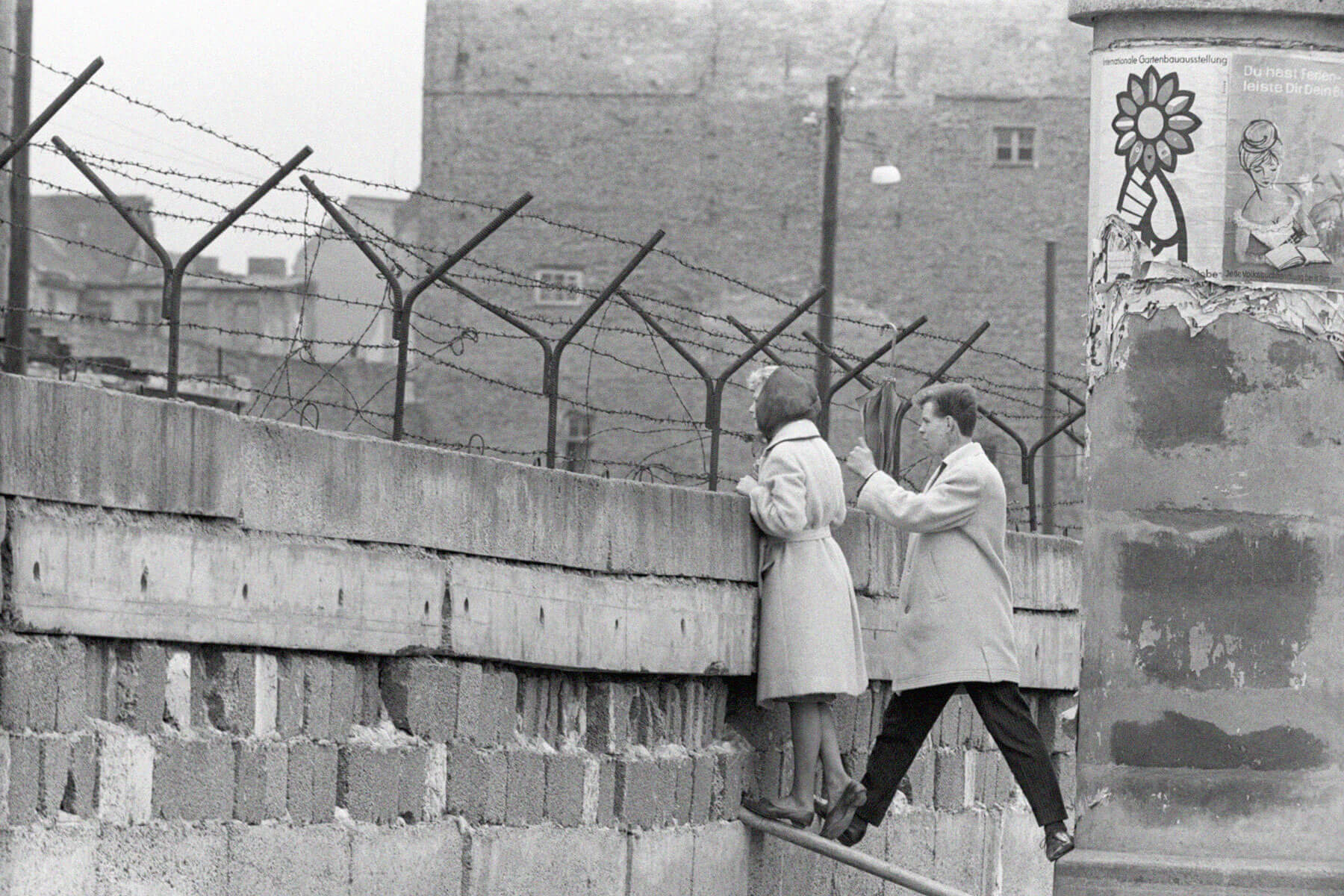
The boundary started off as a barricaded barbed wire between East and West Berlin, and the effects were swift and merciless. Within two weeks, the border to the west was completely sealed — crossing was forbidden, and the wall was guarded by officers permitted to shoot attempted escapees on sight. For the next two decades, the now-infamous barrier served as a symbol of the political and ideological divide of the Cold War. Here are five interesting facts about this notorious structure.
The Name “Checkpoint Charlie” Came From the NATO Phonetic Alphabet
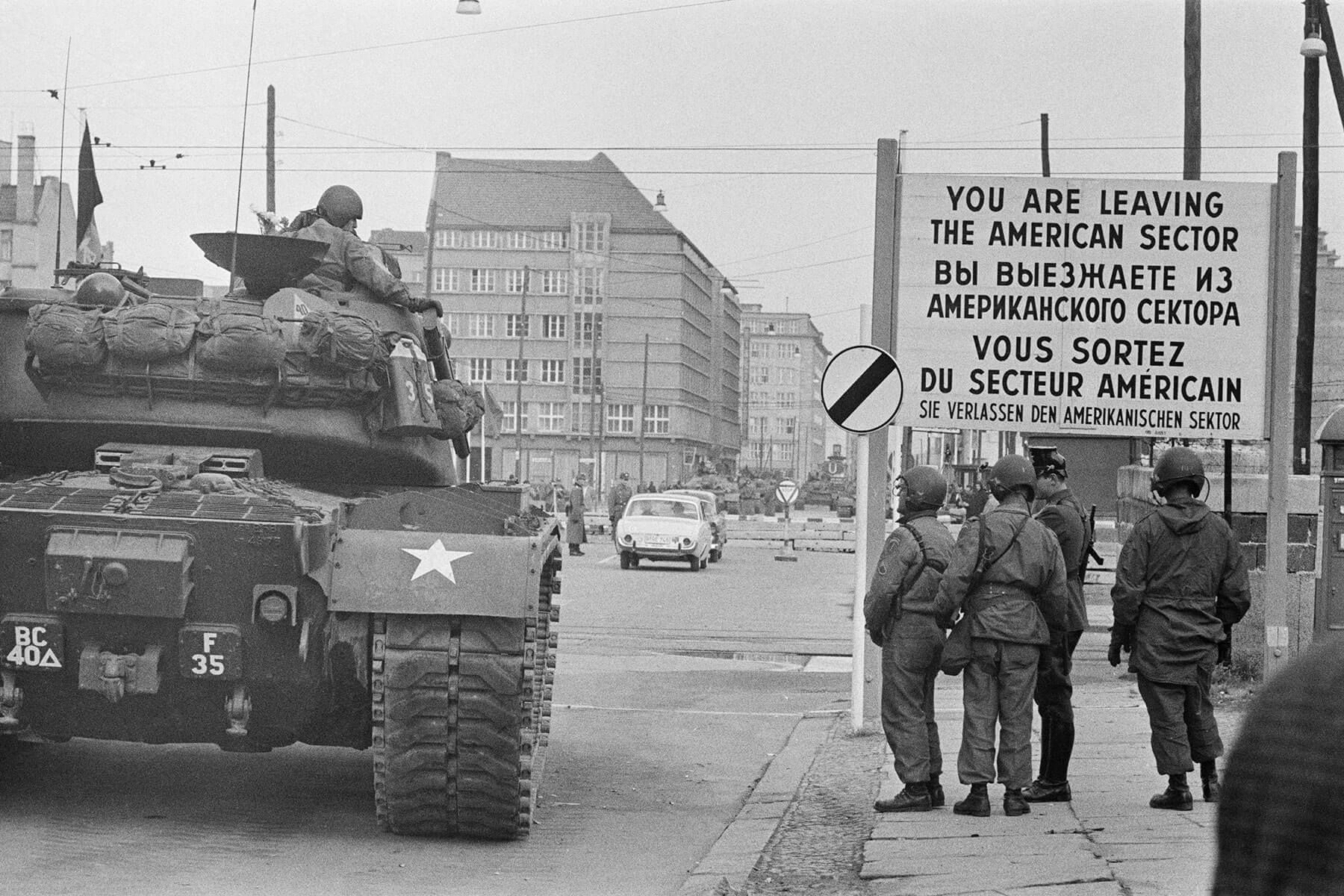
Berlin was divided into four sectors following the Second World War. The Soviet Union controlled the eastern part of the city, while France, the United States, and Britain controlled three sectors in the west. There were three major checkpoints along the Berlin Wall, which monitored the border crossings of foreigners, diplomats, and military officials: Checkpoint Alpha, Checkpoint Bravo, and the most famous, Checkpoint Charlie. The names of all three checkpoints originated with the NATO phonetic alphabet, representing the letters “A,” “B,” and “C.” Checkpoint Charlie was located in the heart of Berlin, and marked the divide between the Soviet and American zones. It became a symbol of the Cold War divisions, and is now a historical site and memorial in Berlin.
Photo credit: Keystone/ Hulton Archive via Getty Images
The “Death Strip” Was the Most Dangerous Part of the Wall
Though it’s known as the Berlin Wall, the boundary was actually two structures. The original 96-mile wire barrier proved too easy to scale, so in 1962, construction began on another fence that ran parallel to the original about 100 yards behind it. Both were later reinforced with concrete topped with barbed wire. The corridor between them became known as the “death strip.” The area was covered in raked gravel so footprints could be easily seen, helping guards track down and shoot those fleeing to the west — that is, if escapees managed to evade the mines and booby traps set up along the way. Still, many risked their lives to cross, and succeeded: An estimated total of around 5,000 East Berliners managed to make it to the other side of the wall.
To deter defections, the Berlin Wall was reinforced multiple times over the years. The final phase began in 1975, when the previous wall was replaced with a sophisticated cement barrier with increased surveillance. Known as “Grenzmauer 75” (“Border Wall 75”), the structure was made up of 45,000 separate sections of reinforced concrete, measuring around 12 feet high and 5 feet wide. Completed in 1976, the final version of the Berlin Wall (and the one commonly seen in images from its fall) was outfitted with armored vehicles, canine units, 300 watchtowers, and a rounded concrete pipe at the top to deter climbing. Yet the escapes continued.
Photo credit: PhotoQuest/ Archive Photos via Getty Images
Escapes Became Increasingly Creative
The sudden border closing of 1961 trapped thousands of people in East Germany, many of whom were desperate to flee. Buildings located on the border with windows facing west provided opportunities to clear the border for those willing to jump, but the Soviets soon bricked up all openings that could aid in escape. East Germans adapted: Some made it to West Berlin by tunneling under the wall, while others swam across the Teltow Canal to the south of the city, walked a tightrope, and used zip lines. Occasionally, East German border guards assisted by choosing not to accurately fire, or by defecting themselves and assisting future escapees.
An Administrative Error Led to the Fall of the Berlin Wall
On November 4, 1989, some 500,000 East Berliners gathered to protest the Soviet state’s strict border laws. The demonstration came roughly two months after Hungary lifted restrictions on travel to Austria, marking one of the first times the Iron Curtain was lifted. In an attempt to calm the crowds, East German leaders announced on November 9 that they too would loosen borders to make travel easier. However, East German spokesperson Günter Schabowski erred when asked when the borders would open. With no time to read through the rules before speaking, he answered, “As far as I know, effective immediately, without delay.” East and West Berliners were finally united as stunned border guards stood aside. That night, the Berlin Wall finally came down.
Advertisement
Advertisement
10 Facts About the First 10 Constitutional Amendments
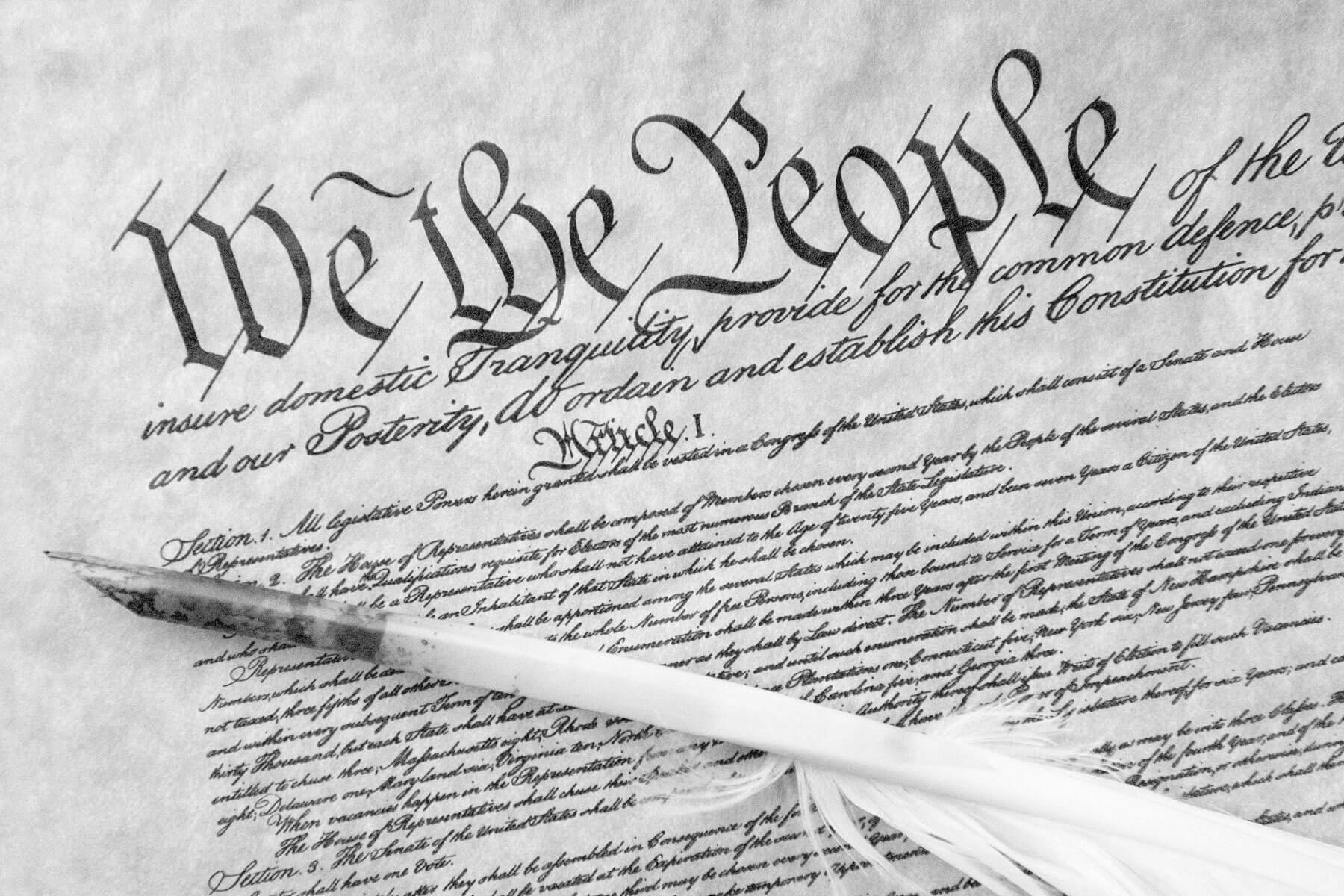
The U.S. Constitution is among the most important and esteemed texts in American history. Since its ratification on June 21, 1788, this living document has served as the groundwork for the country’s government on both the federal and state levels. It’s also constantly evolving: The Constitution has been amended 27 times over the years, beginning with the certification of the first 10 amendments, known as the Bill of Rights, in 1791. Here’s a closer look at each of those first 10 amendments to the U.S. Constitution.
The First Amendment Was Introduced by James Madison
Long before he assumed the role of commander in chief, America’s fourth President, James Madison, introduced the Bill of Rights to Congress, starting with the First Amendment, which protects freedom of speech, religion, the press, assembly, and the right to petition the government. Madison drafted the Bill of Rights in 1789. A representative of Virginia, he based the First Amendment’s text on the Virginia Declaration of Rights, as well as the English Bill of Rights and the Magna Carta.
The Second Amendment Was Agreed Upon as a Compromise
The right to bear arms as defined by the Second Amendment has been a controversial topic for ages, even dating back to when it was first agreed upon. Like much of the Bill of Rights, the final text was a compromise between pro-government Federalists and rival Anti-Federalists, who argued over whether an adequately armed population could deter potential government oppression. Anti-Federalists fought for a Second Amendment that preserved the right of the people to fight back against government oppression, while Federalists maintained that those fears were overblown.
The Third Amendment Has Never Been Argued in Front of the Supreme Court
While many constitutional amendments have been the subject of heated judicial debate, the Third Amendment has never been the focus of a U.S. Supreme Court case. The amendment forbids the government from forcing citizens to house soldiers in their private homes without their consent during peacetime. It is one of the more universally agreed-upon elements of the Constitution.
Advertisement
Advertisement
Photo credit: Nadinlargo/ iStock via Getty Images Plus
An Exemption to the Fourth Amendment Was Created for Cars
The Fourth Amendment was ratified in 1791, establishing rules against warrantless searches by law enforcement. Given that the amendment was ratified long before cars existed, it wasn’t until the 1925 case Carroll v. United States that vehicle searches were first debated on a judicial level. The case ultimately established an exemption to the Fourth Amendment that permits warrantless vehicle searches, provided there is probable cause to suspect there is contraband inside.
Advertisement
Advertisement
“Due Process” Was Added to the Fifth Amendment at New York’s Request
The “due process” clause — which guarantees fair treatment under the law — is an integral component of the Fifth Amendment, which protects those accused of criminal activity against self-incrimination and prohibits “double jeopardy” (being prosecuted twice for the same offense twice), among other protections. In essence, the concept of due process ensures that every American will be treated fairly in court, but it may never have existed if not for a request made by delegates from the state of New York, which had a similar concept included in its own Bill of Rights Statute. The request led James Madison to draft due process into the Fifth Amendment.
The Sixth Amendment Didn’t Include State Court Cases for 172 Years
The Sixth Amendment protects the rights of those facing criminal charges, such as the right to a fair and speedy trial by an impartial jury, as well as legal representation. It has provided the right to a free defense counsel on a federal level since its ratification in 1791, but it wasn’t until 1963 that the amendment was expanded to include felony cases facing state prosecution. The expansion was a result of the landmark decision in the case Gideon v. Wainwright, in which the court ruled that states must provide attorneys to any criminal defendant unable to afford their own counsel.
The Seventh Amendment Still Applies to Cases That Exceed a Value of Just $20
The Seventh Amendment guarantees the right to a trial by jury in federal civil cases, but only regarding issues where the value exceeds $20 — a stipulation that’s still in place today. The amendment was ratified in 1791, so in modern terms, that $20 would be roughly equal to around $650. However, the text of the amendment still reads “twenty dollars.”
The Eighth Amendment Was Taken Nearly Verbatim From the English Bill of Rights
The Eighth Amendment — which reads, “Excessive bail shall not be required, nor excessive fines imposed, nor cruel and unusual punishments inflicted” — was taken nearly verbatim from the English Bill of Rights of 1689. While many other amendments from the Bill of Rights were influenced by the British Constitution, the Eighth Amendment is notable for its highly similar wording.
Advertisement
Advertisement
The Ninth Amendment Doesn’t List Any Specific Rights
While the first eight amendments clearly define the rights they’re meant to protect, the Ninth Amendment is significantly more abstract in nature. It was put in place to reaffirm that rights shouldn’t be denied solely because they aren’t explicitly stated in the Constitution. The entirety of the amendment reads, “The enumeration in the Constitution, of certain rights, shall not be construed to deny or disparage others retained by the people.”
The 10th Amendment Has Never Been Invoked to Protect Individual Citizens
The 10th Amendment essentially establishes the concept of states rights, and underscores the limits of the federal government as restricted to the powers enumerated in the Constitution. The text reads, “The powers not delegated to the United States by the Constitution, nor prohibited by it to the States, are reserved to the States respectively, or to the people.” Though the 10th Amendment has been invoked many times with regard to protecting state’s rights, it’s never been invoked by an individual citizen in a case against the federal government.
Steve Liss/ The Chronicle Collection via Getty Images
Author Mark DeJoy
November 9, 2023
Love it?45
The first line of the preamble to the U.S. Constitution contains the oft-referenced statement of purpose, “to form a more perfect union.” Presidential elections have served as a significant (if not the most significant) part of the process behind that intention, as a quadrennial evaluation of the not-yet-perfect union’s direction. As with any growth process though, there’s bound to be some, well, awkward phases — and the United States certainly has had them. Entire political parties have come and gone, constitutional amendments have been necessitated, and there’s been all manner of outright oddity throughout the history of U.S. presidential elections. Here are some of the most bizarre moments.
If anything proves that partisan politics and electoral machinations are nearly as old as the United States itself, it’s the election of 1800, when Federalist Party incumbent President John Adams sought reelection against Democrat-Republican Vice President Thomas Jefferson. The already-bizarre premise of opposing parties holding the presidency and vice presidency was made possible at the time by a law stipulating that the presidential candidate who earned the second-most number of electoral votes became Vice President. In the election of 1796, Jefferson lost the presidency to Adams by only three votes, and the 1800 election was a rematch between the political rivals.
That time, with another narrow margin likely, both parties turned toward influencing electors, whose votes decided the winning candidate in states where there was not yet a popular vote. Jefferson wrote of his intent to sway electors in New York, Pennsylvania, and New Jersey in a letter to James Madison. Federalist Senator Charles Carroll accused Jefferson and his supporters of also attempting to use “arts and lies” to manipulate votes in Federalist-leaning Maryland. From there, the accusations, well, escalated. Jefferson-supporting pamphleteer James Callendar claimed that John Adams was a hermaphrodite. Federalist newspapers accused Jefferson of maintaining a harem at Monticello.
When the votes were finally cast, the election ended in a tie between Jefferson and… his intended running mate, Aaron Burr. How? Each elector had two votes to cast, but there was no distinction at the time between a vote for President versus a vote for Vice President. Casting one vote for Jefferson and one vote for Burr was in effect a vote for each as President. The Constitution called for resolving this tie between the Democrat-Republican candidates with a vote in the House of Representatives, which was controlled by, you guessed it, the Federalist Party.
The task at hand was to vote on who, between Jefferson and Burr, would be President, but the Federalists saw an opportunity to seize power, either by delaying the proceedings past the end of Adams’ term, or attempting to invalidate enough votes to give Adams the majority. Others advocated for supporting Burr. Between February 11 and February 16, 35 rounds of voting took place, each ending in deadlock. Finally, after much lobbying by Alexander Hamilton against Burr, the 36th ballot resulted in Jefferson being appointed President. In the wake of the turbulent election, the 12th Amendment was ratified in order to prevent a repeat ordeal in 1804.
Photo credit: Kean Collection/ Archive Photos via Getty Images
1840: William Henry Harrison vs. Martin Van Buren
If William Henry Harrison is known today, it’s for the obscurity of his mere 31 days in office. But the campaign leading to his presidency was a rollicking and often rowdy phenomenon that sparked a voter turnout of more than 80%, an increase of nearly 23 percentage points from the previous election.
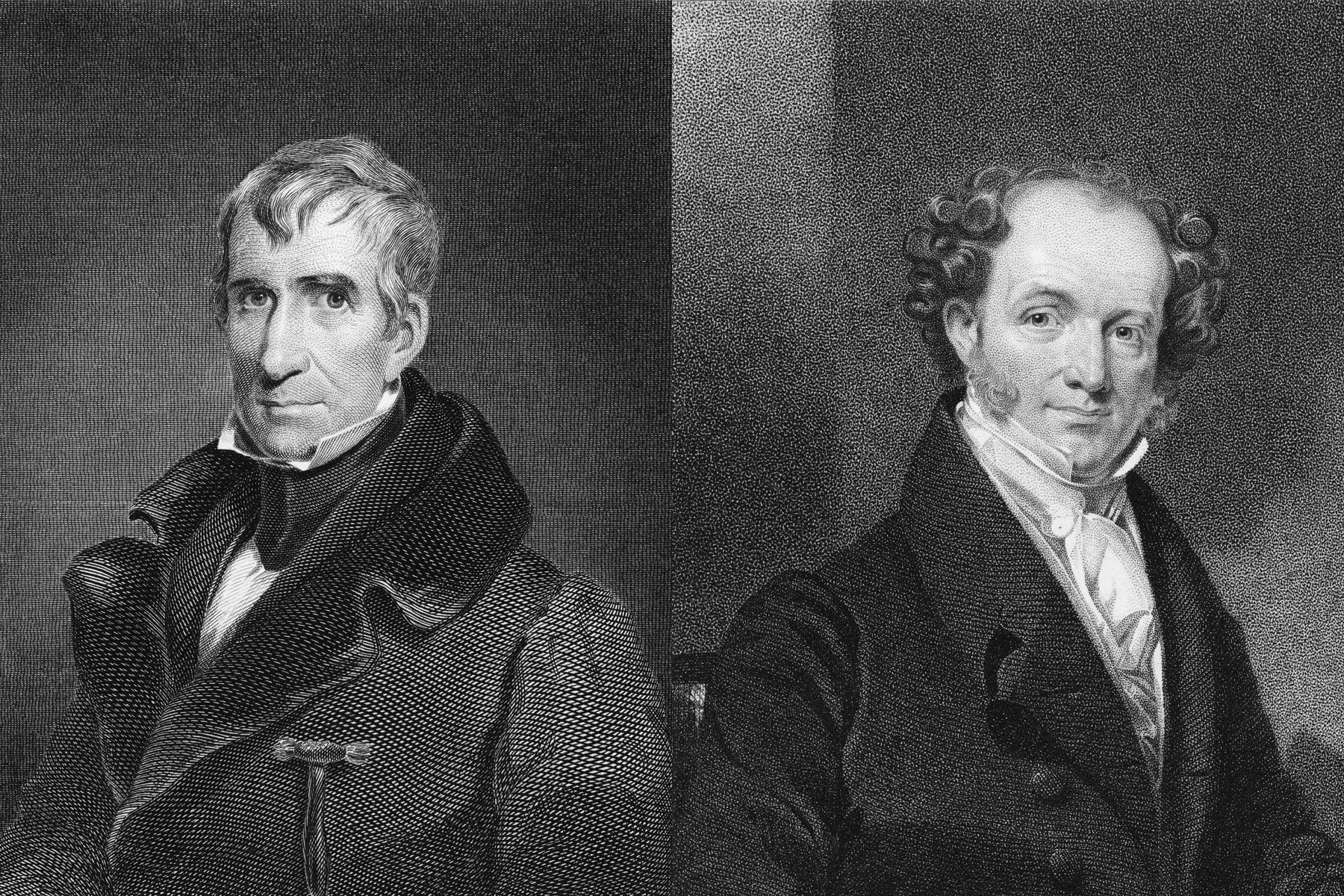
The election pitted Harrison and running mate John Tyler of the upstart Whig Party against incumbent Democratic President Martin Van Buren during a period of economic strife caused by the Panic of 1837. Harrison’s campaign played off of his military fame for his victory at the Battle of Tippecanoe, with the slogan “Tippecanoe and Tyler Too.” It also attacked Van Buren with accusations of living in aristocratic luxury. The Van Buren campaign and its supporters countered by painting the 67-year-old Harrison as too elderly and frail for the presidency. An editorial in the Baltimore Republicanmocked Harrison with the line, “Give him a barrel of hard cider, and settle a pension on him… he will sit the remainder of his days in his log cabin by the side of the fire and study moral philosophy!”
The Whigs, however, embraced the hard cider and log cabin imagery, and built the rest of the campaign around it. They leaned into the association with the “everyman,” and organized cider- and whiskey-fueled mass rallies. There were songs, stump speeches, and all manner of bric-à-brac emblazoned with cider kegs and log cabins. There were also the 10- to 12-foot slogan-covered balls Whigs would roll down the streets while chanting in support of the candidates. It all led to Harrison shellacking Van Buren in the election, albeit not quite as might be expected: The lopsided victory was in the Electoral College, 234 to 60, but the popular vote margin was only about 150,000 votes. No need to pity Van Buren, though. He later remarked, “The two happiest days of my life were those of my entrance upon the office and my surrender of it.”
Incumbent President Ulysses S. Grant’s Republican Party was beginning to fracture leading into the June 1872 National Convention. A reform wing calling itself Liberal Republicans had held its own convention the previous month, nominating New York Tribune founder and editor Horace Greeley as its candidate. Overestimating the power of this new faction, the Democratic Party refrained from nominating its own candidate and instead threw its support behind Greeley, despite Greeley’s history of pointed criticism of the Democratic Party.
Almost immediately, Greeley was lambasted in the press. The New York Timescalled the Democratic Convention that nominated him “the ghastliest of political shows.” Political cartoons were especially harsh, depicting him as mousey or infantile. Greeley soldiered on, making campaign stops in New Jersey, Pennsylvania, Ohio, Kentucky, and Indiana between September 19 and 29, and giving nearly 200 speeches in that short span. Unfortunately for the candidate, his running mate Benjamin Gratz Brown completely undermined that effort by giving an incoherent drunken speech at Yale, and then fainting during an event in New York City.
The Greeley campaign never really mounted a serious threat to Grant. “I have been assailed so bitterly that I hardly knew whether I was running for the presidency or the penitentiary,” Greeley lamented. Grant won reelection easily with 55.6% of the popular vote. In a bizarre and tragic twist, Greeley died on November 29, before the Electoral College could cast its ballots. Because of this, the 63 votes he would have earned were dispersed among other candidates. It remains the only time in U.S. history that a candidate has died in the interim between the popular vote and the Electoral College vote.
The 1872 election was also notable for another reason: Though not a legal candidate (she was under 35 years old), Victoria Woodhull also ran in the 1872 election, making her the first woman to campaign for President of the United States.
Photo credit: Central Press/ Hulton Archive via Getty Images
1964: Lyndon B. Johnson vs. Barry Goldwater vs. a Fabricated “Jewish Mother”
The 1964 presidential election took place less than a year after the assassination of John F. Kennedy; the Vietnam occupation was approaching its midpoint, and segregationist Alabama Governor George Wallace was running a primary campaign in the northern U.S. on a platform of outright racism. Into this fraught atmosphere stepped a wisecracking independent write-in candidate named Yetta Bronstein, with slogans such as “We need a Jewish mother in the White House,” A mink coat in every closet,” and “If you want simple solutions, then you gotta be simple.” Calling herself a “Jewish housewife” running for a political party called the “Best Party,” Bronstein managed to attract media attention and invitations for radio interviews, wherein she advocated for increasingly kooky things such as adding “truth serum” to the Senate drinking fountains, and putting a nude photo of Jane Fonda on postage stamps.
Yetta Bronstein was a complete fabrication, though. A character invented by husband-and-wife hoaxers Alan and Jeanne Abel (and played by Jeanne in radio interviews), Yetta was conceived as a way to poke fun at credulous media. In the real world, Lyndon B. Johnson and Barry Goldwater were engaging in some of the most grueling mudslinging yet, culminating in the legendary Johnson “Daisy” campaign ad (officially titled “Peace, Little Girl”), in which a young girl counts petals as a nuclear countdown cuts to a mushroom cloud. Ultimately, Johnson trounced Goldwater by more than 15 million votes in the popular election, and 486 Electoral College votes to Goldwater’s 52. Yetta Bronstein didn’t get a single vote.
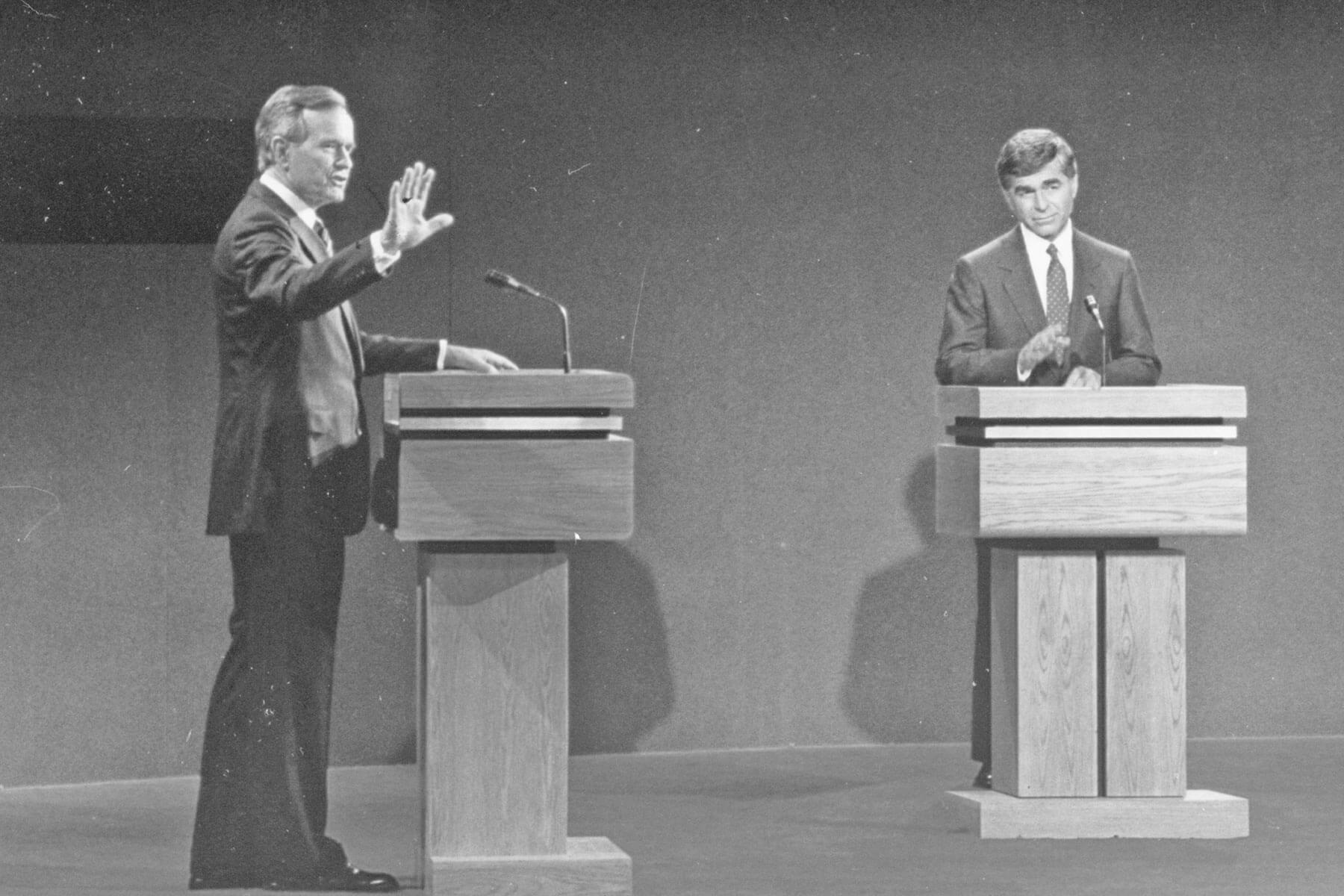
The 1988 presidential election was an open field, with Ronald Reagan finishing out his last term as President. The primary season on the Democratic side included a slate of relative upstart contenders referred to in overtly derisive political commentary as “the Seven Dwarfs”: Bruce Babbitt, Joe Biden, Michael Dukakis, Richard Gephardt, Al Gore, Jesse Jackson, and Paul Simon. On the Republican side, Vice President George H.W. Bush, Bob Dole, Jack Kemp, and televangelist Reverend Pat Robertson were the contenders, escaping a derisive nickname of their own for reasons that are lost to history.
Almost immediately, the Democratic side was beset with paparazzi-style scandals: Early, pre-Seven Dwarfs contender Gary Hart was caught having an affair with a woman who accompanied him on a luxury yacht called, all too on-the-nose, Monkey Business. Another scandal followed when a tape surfaced with footage of Joe Biden speaking at the Iowa State Fair and quoting British Labour Party leader Neil Kinnock without attribution. The resulting furor, and Biden’s subsequent mishandling of it, prompted him to drop out of the race. When TIME magazine reported that the tape came from the Dukakis campaign, the campaign initially denied the report, before eventually coming clean. Dukakis aides John Sasso and Paul Tully also stepped down.
Meanwhile, George H.W. Bush was emerging as the Republican nominee, despite receiving frequent criticism for not communicating the priorities of a Bush presidency (“the vision thing,” as Bush himself rather flippantly put it). Once Dukakis became the Democratic nominee, Bush fully dismissed “the vision thing” in favor of Lee Atwater-aided negative campaigning, successfully painting Dukakis as soft on crime with the viciousness of a Thomas Jefferson-John Adams-era series of invectives.
Another enduringly famous attack ad was one that the Dukakis campaign itself unintentionally provided the imagery for. The ad featured an unfortunately goofy Dukakis video op with the candidate perched upon an M1 Abrams tank and wearing a too-large helmet that looked more Great Gazoo than commander in chief. Bush won the election with 53.4% of the popular vote and a whopping 426 electoral votes.
Advertisement
Advertisement
We Asked an Anthropologist About the Gangs of 19th-Century New York
Beginning in the 1830s, a combination of poverty, rapid industrialization, and immigration contributed to the rise of notorious street gangs throughout New York City. For the next several decades, these groups ran rampant until being largely replaced by organized crime syndicates toward the end of the 19th century. But during their heyday, gangs such as the Bowery Boys and Dead Rabbits ruled the streets of New York, particularly a neighborhood in southern Manhattan known as the Five Points. This turbulent period in New York City was marked by violence and corruption, events that were brought to the silver screen in Martin Scorsese’s 2002 historical drama Gangs of New York.
While that film is based on realities of the time, it also furthered several misconceptions about this crime-ridden era. We reached out to anthropologist R. Brian Ferguson, a professor at Rutgers University-Newark and author of the 2023 book Chimpanzees, War, and History, to learn more about this volatile period in NYC history. Ferguson has spent decades studying and teaching how conflict permeates throughout society, and was interviewed for the 2002 documentary Uncovering the Real Gangs of New York, a special feature included on DVD copies of the Scorsese film.
(Editor’s note: This interview has been edited for length and clarity.)
HISTORY FACTS: What was life like in New York City’s Five Points neighborhood?
FERGUSON: Well, the Five Points was from the intersection of different streets, and it began as a residential neighborhood but it was built on landfill from filling in a big lake. So it was wet, and it was sinking, which meant that it was full of diseases in the summer. By 1827, it was already disreputable. Mainly poor people who had no choice about where to live were there — it was the bottom for New York society.
For decades it became — not just in New York, but internationally — famous for incredible squalor and crime and drunkenness and prostitution. It became a symbol for all of that. It was also a highly political environment, and the politics of the time were more contentious in New York than what we’re seeing today in our own lives. It was really a tough time politically.
HISTORY FACTS: Speaking of politics, I know Tammany Hall was a big player in New York City. What was Tammany Hall and how did it play a role in local politics?
FERGUSON: Tammany Hall was the Democratic political machine. It won elections, gave out patronage; it was famous for corruption and vote fraud. But besides that, it was the only kind of government that did anything for the poorest of the poor. In the 1840s, it had found its base in immigrants who were pouring into New York, many of whom were Catholic, which Protestant America generally hated.
Tammany Hall was controlled by political ward politicians from the street up, using force. It wasn’t a top-down organization as it once was, but it was really responding to what was happening on the streets, like in the Five Points. The Five Points was its central power base because it was so densely populated. It was known as the “Bloody Ould Sixth Ward,” and the votes from there could control mayors, city government, even tip state and presidential elections.
HISTORY FACTS: Who were the predominant gangs at the time?
FERGUSON: Gangs were always changing; they rarely lasted more than a few years. They came and went by time and place and by politics. The movie by Scorsese is based on a book by Herbert Asbury, both called Gangs of New York, and both of those introduced a lot of inaccuracies. In the movie, the big gangs were the Dead Rabbits and the followers of Bill “the Butcher” Poole. The riot that did occur was between the Dead Rabbits and the Bowery Boys. The Dead Rabbits were a gang; whether the Bowery Boys were a gang or not — they were also kind of a social type — is not as clear.
The movie was inspired by the Bowery Boy-Dead Rabbit riot of 1857. That was a real thing that went on for hours with maybe 11 people dead, and it involved fighting — bricks, up to guns. It was the biggest gang clash that ever occurred in New York City. Not the biggest violence on the street, but the biggest gang clash. And that was the inspiration for Scorsese’s film adaptation.
HISTORY FACTS: You mentioned immigration — how did the gangs reflect the ethnic makeup of New York City at this time?
FERGUSON: The gangs were organized — the nucleus of the power structure were saloons and volunteer fire companies, which were omnipresent and very political. Leadership in a gang came by association with one of those, and leadership was based mainly on fists. Fighting in the street was extremely common. All neighborhoods had their ethnic character, but it was never pure; it was always a mix.
So the Five Points was mostly Irish-inhabited at this point, but not exclusively. Gangs were mostly Irish but wouldn’t turn away anybody who lived in the neighborhood who could fight. But they were also shaped from the top down. Politicians built their organizations based on the compositions of neighborhoods. It was both a cause and effect of the political organization that gave life to the gangs. And it wasn’t just mostly Irish, but you could say particular areas of Ireland. A whole building might be from one area.
But [in terms of the city’s general ethnic makeup] German immigration was big; [New York City] also had people who were native born and were seen as “true” Americans. Italians hadn’t come in yet; the Eastern European Jews hadn’t come in yet. But New York always had lots of different people in it, like Syrians were a big immigrant population.
Advertisement
Advertisement
HISTORY FACTS: How did immigration contribute to the rise of these gangs?
FERGUSON: The immigration was a big part of, to use a contemporary word, the intersectionality of street organizations back then. Most immigrants were also extremely poor. But it wasn’t just the immigrants — this is when industrialism was on the rise, unemployment was exploding for all, and the time around the 1850s was seen as mainly just rich and poor. [There was] little in between. And poverty was mapped onto the ethnic divisions.
Also, politicians would scare the immigrants with the specter of competition from freed slaves, and really conjured up racism to a hot degree. So, there were mixes in terms of how people were organized. The racist, and anti-abolitionist groups, were mostly poor and could include any of the poor. But nativism, which was anti-immigrant, excluded the Catholics, and the Catholics were a lot of the poor. So there were these different combinations possible, and the local ward politicians worked all of these permutations.
HISTORY FACTS: Is the Irish vs. “native” conflict as depicted in Scorsese’s film accurate?
FERGUSON: The Irish versus the “native” thing, it’s a yes and no. It’s not false, but it’s not really true either. The Bowery Boy-Dead Rabbit riot of 1857 was part of crises all across the United States in the time leading up to the Civil War. In New York state, this played out largely as a conflict between the state government and the city government. The state government in Albany was Protestant, Republican, and anti-immigrant, and the city government by this time was more immigrant- and Catholic-oriented and Democrat. So this was the polarization.
The state of New York then put through, in 1857, a kind of a coup, restructuring the city, which took over many of the city functions — like control of the Port of New York. But most important of all, they disbanded the police force at the time — the Tammany police force known as the Municipal Police — and created a new police force called the Metropolitan Police that were controlled from Albany. Tammany itself, besides the state and city thing, was extremely divided into two warring factions. So there was like a three-way struggle going on.
Nativism was a part of all of that, but who had political power, and who got the benefits of controlling corruption were at least as big or bigger issues. When I did research on the gangs that fought in 1857, they all had clear local political alignments, and one thing that was left out entirely of the film, and Asbury’s book, was that the fights that became riots began with attacks on the Metropolitan Police — that’s the state police force. That was clearly one of the biggest issues here.
Advertisement
Advertisement
HISTORY FACTS: What led to the rise of these gangs and their eventual downfall?
FERGUSON: Well, poor neighborhoods like the Five Points — but there were many — provided kind of the raw material: people who could fight and were looking for something to do, and were looking for a leg up. These could be shaped into adult gangs. But as an anthropologist, what I like to look at is the local organizations of the street that organized and raised up gangs into kind of political actors. Back at that time, there were two organizations: There was the saloon, which was the neighborhood center, and the volunteer fire companies, which were all over the city and connected to large political factions. And [all of these groups] were always fighting; they would fight each other all the time. So, the conflicts in 1857 went through these things, like volunteer fire companies and saloons, to raise these local street people up into named gangs and to pit them against each other.
If you look at the gangs around then, they’re very big in newspapers of the times. After that, they’re not so much. In later years, and I’ll just pick 1885 as an example, there were still street gangs all around the town, but they were less important politically. The reason was the then-boss of Tammany Hall, a guy named Dick Croker, had iron control and didn’t need [the gangs] as much.
Also, that was the Gilded Age of extreme capitalist fortunes, and the capitalists who had great control over the city supported the police, which by that point was the NYPD, to keep control of what they saw as dangerous classes — the people who lived in the slums. Otherwise, cops — if [the cops] kept [the people in the slums] from being a problem — could do whatever they wanted, which led over a couple of decades to police brutality and corruption.
And then there was a big scandal that came along in 1895. It was called the Lexow Investigation and it revealed that the New York Police Department was what they called “organized criminality” in New York City. It wasn’t allowing it, it was it. So, reform and another era of political turmoil in Tammany Hall led to new named gangs coming up. People might recognize the Monk Eastman gang or the Paul Kelly gang. And by about 1900, these were changing from what they used to be and taking over what the police had been pushed out of and had controlled, including gambling and prostitution and rackets and extortion.
That was a new era that led to the gangster era, and the gangsters in their peak generally led to less street crime because they were organized to make money. You didn’t want people to get mugged when they came out of a speakeasy. So, the area got less violent, less uncontrolled, as that developed. And as it went on, New York City went through the whole process of development, which is a much bigger topic about changing industrial structure and job structure and development of a middle class.
HISTORY FACTS: Going back to Scorsese’s movie, what did the film get right and what did it get wrong?
FERGUSON: It’s imaginary, like any movie; I don’t hold that against it. The plot, of course, is fiction. The film was loosely based on Herbert Asbury’s book, and Herbert Asbury really tried, but he had bad information. I’ve tracked down most of his sources in my own research. The movie did get the look right. Many details of the time are very real. They exaggerated certain things, like they made the Dead Rabbits look like they wore a particular kind of uniform, which, not really. No naval ships fired cannons on crowds, although soldiers did. The film left out the stench and the insects and the sewers in the street and all of that stuff. So you don’t get quite that depth of it, but it’s a movie. (Editor’s note: Ferguson recommended a book by Tyler Anbinder called Five Points for those interested in learning more about these details.)
Other big inaccuracies are due to the fact that the filmmakers had to compress time. And so Bill “the Butcher” [Poole] — the guy played by Daniel Day-Lewis — was dead a few years before the big Bowery Boy-Dead Rabbits riot. And Scorsese, consistent with his own film background, made Bill Poole a crime boss, getting a cut of everything. No, that came later. There’s nothing indicating that this was organized crime in that sense. Another thing is that Bill Poole worked for the politicians. He wouldn’t kill one of them, as he does in the film. There was a political hierarchy and he was a step down.
There were, in reality, lots of little turf fights all the time, but there wasn’t anything like Daniel Day-Lewis says to decide once and for all who’s going to be the lords of the Five Points. It wasn’t that kind of territorial control. And one big inaccuracy of the movie is the excessive violence, especially in the opening riot. Now, there was violence all the time, but with fists and bricks and sometimes up to guns. Most people in the poor neighborhoods didn’t own guns; they were too expensive. But there were chimneys all over the place and you could topple a chimney over and you’ve got a supply of bricks, which is what they did.
I think the thing that I have the biggest issue with in the film is that it leaves out how important was politics and everything that was going on, and how important was the role of the new state Metropolitan Police. But I’ll add, on a positive note, I think it was great that Scorsese brought in the Draft Riots [violent citywide protests against the Civil War draft and fueled by racial tension] — although, this was not a gang event, other than gang members participating in rioting mobs, individually. But I teach about the Draft Riots, and what I can tell you is that no one has heard about this incredible event in American national history. The Draft Riots tell you an awful lot about what was becoming America.
Advertisement
Advertisement
HISTORY FACTS: What gang-related sites from this time period are still standing?
FERGUSON: There are a lot of gang locations if you know where to look, walking on 2nd Avenue from 14th Street to Houston Street. And there’s more than a dozen significant locations, mainly shootings, that took place on that stretch, although that was mostly the later gangsters up to the beginning of Prohibition.
From the [Gangs of New York] film era, and for the Five Points, there’s really only one thing that remains. On the northwest corner of Baxter and Worth Street — this is between the courthouse district and Columbus Park — is the only remaining point. That point, I can’t go by that area without going by and standing on that point. I’ve seen lots of illustrations of the Five Points and I just imagine all those illustrations while I’m there and standing on that point. But that’s the only physical remnant that you can see.
As time went on, the Five Points kind of got toned down by mission and other reform efforts in the Five Points itself. The most squalid and dangerous part of New York moved just one block east to Mulberry Street. When they tore down the block known as Mulberry Bend, they didn’t cart the stuff away; they just tumbled everything into the basements. So when they were redoing Columbus Park, they cleaned away the surface and I could see all of these basements that were the Five Points, that were Mulberry Bend — they’re still there. But they’re underground.
If I can expand the scope a little bit for gangster sites, my favorite is many blocks north on Great Jones Street, which is in the East Village. Right on the south side of Great Jones Street, west of the Bowery, there are two buildings. One has a window on the second floor that has an arch to it. This window became famous because Andy Warhol bought it some years ago, and the artist [Jean-Michel] Basquiat had a studio there, and in fact died in that room. But that building was the headquarters of Paul Kelly’s gang. Paul Kelly, whose birth name was Paul Vaccarelli, is what my [current] research centers on, and I think he was the most successful gangster in New York City history. For one thing, he died in bed, which most gangsters didn’t.
____
R. Brian Ferguson is a New York City-based anthropologist. To learn more about his work, visit his website. His most recent work, Chimpanzees, War and History, is also available for purchase here.
Advertisement
Advertisement
The Catchy History of Presidential Campaign Slogans
In the American political arena, presidential campaign slogans have a long and varied history. When a presidential hopeful is building their platform, they and their team choose slogans for how well they set the tone for the candidate’s agenda, message, and direction for the country. A memorable phrase can concisely convey a candidate’s vision for their presidential term as well as become a rallying cry for supporters. But crafting a winning campaign slogan isn’t just about having the catchiest saying — the right slogan can play a vital role in shaping the narrative of a campaign and influencing voter perceptions about the candidate.
A good campaign slogan can offer hope, such as Franklin D. Roosevelt’s 1932 slogan (and campaign song), “Happy Days Are Here Again,” or serve as a reminder of the prosperity enjoyed under an incumbent, such as William McKinley’s 1900 slogan, “Four More Years of the Full Dinner Pail.” On the other hand, a bad slogan, such as Democratic presidential candidate Alfred E. Smith’s 1928 slogan, “Vote for Al Smith and Make Your Wet Dreams Come True,” might cost a candidate an election as well as land on a list of the worst presidential campaign slogans ever. (Smith’s slogan was a reference to his anti-Prohibition stance that made him a “wet” candidate.) Here is a brief look at the evolution of presidential campaign slogans in the United States.
The first presidential campaign slogan is often attributed to Whig Party candidate William Henry Harrison in the election of 1840. Harrison used the catchy phrase “Tippecanoe and Tyler Too,” a reference to his military victory over Shawnee Chief Tecumseh at the 1811 Battle of Tippecanoe, as well as Harrison’s running mate, John Tyler. The rhyming refrain helped promote Harrison’s image as a war hero and a man of the people. It also contributed to his successful campaign against the incumbent President, Martin Van Buren, and played a significant role in shaping the way presidential candidates used slogans to support their platforms in future elections. Harrison’s campaign for President lasted longer than his presidency; he developed pneumonia and died in April 1841, one month into his term, becoming the first President to die in office.
Campaign slogans need to be short and memorable, which has led to a history of using rhymes, puns, and plays on words to craft phrases that carry a strong message and are still succinct enough to fit on a button. Calvin Coolidge used a play on his name with the 1924 slogan “Keep Cool and Keep Coolidge,” while Lyndon B. Johnson’s winning campaign in 1964 created a rhyme with his initials: “All the Way With LBJ.” (Johnson was inspired by Adlai Stevenson’s catchy slogan in his 1952 failed run against Dwight D. Eisenhower, “All the Way With Adlai.”)
Dwight D. Eisenhower’s successful 1952 campaign, meanwhile, was notable for its own simple rhyming slogan: “I Like Ike.” The slogan appeared on a wide variety of campaign materials and was featured in one of the first televised political endorsements, which included a song written by Irving Berlin and animation by Walt Disney Studios. The catchy jingle incorporated Eisenhower’s popular catchphrase in the lyrics: “You like Ike, I like Ike, everybody likes Ike (for President) / Hang out the banner and beat the drum / We’ll take Ike to Washington.” The slogan served Eisenhower so well in his 1952 presidential bid that his successful 1956 run featured a slightly revised version: “I Still Like Ike.”
Photo credit: Eric Thayer/ Getty Images News via Getty Images
Some Slogans Have Been Used By More Than One Candidate
Campaign slogans have changed over time to reflect the shifting political, social, and economic landscape of the United States — but some slogans have done so well that they’ve been adopted and reused. Two Presidents successfully used “Don’t Swap Horses in Midstream,” encouraging voters to support the incumbent President during times of conflict. Abraham Lincoln used the metaphor as one of his slogans during the Civil War in 1864, and 80 years later in 1944, FDR recycled it in the lead-up to his unprecedented fourth-term win during World War II.
In more recent political history, Barack Obama borrowed one of his most effective and powerful campaign slogans from 1970s labor organizers César Chávez and Dolores Huerta, who led the United Farm Workers of America. Obama loosely translated their catchphrase “Sí, Se Puede!” into the English “Yes, We Can!” Donald Trump’s 2016 slogan “Make America Great Again” was also previously used, first in promotional materials for Barry Goldwater’s failed 1964 presidential bid, and again as “Let’s Make America Great Again” by Ronald Reagan in 1980.
Some historians and political consultants believe that social media may mark the end of official campaign slogans. Instead, unofficial slogans in the form of memes and hashtags shared by supporters may prove to be even more effective campaign tools. Even before social media, an unofficial slogan set the tone for Bill Clinton’s first presidential campaign. Clinton’s platform utilized a handful of lofty and aspirational slogans, including “For People, for a Change,” “It’s Time to Change America,” and “Putting People First.” But while all of the official slogans referenced a serious regard for voters’ concerns, none of them specified what those concerns might be. Then an in-house phrase coined by lead strategist James Carville to describe Clinton’s platform became the defining catchphrase of the 1992 campaign. “It’s the Economy, Stupid” may not have been an official campaign slogan, but it caught the attention of voters who were tired of the lingering effects of the 1990 recession, and it helped Clinton define his campaign message.
In American politics, there are few families who have had as big an impact on the nation’s history as the Kennedys. The family’s roots can be traced back to two Irish Catholic immigrant families, the Fitzgeralds and the Kennedys, who came to the U.S. beginning in the 1840s to escape the potato famine in Ireland. In 1914, Joseph P. Kennedy, the son of a wealthy Boston businessman, married Rose Fitzgerald, the daughter of an equally prominent Boston family. The couple went on to have nine children: Joseph Jr., John (“Jack”), Rose Marie, Kathleen, Eunice, Patricia, Robert (“Bobby”), Jean, and Edward (“Ted”), many of whom served the country in a variety of elected and appointed roles, helping steer the course of the nation.
The most famous of Joseph and Rose’s children was their second-oldest child, John F. Kennedy. Before he became the 35th and youngest elected President of the United States in 1961, he served in the Navy and represented Massachusetts in both houses of Congress. The 1963 assassination of the young and charismatic President triggered a wave of profound shock and grief across the nation, marking the end of an era as postwar idealism gave way to a period of political and social turbulence. Here are six little-known facts about this famous political family.
Photo credit: Historical/ Corbis Historical via Getty Images
Jackie Kennedy Started a School in the White House
First Lady Jacqueline Kennedy was known to be a private person who was very protective of her children. Concerned about potential security risks and the omnipresent press, Jackie decided to turn the third-floor solarium in the White House into a nursery school for her young daughter, Caroline, in 1961. The school grew to around 20 students that included Caroline’s playmates and children of White House staff, and the salaries of two New York State-certified teachers were paid by the Kennedys and other parents. Though school segregation was outlawed in 1954, the process to integrate schools was ongoing at the time, and President Kennedy was criticized for not sending his own daughter to an integrated public school. In September 1962, The New York Timesreported that Caroline’s school was being desegregated that fall with the addition of a Black student, the son of associate White House press secretary Andrew Hatcher.
The “Camelot” Comparison Came From an Interview With Jackie
Just a week after John F. Kennedy’s assassination, Pulitzer Prize-winning journalist Theodore H. White interviewed the grieving First Lady forLife magazine. Jackie’s recollections of the day her husband was killed, and what happened in the aftermath, were published as an “epilogue” of the President’s life. The First Lady reminisced about her husband’s fondness for the musical Camelot, noting that his favorite lines were from the last song in the show, “Finale Ultimo”: “Don’t let it be forgot, that once there was a spot / for one brief shining moment / that was known as Camelot.” Jackie went on to say, “There’ll be great Presidents again… but there’ll never be another Camelot again.” Her poignant commemoration of her husband’s presidency contributed to JFK’s enduring legacy as a modern-day hero whose life was cut tragically short.
Just like his older brother, Robert F. “Bobby” Kennedy was actively involved in politics. He even served as U.S. attorney general when JFK became President. In a May 1961 Voice of America radio broadcast, Bobby envisioned a time when a Black person would be able to “achieve the same position that my brother has as President of the United States.” It was an optimistic prediction in the years before the Civil Rights Act of 1964 — legislation that Bobby urged his brother to advance — and one that took 47 years to fulfill with Barack Obama’s presidency. Bobby was assassinated just two months after Martin Luther King Jr., but his legacy of civil rights advocacy continues with the Robert F. Kennedy Human Rights foundation, which was founded in his name just a few months after his assassination in 1968.
Ted Kennedy’s Long Senate Career Started With JFK’s Seat
Edward “Ted” Kennedy was the youngest of Joseph and Rose Kennedy’s nine children, and just as politically ambitious as his older brothers. After JFK won the 1960 presidential election, he resigned from his Senate seat, and Ted wanted the position. However, he wasn’t yet eligible to pursue the office because he was only 28 years old — two years younger than the minimum age to be a senator. JFK asked the Massachusetts governor to appoint family friend Ben Smith to serve as interim senator, a “seat warmer” until Ted was able to run. Ted went on to win the 1962 special election and maintained his place in the Senate until his death in August 2009. Despite family tragedies and the infamous Chappaquiddick controversy, the “Lion of the Senate” represented the state of Massachusetts for 46 years, nine months, and 19 days, making him the fifth-longest-serving senator in U.S. history.
In 1928, Joseph and Rose Kennedy bought the summer home they had been renting in Hyannis Port, a village on the Cape Cod peninsula in Massachusetts. The “big house” was renovated and expanded to accommodate their large family, becoming a place for the elder Kennedys to gather with their children and grandchildren. The purchase of two nearby properties, one owned by John and Jackie, the other by Bobby and his wife Ethel, established what came to be known as the “Kennedy Compound.” The 6-acre property remained in the family until 2012, when the main house (which had been Ted Kennedy’s primary residence until his death in 2009) was donated to the Edward M. Kennedy Institute for the United States Senate. Robert Kennedy’s widow, Ethel, still lives in the nearby home she shared with her husband, and the house that once belonged to JFK is now owned by Ted Kennedy’s son Edward M. Kennedy Jr.
Chicago History Museum/ Archive Photos via Getty Images
Author Tony Dunnell
August 25, 2023
Love it?53
As early as the colonial era, the consumption of alcoholic beverages was a contentious issue in America. Drunkenness was generally frowned upon, and certain sectors of society believed that alcohol was nothing short of the devil’s juice. Tensions came to a head in the early 20th century, when the temperance movement (which advocated for moderation in all things), supported by groups such as the Anti-Saloon League, the National Prohibition Party, and women suffragists, convinced lawmakers to curtail what they saw as the calamitous and ungodly effects of alcohol.
The result was the 18th Amendment to the U.S. Constitution, ratified on January 16, 1919. One year after the ratification, the prohibition of alcohol in the United States began, and breweries, wineries, and distilleries across the country were shuttered.
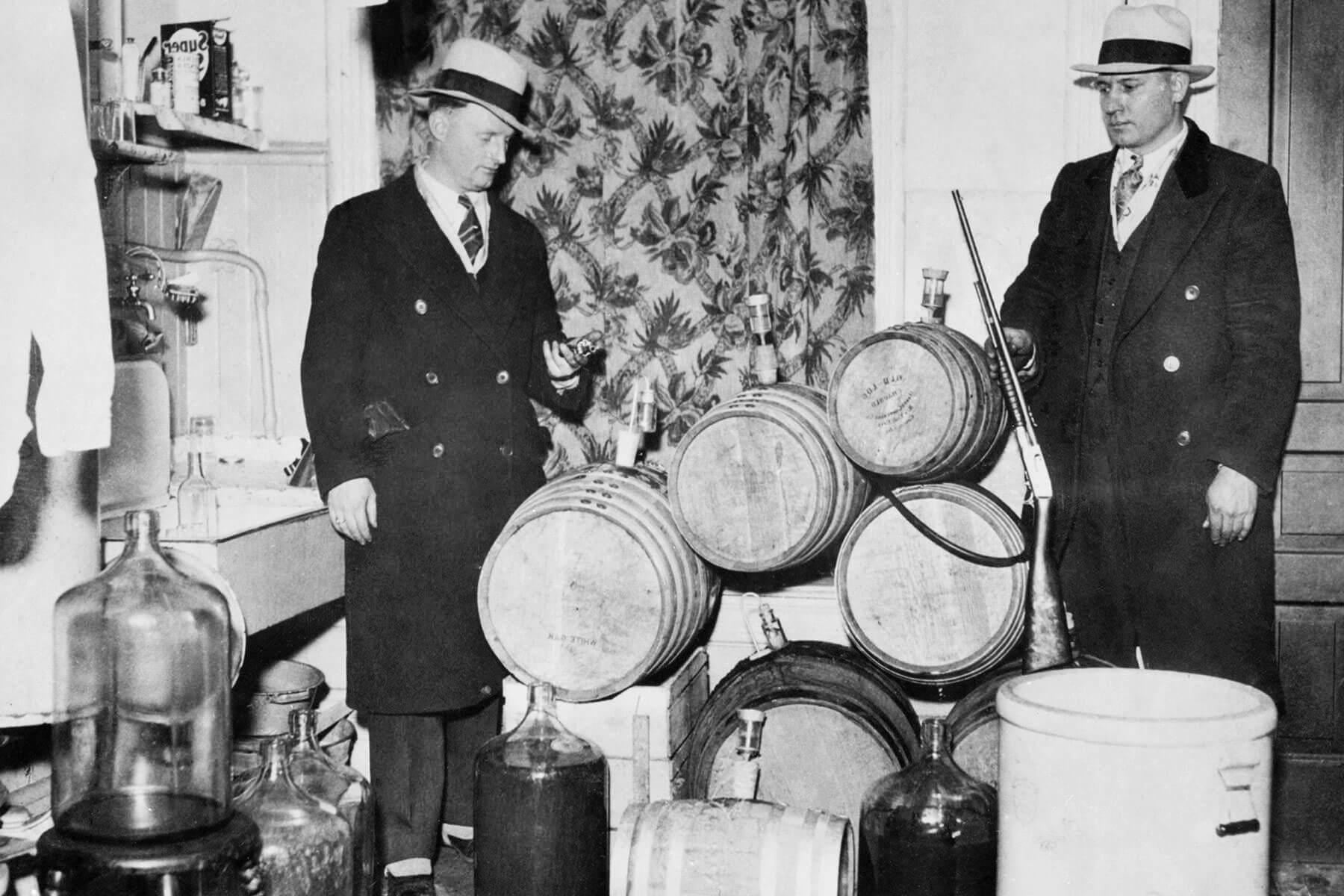
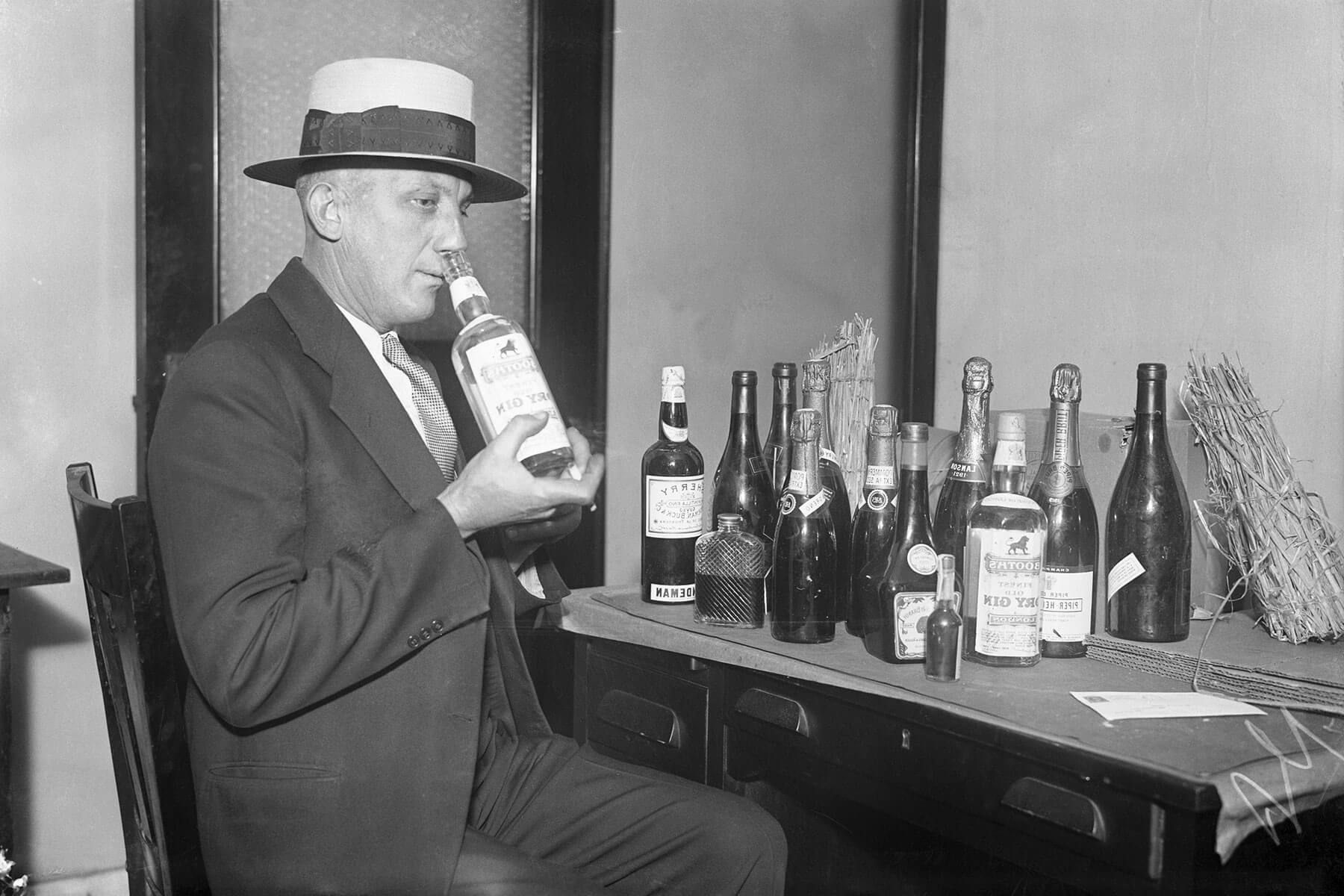
Initially, the signs were positive. There was a significant reduction in alcohol consumption, booze-related hospitalizations declined, and there were notably fewer crimes related to drunkenness. But one thing never changed: Many people still enjoyed an occasional drink and weren’t willing to live completely dry lives. Enter bootleggers, speakeasies, and organized crime. The Prohibition era lasted until 1933, and marked a period of colorful characters, clandestine operations, and government corruption. Here are seven facts from this fascinating time in U.S. history.
The 18th Amendment prohibited “the manufacture, sale, or transportation of intoxicating liquors” within the United States, but it didn’t ban the consumption of alcohol at home. So, during the one-year grace period before Prohibition began, people — those who could afford it, at least — began stockpiling wine and liquor while it was still legal to buy. Once the cellars had been stocked and Prohibition began, there was a notable rise in home entertaining and dinner parties — a shift that transformed America’s drinking culture in a way that’s still felt to this day.
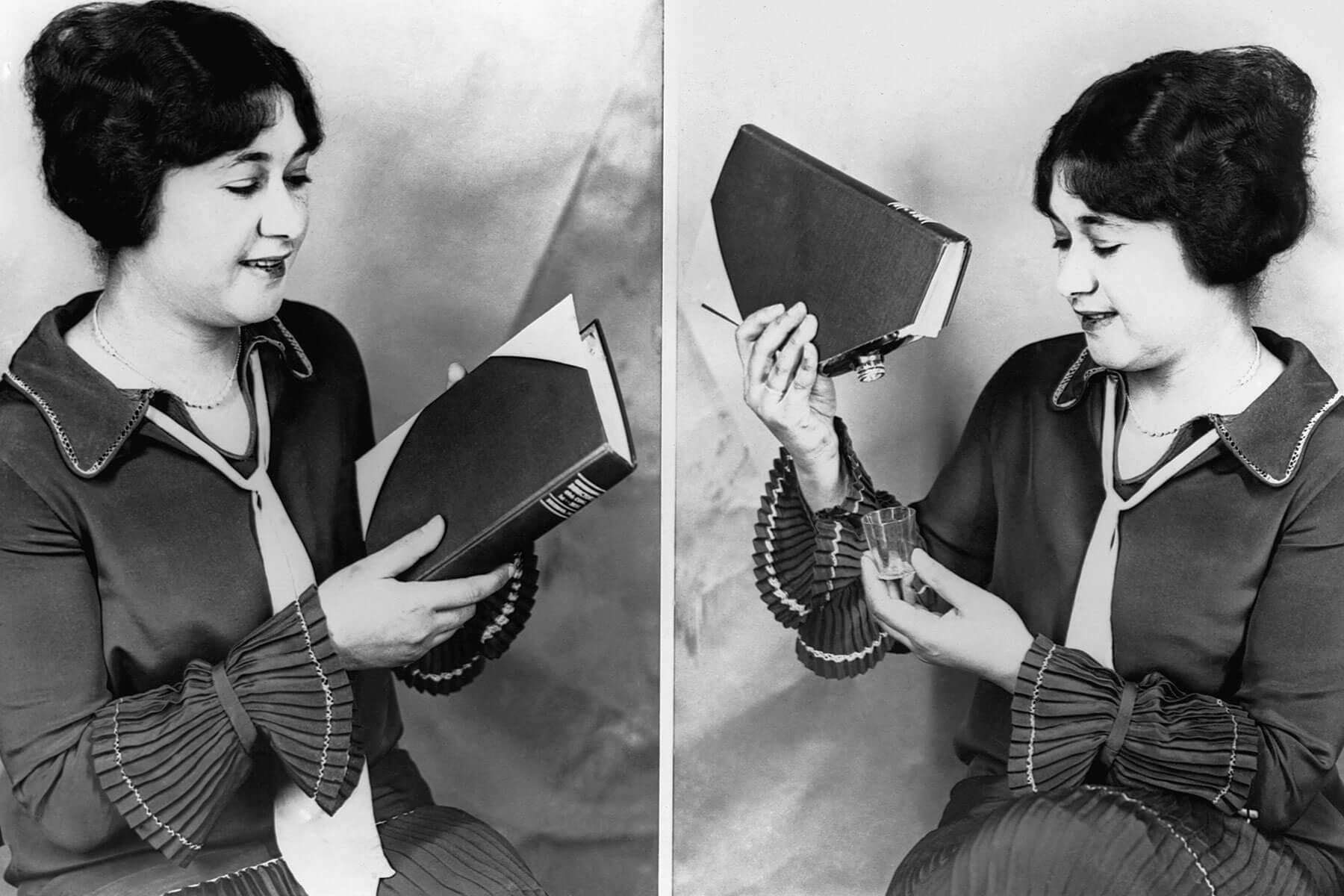
Despite the constitutional law, certain legal loopholes existed that facilitated the acquisition of alcohol. Doctors could prescribe whiskey for medicinal purposes, making a friendly neighborhood pharmacist a handy source of booze — not to mention an ideal front for bootlegging operations. Religious congregations were allowed to purchase communion wine, which led to an increase in church enrollment. Winemakers, meanwhile, began selling “wine bricks,” rectangular packages of entirely legal concentrated grape juice that could be used to make wine at home. The packaging even came with a handy “warning”: “After dissolving the brick in a gallon of water, do not place the liquid in a jug away in the cupboard for twenty days, because then it would turn into wine.”
The main source of liquor during Prohibition was industrial alcohol, the kind of stuff used to make ink, perfume, and camp stove fuel. Bootleggers could make about 3 gallons of barely drinkable — and dangerous — “gin” or “whiskey” from 1 gallon of industrial alcohol. But industrial alcohol was denatured, meaning it had additives to make it foul-smelling, awful-tasting, and poisonous. And while bootleggers found a way to recondition the denatured alcohol into cheap booze — colloquially known as “rotgut” — that was drinkable, it was still capable of causing blindness or death. On average, about 1,000 Americans died every year during the Prohibition era from drinking tainted liquor. Many estimates put the number even higher, with up to 50,000 total deaths from unsafe alcohol during Prohibition.
Like thousands of other Americans, congresspeople and senators, including many of those who had voted in favor of Prohibition, often sought out illegal alcohol. One of their main suppliers was a bootlegger named George Cassiday, who started off supplying hooch to two House of Representatives members. Demand for his services soon increased, and before long he was making 25 deliveries a day to House and Senate offices. A dapper gentleman, Cassiday was easily recognized by his emerald fedora, and soon became known as the “man in the green hat.” He was arrested in 1930 and sentenced to 18 months in prison, but was allowed to sign out every night and return the next morning during his time in jail. The same year he was arrested, Cassiday wrote a series of articles for The Washington Post in which he estimated that 80% of Congress drank illegally.
Al Capone’s Oldest Brother Was a Prohibition Enforcement Agent
Al Capone was the most famous of all the gangsters who came to prominence during the Prohibition era. Capone’s brothers Frank and Ralph were also mobsters. Then there was James Vincenzo Capone, the oldest of the Capone brothers, who later changed his name to Richard James Hart. He took a decidedly different path than his siblings: He became a Prohibition agent. He was, by most accounts, a daring and effective law enforcer, whose tendency to carry two ivory-handled pistols earned him the nickname “Two-Gun” Hart.
The End of Prohibition Made U.S. Constitutional History
Prohibition was, ultimately, a failure. At least half of the adult population wanted to carry on drinking, the policing of Prohibition was marred by contradictions and corruption, and with no actual ban on consumption, the whole thing became untenable. So, on December 5, 1933, the 18th Amendment was repealed by the 21st Amendment, bringing about the end of the Prohibition era. The 18th Amendment made constitutional history, becoming the first — and, to this day, only — constitutional amendment to be repealed in its entirety.
If for some reason you yearn for the days of Prohibition, you can always vote for the Prohibition Party. Yes, the anti-alcohol party, formed in 1869, still exists. Not only has it championed the cause of temperance for more than 150 years, but it’s also the oldest existing third party in the United States. And while the Democrats have their donkey and the Republicans their elephant, the Prohibition Party’s mascot is the camel — an animal that can survive without drinking for almost seven months.
Between 1789 and today, 45 people have served as president of the United States. During their time in office, as well as throughout their lives before and after the presidency, these leaders saw accomplishments and setbacks that shaped the nation in ways both big and small. Some of these stories have gone down in history, while others — such as George Washington’s time as a whiskey distiller, or Franklin D. Roosevelt’s pioneering foray into television — are less well known. Here are some surprising and fascinating facts about every U.S. president in history.
Photo credit: John Greim/ LightRocket via Getty Images
George Washington Distilled Whiskey After His Presidency
In 1797, mere months after leaving office, George Washington opened a whiskey distillery on his vast Mount Vernon estate. The venture proved to be wildly successful, as the distillery produced nearly 10,000 gallons of the liquor in 1799 — far more than the average of 650 gallons produced by other Virginia-based distilleries at the time.
John Adams Was the First President to Live in the White House
When John Adams’ predecessor, George Washington, took office, the White House was just an idea. Irish American architect James Hoban was tapped to design the building, which was finally completed in 1800 during the Adams administration, allowing America’s second president to become the first White House resident.
Thomas Jefferson Helped Popularize Macaroni and Cheese
Around the time he served as U.S. minister to France (1785 to 1789), future President Thomas Jefferson wrote, "The best maccaroni in Italy is made with a particular sort of flour called Semola, in Naples.” Jefferson tasked his private secretary, diplomat William Short, with tracking down a machine for making this dish, which he eventually had shipped to the U.S. The founding father was known for serving “maccaroni” — a term he used to describe all pastas — both with and without cheese to his guests. Jefferson even had his own written recipe for an early form of mac and cheese that was influenced by similar Italian recipes. The spoken and written accounts of those meals led to the dish’s increased popularity throughout the United States.
James Madison Was the Shortest President
Standing at just 5 feet, 4 inches, James Madison — who also weighed only around 100 pounds — was exactly a foot shorter than the tallest U.S. president, Abraham Lincoln (who stood at 6 feet, 4 inches). Madison’s closest presidential rivals in height were Benjamin Harrison and Martin Van Buren, both of whom were a wee bit taller at 5 feet, 6 inches.
Advertisement
Advertisement
Photo credit: MPI/ Archive Photos via Getty Images
James Monroe Was the Third President to Die on the Fourth of July
In an eerie coincidence, three of the first five U.S. presidents passed away on the anniversary of America’s birth. Both John Adams and Thomas Jefferson died on July 4, 1826, while James Monroe passed away on Independence Day in 1831. On the flip side, Calvin Coolidge was the only president born on the Fourth of July, in the year 1872.
John Quincy Adams Served in Congress Before and After Being President
Only one U.S. president — John Quincy Adams — served in the House of Representativesafter being elected commander in chief. Adams served as a senator from Massachusetts from 1803 to 1808, then as president of the United States from 1825 to 1829. He was elected to the House of Representatives shortly after his presidential term, serving from 1831 until his death in 1848.
Advertisement
Advertisement
Andrew Jackson Kept a Giant Wheel of Cheese in the White House
In 1836, President Andrew Jackson received a 1,400-pound block of cheese as a gift from a dairy farmer in New York, which he displayed in the White House for more than a year. Before leaving office, Jackson invited the public to the White House to come take some cheese. A firsthand account recalls men, women, and children hacking away at it until "the carpet was slippery with cheese."
Photo credit: Heritage Images/ Hulton Archive via Getty Images
Martin Van Buren Was the First President Born a U.S. Citizen
Unlike the seven presidents who preceded him, Martin Van Buren wasn’t born under the authority of the British crown. Van Buren was born in 1782, several years after the signing of the Declaration of Independence, and was thus a U.S. citizen for his entire life. While his successor, William Henry Harrison, was also born under British rule, every POTUS since Harrison has been an American citizen from birth.
Advertisement
Advertisement
William Henry Harrison Delivered the Longest Inaugural Address
On a cold, wet day in March 1841, William Henry Harrison refused an overcoat as he delivered his lengthy 8,445-word inaugural address. Harrison died 31 days into his term as President, and while some initially attributed his death to the long, chilly speech, researchers now believe unclean drinking water was the cause of Harrison’s fatal illness.
John Tyler Was the First Vice President to Succeed to the Presidency
John Tyler — notoriously dubbed “His Accidency” — became president upon the death of William Henry Harrison, and served as commander in chief from 1841 until 1845. Tyler was the first vice president elevated to the highest office in the land due to such an event, though he served only the one abbreviated term before being succeeded by James K. Polk.
Advertisement
Advertisement
James K. Polk Oversaw the Greatest Territorial Expansion of Any President
Between 1845 and 1849, America’s 11th president oversaw the largest U.S. territorial expansion of any POTUS. The United States added upwards of 1 million square miles of land during Polk’s time in office, including land that now makes up modern-day Arizona, Utah, Nevada, California, Oregon, Idaho, Washington, New Mexico, Wyoming, Montana, and Colorado.
Photo credit: Hulton Archive/ Hulton Archive via Getty Images
Zachary Taylor Was Nominated for President Without His Knowledge
At the 1848 Whig Party convention, delegates nominated former military general Zachary Taylor as their candidate for president — and he was eventually elected to the position. However, Taylor wasn’t present at the convention and was nominated without his prior knowledge. He didn’t find out about his own nomination for several weeks, as he initially refused to pay postage on a letter sent his way alerting him of the news.
Advertisement
Advertisement
Millard Fillmore Was the Last President Who Was Not a Democrat or Republican
Since 1853, the American presidency has been dominated by politicians who belonged to either the Democratic Party or the Republican Party. That trend began after Millard Fillmore, who was a member of the Whig Party during his presidency from 1850 until 1853. The Whig Party dismantled shortly after his term, and the two-party system has dominated ever since.
Franklin Pierce Defeated His Former General to Become President
The presidential election of 1852 was a race between Franklin Pierce and Winfield Scott, two men who served in the U.S. Army during the Mexican-American War. Pierce served as brigadier general during the conflict, whereas Scott was commanding general of the entire U.S. Army. Despite Scott’s greater military rank, Pierce emerged victorious during the presidential election.
Advertisement
Advertisement
Photo credit: Hulton Archive/ Archive Photos via Getty Images
James Buchanan Was the Only President to Remain a Lifelong Bachelor
James Buchanan was a lifelong bachelor, the only U.S. president who never married. He was engaged at one point, but his fiancée called off the engagement, after which Buchanan was reportedly brokenhearted and vowed not to marry. During his time in office, the president’s niece Harriet Rebecca Lane Johnston took on the hostess role usually filled by a First Lady.
Abraham Lincoln Was the First President to Appear on a Coin
In 1909, in honor of his 100th birthday, Abraham Lincoln became the first president to appear on a U.S. coin. The famous side profile bust design, created by engraver Victor David Brenner, is still in use today. Though some have called for the penny to be discontinued thanks to inflation cratering its value, there are still billions in circulation.
Advertisement
Advertisement
Photo credit: Kean Collection/ Archive Photos via Getty Images
Andrew Johnson Was the First President to Be Impeached
After Abraham Lincoln’s death, his Vice President Andrew Johnson took over the highest office in the land. A few years into his presidency, Johnson tested the newly passed Tenure of Office Act of 1867 by illegally firing Lincoln’s former secretary of war, Edwin Stanton. The House impeached Johnson for it, but the president survived removal from office by just one vote in the Senate.
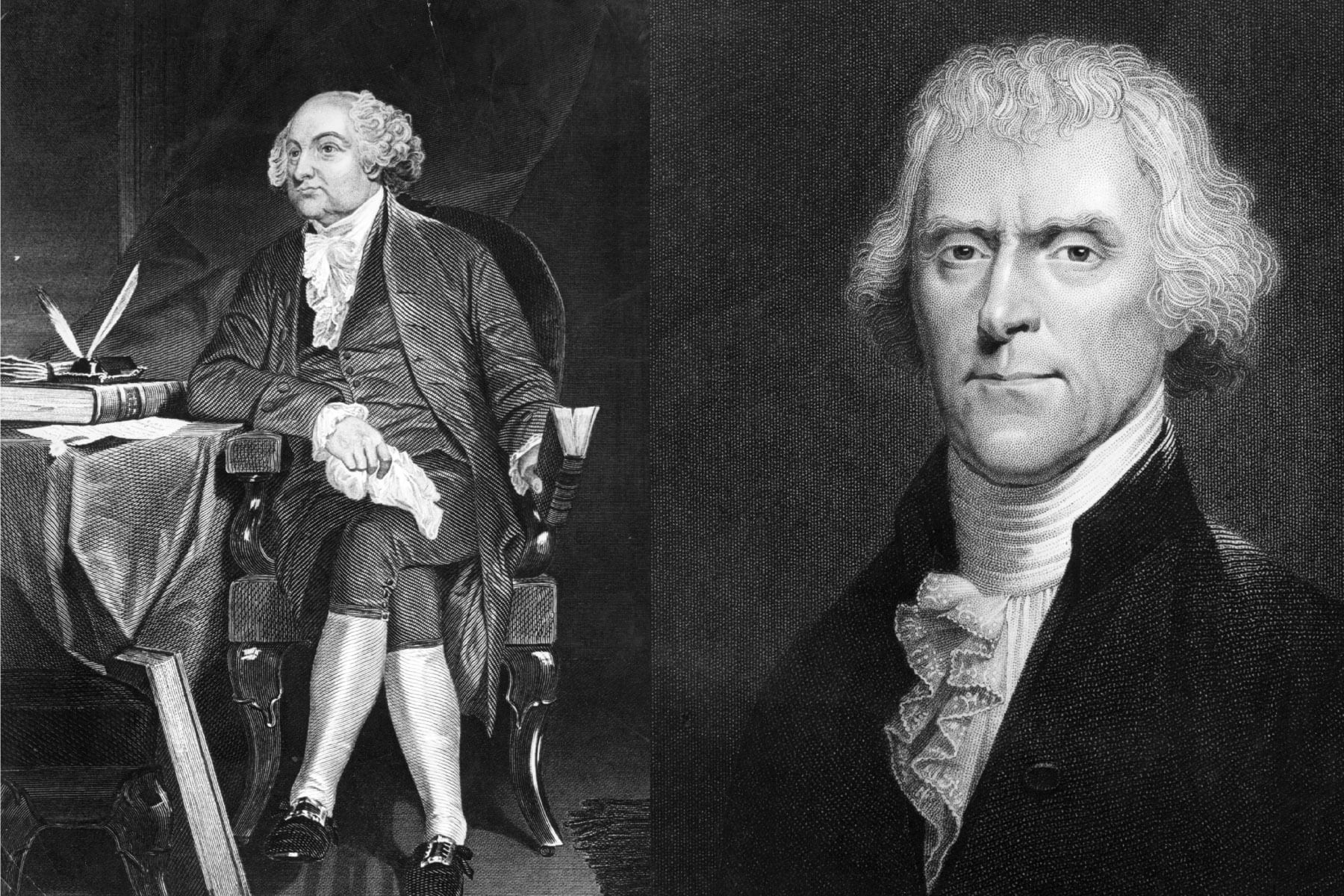
Ulysses S. Grant’s Middle Initial Didn’t Stand for Anything
America’s 18th president was born Hiram Ulysses Grant. His now-famous middle initial “S” was the product of a clerical mistake. Grant was nominated to West Point by Ohio Congressman Thomas Hamer, who accidentally wrote Grant’s name in the application as “Ulysses S. Grant.” The confusion stemmed from the fact that Grant often went by Ulysses, rather than Hiram. The application called for a middle initial, so the confused Hamer added an “S” for Grant’s mother’s surname, Simpson. Despite Grant’s efforts to change the name, the middle initial stuck.
Rutherford B. Hayes Had the First White House Telephone Installed
On May 10, 1877, during Rutherford B. Hayes’ administration, the White House’s first telephone was installed in the telegraph room. Hayes was supportive of this new technology, though rarely received phone calls. However, it was pretty easy to remember how to dial the White House, as its phone number was simply “1” at the time.
James A. Garfield Was the First Left-Handed President
In 1881, James A. Garfield was elected as the 20th president of the United States. The 19 who came before him were all right-handed, making Garfield the first lefty ever to hold the office. Garfield could also be said to be ambidextrous, as he was known to have the ability to write in Greek and Latin with different hands at the same time. Since his tenure, there have been many other left-handers in the Oval Office, including Gerald Ford and Barack Obama.
Advertisement
Advertisement
Chester A. Arthur Owned Approximately 80 Pairs of Pants
Chester A. Arthur was a fashionable president, dubbed “Elegant Arthur” and the “Dude of all the White House residents” by political commentators and cartoonists of the time. He was said to own around 80 pairs of pants, which was considered an extravagance at the time (and even today). Arthur was known for changing his pants multiple times a day, and often wore a tuxedo to dinner.
Grover Cleveland was the 22nd and 24th president of the United States. When Cleveland ran for reelection after his first term in 1888, his opponent Benjamin Harrison won the electoral count despite Cleveland winning the popular vote. Four years later, Cleveland was successful in denying Harrison’s reelection and reclaiming his former role as president.
Advertisement
Advertisement
Benjamin Harrison Introduced Electricity at the White House
Electricity was first installed at the White House in 1891 during Benjamin Harrison’s time in office. Initially, the Harrison family was afraid of flipping any light switches, as they feared being electrocuted. Instead, they tasked electrician Irwin “Ike” Hoover with turning the lights off and on, sometimes resulting in lights burning overnight until Hoover returned the next morning to switch them off.
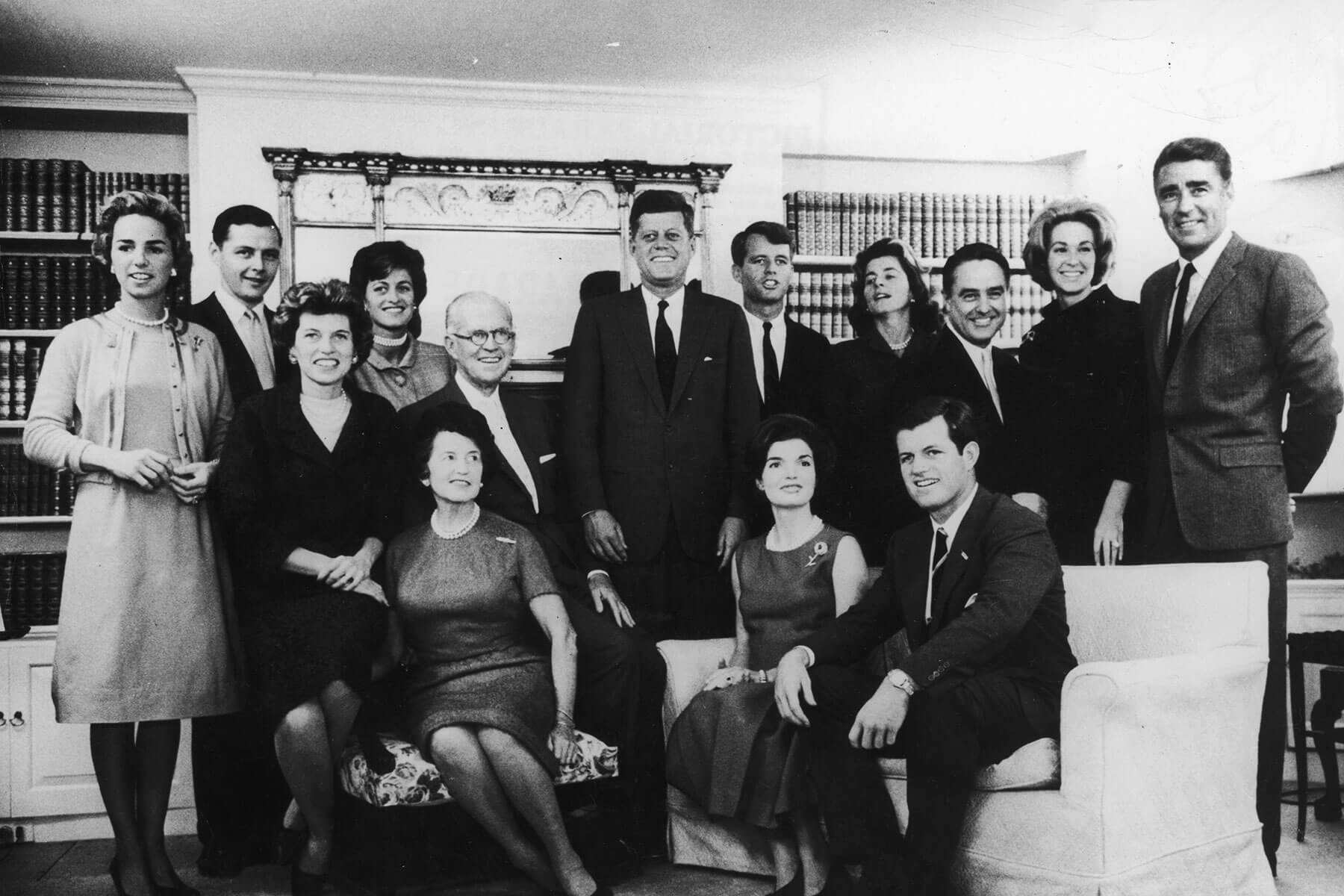
Photo credit: Photo 12/ Universal Images Group via Getty Images
William McKinley Was the First President to Ride in a Car
After taking a reportedly unenjoyable ride in an early automobile called the Stanley Steamer in 1899, President William McKinley is said to have remarked, “Stanley’s overoptimistic, I think, when he says those things will someday replace horses.” Though McKinley was wrong about the future of cars, he left a lasting mark on their history, as his Steamer ride was the first time a sitting president ever rode in an automobile.
Advertisement
Advertisement
Theodore Roosevelt Witnessed Abraham Lincoln’s Funeral Procession
When he was just 6 years old, young Theodore Roosevelt witnessed Abraham Lincoln’s funeral procession in New York City. On April 25, 1865, the future POTUS gazed down from a second-story window as the late president passed the Roosevelt family mansion on Broadway. A perfectly timed photograph captured the image of two young boys — Teddy and his brother Elliott — looking out from the window that day.
Photo credit: George Rinhart/ Corbis Historical via Getty Images
William Howard Taft Also Served as Chief Justice
President Theodore Roosevelt supported William Howard Taft as his successor in 1908, but their relationship soured, and Roosevelt challenged President Taft for reelection during the 1912 campaign. (Both candidates lost the election to Woodrow Wilson.) Later, in 1921, President Warren G. Harding appointed Taft as chief justice of the United States. Taft preferred the role, once saying, “I don’t remember that I ever was president.”
Advertisement
Advertisement
Woodrow Wilson Was the Only President Buried in Washington, D.C.
Of all the former presidents who have since passed away, only one is buried within the nation’s capital. That former leader is Woodrow Wilson, a native of Virginia, who died in 1924 and was interred at the Washington National Cathedral in the District of Columbia.
Warren G. Harding’s Dog Sat in on Cabinet Meetings
The first White House animal to really achieve celebrity status was President Warren G. Harding’s pup, an Airedale terrier named Laddie Boy, who lived in Washington, D.C., during the Harding administration from 1921 to 1923. On March 5, 1921, one day after taking office, Harding interrupted his first official Cabinet meeting to introduce the dog, who had just arrived from Ohio. After that, Laddie Boy became a regular at Cabinet meetings, and even had his own chair at the table.
Advertisement
Advertisement
Photo credit: FPG/ Archive Photos via Getty Images
Calvin Coolidge Had at Least 29 Pets Living in the White House
Calvin Coolidge practically ran a petting zoo out of the White House. The 30th president kept no fewer than 29 pets during his tenure on Pennsylvania Avenue. There were normal pets in large numbers, but there were some strange ones, too. Among them: a goose named Enoch, a mockingbird, Rebecca and Reuben the raccoons, Ebenezer the donkey, and Smoky the bobcat.
Herbert Hoover Was the First President Born West of the Mississippi River
Herbert Hoover was born on August 10, 1874, in West Branch, Iowa. Fifty-four years later, he was elected president, becoming the first POTUS born west of the Mississippi River. Hoover remains the only president born in Iowa, though there have been several other presidents born west of the Mississippi, including Harry Truman (in Missouri), Gerald Ford (in Nebraska), and Richard Nixon (in California).
Franklin D. Roosevelt Was the First President to Appear on Television
In 1939, Franklin D. Roosevelt became the first president to appear on television when he attended the New York World’s Fair in Queens. The technology was fairly new at the time, so not many people actually tuned in. Less than a decade later, in October 1947, FDR’s successor, Harry S. Truman, delivered the first televised presidential address, asking Americans to cut back on grain and meat consumption to help a struggling Europe.
Harry S. Truman Signed a Bill Creating the Air Force
Back in 1907, just four years after the Wright brothers took their first successful flight, a small division of the U.S. Army was established to focus on aeronautics. The Army’s aviation segment grew over the years, serving an important role in both world wars. After World War II ended, President Truman signed the National Security Act of 1947, formally establishing the U.S. Air Force.
Advertisement
Advertisement
Dwight D. Eisenhower Was Responsible for America’s System of Highways
In 1956, President Dwight D. Eisenhower signed one of the most ambitious public works projects in U.S. history into law, the Federal-Aid Highway Act. This feat of engineering added more than 41,000 miles of roadway across the United States. The interstate system provided both ease of travel for American citizens as well as strategic military benefits.
Photo credit: Historical/ Corbis Historical via Getty Images
John F. Kennedy Helped Popularize James Bond
President John F. Kennedy was a fervent early supporter of the James Bond franchise, as he was gifted a copy of the novel Casino Royale while recovering from back surgery in 1954, long before Bond became widely popular. Kennedy was such a fan that during the 1960 presidential campaign, he even invited author Ian Fleming to his house, where the pair discussed foreign affairs. In 1961, shortly after JFK’s inauguration, the new president told reporters that Fleming’s novel From Russia With Love was among his favorite books, causing the James Bond series to spike in popularity.
Advertisement
Advertisement
Lyndon B. Johnson Held Meetings on the Toilet
LBJ had an unorthodox style of conducting meetings. In fact, sometimes he dragged aides into the bathroom, where he discussed official government business while on the toilet. The president even had phones installed in White House bathrooms so he could take calls while using the facilities.
Photo credit: Hulton Archive/ Archive Photos via Getty Images
Richard Nixon Participated in the First Televised Presidential Debate
On September 26, 1960, Richard Nixon went up against John F. Kennedy in the first-ever televised presidential debate. Kennedy was widely deemed the winner due to his charismatic presence on camera compared to Nixon, who refused to wear makeup and appeared visibly sweaty. Though Nixon fared better in future debates, this moment in TV history turned the early tides in favor of Kennedy, who went on to win the election.
Advertisement
Advertisement
Gerald Ford Was a Collegiate Football Star
Gerald Ford was an MVP football player at the University of Michigan, and played with the 1935 Collegiate All-Star football team. Ford turned down offers to play for the Detroit Lions and the Green Bay Packers, instead choosing to pursue his law degree at Yale University, though he did serve as the Yale football team’s assistant coach during his time there.
Jimmy Carter Was the First President Born in a Hospital
Jimmy Carter, born in 1924, was the first U.S. president born in a hospital. All of Carter’s presidential predecessors were born in their parents’ homes, and it wasn’t until the early 20th century that hospital births became common nationwide. However, when baby Carter went home to the family farm, his house lacked plumbing and electricity, so the future president’s upbringing wasn’t quite so modern.
More than three tons of Jelly Belly jelly beans were brought in for Ronald Reagan’s inauguration on January 20, 1981. The flavors were Very Cherry (red), Coconut (white), and Blueberry (blue), the last of which was made specifically for the event to complete the American flag colors. Why jelly beans? Reagan used them to quit smoking and was known to carry around a jar of the colorful candy.
George H.W. Bush Formalized the Tradition of Pardoning a Thanksgiving Turkey
The tradition of presidents pardoning turkeys has unofficial roots dating as far back as Abraham Lincoln, who’s said to have granted clemency to a Thanksgiving turkey in 1863. While JFK “unofficially” pardoned a turkey in 1963, the tradition was formalized in 1989 under George H.W. Bush, who officially granted a bird a presidential pardon that year.
Bill Clinton Was the Only President Who Was a Rhodes Scholar
Bill Clinton experienced a thorough education, attending the prestigious Georgetown University beginning in 1964. Four years later, just prior to his college graduation, Clinton earned the esteemed Rhodes Scholarship, allowing him the opportunity to study at England’s Oxford University. Upon returning to the states, the future president earned a law degree at Yale Law School.
George W. Bush Once Owned the Texas Rangers Baseball Team
Before his full-time transition into politics, George W. Bush was part of the ownership group of Major League Baseball’s Texas Rangers from 1989 to 1998. He gave up his leadership role in 1994 upon being elected governor of Texas, but remained invested in the team until it was sold in 1998. Bush ran for president two years later, and was elected in 2000.
Advertisement
Advertisement
Photo credit: The White House/ Getty Images News via Getty Images
Barack Obama Won an Emmy and Two Grammys
Barack Obama not only won a Nobel Peace Prize for his international diplomacy, but he also earned himself an Emmy Award and two Grammys. Obama won his Emmy for narrating the Netflix documentary series Our Great National Parks, and his two Grammys for audiobook recordings of his personal memoirs, The Audacity of Hope and Dreams From My Father.
Donald Trump Appeared in the Movie Home Alone 2
Before taking office, Donald Trump was a celebrity who made regular appearances in television and film, including a small role in the 1992 filmHome Alone 2: Lost in New York. In the scene, a young Kevin McCallister — portrayed by Macaulay Culkin — encounters Trump in the lobby of the Plaza Hotel and asks him for directions.
Joe Biden First Sought the Presidency in 1987
America’s current president, Joe Biden, first ran for the nation’s highest office a whole 33 years before he actually proved victorious. Biden was elected to the Senate in 1972 and later ran for president in 1987 at age 44. He ended his campaign after a mere three months, opting to run again in 2008 (albeit unsuccessfully) and 2020, when he was finally elected.
Advertisement
Advertisement
Another History Pick for You
Today in History
Get a daily dose of history’s most fascinating headlines — straight from Britannica’s editors.