

Where Did the QWERTY Keyboard Layout Come From?

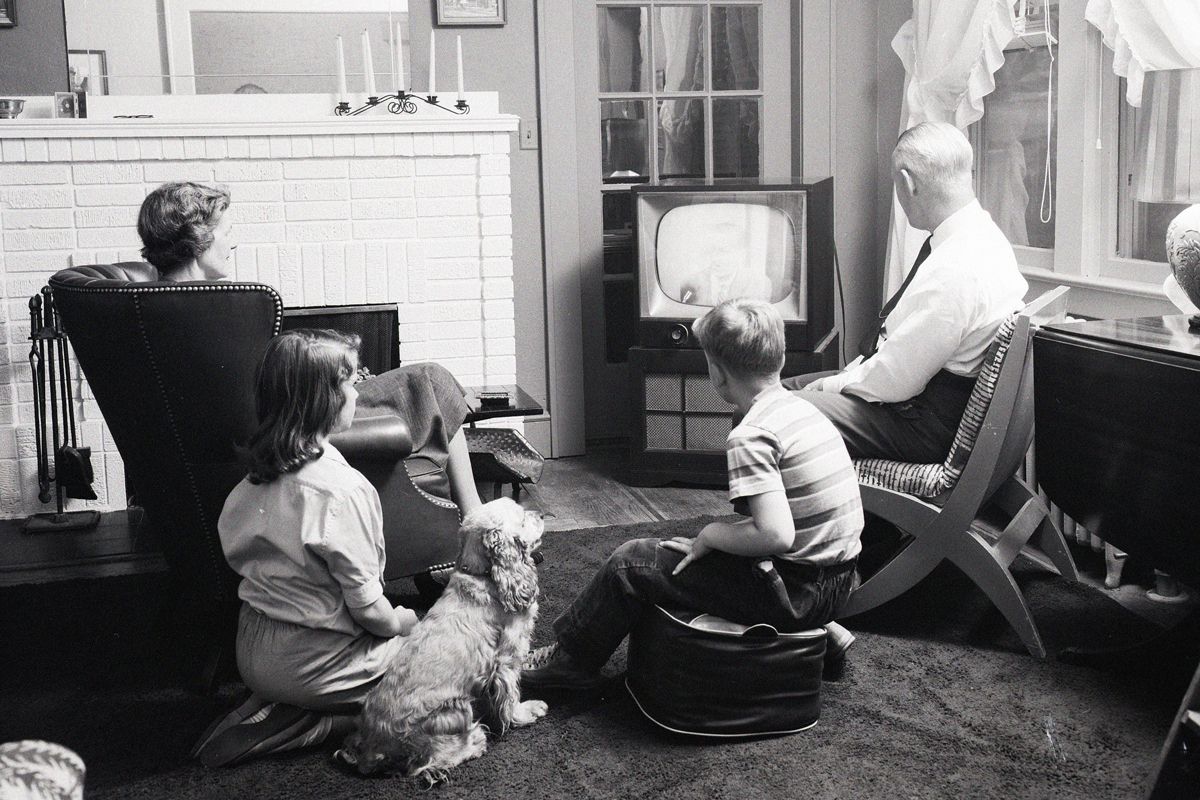
  • 1950s typewriter keys
1950s typewriter keys
Credit: Robert Alexander/ Archive Photos via Getty Images
Author Tony Dunnell

January 15, 2025

Love it?

The QWERTY keyboard layout is so common that most of us never stop to question its unusual arrangement of letters. But when we do look down at our keyboards, we might find ourselves struggling to understand the logic behind the layout: Why does the top row begin with the letters Q, W, E, R, T, Y? 

Found on nearly every computer, laptop, and smartphone worldwide (at least in countries that use a Latin-script alphabet), this seemingly random configuration of keys has an interesting history — though perhaps not the one most people have been led to believe.

Credit: Science & Society Picture Library/ SSPL via Getty Images

The Rise of the Typewriter

During the 19th century, inventors came up with various kinds of machines designed to type out letters. Most of these machines, however, were large and cumbersome, often resembling pianos in size and shape. In some cases, they proved highly valuable to people with visual impairments, but for general use they were inefficient, being much slower than simple handwriting.

Enter Christopher Latham Sholes, an American inventor who, in 1866, was working alongside Carlos Glidden on developing a machine for numbering book pages. Sholes was inspired to build a machine that could print words as well as numbers, and he and Glidden soon received a patent for their somewhat ungainly prototype. The contraption had a row of alphabetized keys that, when struck, swung little hammers with corresponding letters embossed in their heads. The keys, in turn, struck an inked ribbon to apply the printed letters to a sheet of paper. It was far from the perfect solution, however, so Sholes persevered. 

Five years later, in 1872, Sholes and his associates produced the first-ever practical typewriter. Rather than an alphabetized row of keys, this new typewriter featured a four-row layout with what was then a QWE.TY keyboard (with a period where the R is today). In 1873, Sholes sold the manufacturing rights to the Remington Arms Company, which further developed the machine. It was marketed as the Remington Typewriter — complete with the slightly altered QWERTY key layout. It became the first commercially successful typewriter, and in so doing made the QWERTY keyboard the industry standard. 

You may also like

What Was George Washington’s Inauguration Like?

  • Inauguration of George Washington, 1789
Inauguration of George Washington, 1789
Credit: North Wind Picture Archives/ Alamy Stock Photo
Author Timothy Ott

January 7, 2025

Love it?

Every four years, a new United States presidential administration commences with an inauguration ceremony on the western front of the U.S. Capitol in Washington, D.C. Held on January 20, or January 21 if the traditional date falls on a Sunday, the inauguration begins around noon with the vice president-elect reciting the oath of office.

That’s followed by the only constitutionally mandated component of the inauguration, the president’s oath of office, typically administered by the chief justice of the United States. The president-elect repeats the words: “I do solemnly swear (or affirm) that I will faithfully execute the office of president of the United States, and will to the best of my ability, preserve, protect, and defend the Constitution of the United States.”

The president then delivers their inaugural address, followed by a luncheon in the Capitol’s Statuary Hall, and a parade that takes the chief executive and their party to the White House. The evening’s events include varying numbers of official and unofficial balls, held in hotels and government buildings throughout the city. 

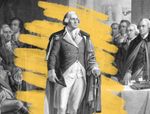
While the roots of these traditions go back to the very first U.S. presidential inauguration — that of George Washington in 1789 — the events of that particular day were noticeably different from what transpires now. In fact, the ceremonies surrounding this landmark moment of American history weren’t even formalized until just a few days before it all unfolded.

Credit: Old Paper Studios/ Alamy Stock Photo

A Military Procession Escorted George Washington to New York City

Following a week’s journey from his beloved Virginia plantation Mount Vernon, which saw him feted by residents of every town he passed through, Washington arrived at his new home in what was then the federal capital, New York City, on April 23, 1789. His wife, Martha Washington, who was still tending to business at Mount Vernon, did not join him for another month.

With the president’s safety secured, a joint committee of the Senate and House of Representatives met to hammer out details of where the inauguration would take place, who would administer the oath of office, and seating arrangements. On April 25, Congress adopted the committee’s recommendations for ceremonies to be held five days later.

At sunrise on the determined day of April 30, a military salute was discharged at Fort George near the southern tip of Manhattan. At 9 a.m., church bells sounded throughout the city for approximately half an hour, summoning their congregants for a morning service.

Meanwhile, Washington, who’d had barely any downtime since adjusting to his accommodations in a three-story brick building on Cherry Street, dressed in a Connecticut-made brown broadcloth suit, adorned with gilt buttons engraved with the arms of the United States, as he awaited the military procession that would escort him to Federal Hall on Wall Street.

The escorts arrived around noon and set off with the president in his coach about half an hour later. Numbering some 500 men in total, the procession included two companies of grenadiers, a company of light infantry, members of the Senate and House committees, and the Spanish and French ministers.

Within 200 yards of Federal Hall, the procession split into lines on either side of the street, its participants presenting arms and lowering flags as Washington and his party passed between them on foot and entered the federal building.

Inside the Senate Chamber, Washington was greeted by his vice president, John Adams, and members of both the Senate and House of Representatives. At about 2 p.m., Adams informed Washington that it was time to take the oath of office, and the gathered congressmen escorted the president to a canopy-covered balcony decorated with red and white curtains.

Before a crowd of spectators gathered on the streets below, and on the roofs and balconies of neighboring buildings, Washington placed his right hand on an open Bible supplied by St. John’s Masonic Lodge of New York and repeated the oath of office administered by the chancellor of New York, Robert R. Livingston. After the president finished by kissing the Bible, Chancellor Livingston turned to the crowd and ignited a celebratory roar by proclaiming, “It is done; long live George Washington, president of the United States.”
You may also like

Meet America’s Gilded Age ‘Dollar Princesses’

  • Jennie Churchill, 1888
Jennie Churchill, 1888
Credit: Herbert Barraud/ Archive Photos via Getty Images
Author Kristina Wright

January 7, 2025

Love it?

The turn of the 20th century marked a time of rapid industrialization and wealth accumulation in the U.S., now known as the Gilded Age. A unique social phenomenon emerged during this era as wealthy American heiresses married into aristocratic British families. The brides brought their extensive fortunes to England’s cash-strapped noble families in exchange for coveted British titles and social status. The term “dollar princesses” captures the transactional nature of these unions, which often symbolized the blending of New World wealth with Old World prestige.

The concept of dollar princesses came out of the economic realities of the period. Many British noble families had inherited land-rich but cash-poor estates and struggled to maintain their ancestral homes in the face of declining agricultural incomes and the increasing costs of managing these vast properties. Meanwhile, newly wealthy American industrialists and financiers were looking to elevate their social standing in the U.S. and abroad — and saw their unmarried daughters as the perfect conduit for forming beneficial alliances.

These marriages were not just personal but also highly strategic, often negotiated with the same acumen as a business deal — not unlike the arranged marriages between royal families. Traditional introductions were made at social events between like-minded families, and American debutants could be presented at court — for a price — making it more likely for them to find suitable husbands. A publication called Titled Americans announced heiresses who had married into the aristocracy and listed eligible British bachelors who might be amenable to marrying their own dollar princesses. The 1915 edition reported that 454 American heiresses had married into European noble families between 1870 and 1914.

The dollar princesses of the Gilded Age represent a fascinating intersection of extravagant wealth, political ambition, and cultural exchange. While their marriages were often arranged with pragmatic goals in mind, many of these women went on to leave significant legacies in philanthropy, politics, and society. Here are some of the most notable dollar princesses of the era.

Credit: PhotoQuest/ Archive Photos via Getty Images 

Consuelo Vanderbilt

Perhaps the most famous dollar princess, Consuelo Vanderbilt was born into the staggeringly wealthy Vanderbilt family. When Consuelo married Charles Spencer-Churchill, 9th Duke of Marlborough, in 1895, her father, railroad tycoon William Kissam Vanderbilt, signed an agreement providing a dowry of $1.6 million (equivalent to around $60 million today), as well as an income of $2 million in stocks. The match was arranged by Consuelo’s Southern belle mother, Alva Vanderbilt, as a way of securing the family’s place in society. Consuelo was vehemently opposed to the union and the duke was no more enamored of her, telling Consuelo after their wedding that he was in love with another woman.

Despite her unhappy marriage, Consuelo gained a prominent place in British society as the Duchess of Marlborough and became a supporter of women’s suffrage. After living apart for years, the couple divorced in 1921, and Consuelo married the love of her life, French aviator Jacques Balsan.

You may also like

How Were the Egyptian Pyramids Built?

  • Engraving of the Pyramids of Giza
Engraving of the Pyramids of Giza
Credit: World History Archive/ Alamy Stock Photo
Author Tony Dunnell

January 7, 2025

Love it?

Ancient Egypt was home to more than 100 pyramids, many of which still stand today. One of the oldest monumental pyramids in Egypt, the Step Pyramid of Djoser, was built sometime between 2667 BCE and 2648 BCE and began a period of pyramid construction lasting more than a thousand years. The most famous monuments are found at the Giza complex, home to the Great Pyramid, the Pyramid of Khafre, and the Pyramid of Menkaure, all built during the Fourth Dynasty around 2600 to 2500 BCE — the golden age of ancient Egypt.

The Egyptian pyramids stand as one of humanity’s most remarkable architectural achievements, and their incredible precision and massive scale have confounded researchers for centuries. Despite numerous theories and extensive archaeological research, the exact methods of their construction remain a subject of scholarly debate. How did ancient Egyptians erect pyramids using millions of massive blocks weighing as much as 2.5 tons each? And how, more specifically, did they move those blocks up the superstructure? 

To this day, there is no known historical or archaeological evidence that resolves the question definitively. While popular speculation often veers into fantastical explanations — yes, including aliens — serious historians and archaeologists have given much thought as to how these monumental structures might have been erected using the technological capabilities of the time. Here are three of the most likely construction theories. 

Credit: Science History Images/ Alamy Stock Photo

The Herodotus Machine

The first historical account of the construction of the pyramids came from the ancient Greek historian Herodotus in the fifth century BCE. In his Histories, he wrote that the Great Pyramid took 20 years to build and demanded the labor of 100,000 people. Herodotus also wrote that after laying the stones for the base, workers “raised the remaining stones to their places by means of machines formed of short wooden planks. The first machine raised them from the ground to the top of the first step. On this there was another machine, which received the stone upon its arrival and conveyed it to the second step,” and so on. 

These “Herodotus Machines,” as they later became known, are speculated to have used a system of levers or ropes (or both) to lift blocks incrementally between levels of the pyramid. Egyptian priests told Herodotus about this system — but it’s important to note that this was a long time after the construction of the Great Pyramid, so neither the priests nor Herodotus were actual eyewitnesses to its construction. It is certainly feasible, however, that the machines he described may have been used, either by themselves or, more likely, in conjunction with other methods.

You may also like

What Did People Do Before Eyeglasses?

  • Old spectacles on a book
Old spectacles on a book
Credit: dero2084/ Alamy Stock Photo
Author Timothy Ott

December 20, 2024

Love it?

Somewhere in the vicinity of Pisa, Italy, around 1286, an unknown craftsman fastened two glass lenses to a frame likely made of wood or bone to create the first eyeglasses.

With approximately two out of three adults in the United States today requiring some form of visual aid, it’s safe to say that invention has been well received. But even though 1286 is well before any of us first discovered the splendor of improved eyesight, it’s relatively recent in the larger picture of human existence. So how did people with subpar vision get by before there was a convenient LensCrafters to pop into?

Credit: Shotshop GmbH/ Alamy Stock Photo

There’s not much historical evidence explaining how our prehistoric ancestors fared in the absence of visual aids, so we’re left to use some combination of deduction and common sense to determine how, say, a sight-impaired individual would keep up with the pack in a group of hunter-gatherers.

A person with imperfect vision could still be useful to a group simply because sharp eyesight to read signs, documents, and the like wasn’t necessary in prehistoric times. As civilization progressed, those with visual impairments could even find their condition produced certain advantages. A myopic (nearsighted) person, for example, could find themselves steered toward a craftsman role for their ability to focus on detail.

That said, humankind used visual aids for many centuries before the first eyeglasses appeared in the Middle Ages. Here are a few of the tools that helped those dealing with hyperopia (farsightedness) and other sight-related challenges.

Credit: Feng Yu / Alamy Stock Photo

Early Lenses

Archaeological digs in the eastern Mediterranean area have uncovered the existence of plano-convex lenses (flat on one side and rounded on the other) made of glass and rock crystal that date back to the Bronze Age. The most well known example is the Nimrud lens, which was found in the remains of an Assyrian palace in modern-day Iraq. While it’s unknown what these lenses were used for, some of them magnify objects between seven and nine times, rendering them useful for work on items in close quarters. 

In his book Renaissance Vision From Spectacles to Telescopes, Vincent Ilardi suggests that the presence of holes or “resting points” on some of these lenses indicates they may have been propped up in a way that allowed artisans to use their hands. Additionally, he offers the discovery of a 5,300-year-old Egyptian ivory knife handle with carved microscopic figures as evidence that ancient Egyptians had a means for providing vision enhancements.

These weren’t the only civilizations to discover uses for lenses. A 2.3-gram convex crystal lens was found in the tomb of a son of Chinese Emperor Liu Xiu, who lived in the first century CE. Its creation was fostered by the optical studies published centuries earlier by Chinese scholars, including the philosopher Mozi and King Liú Ān.

You may also like

Why Is the Dollar Symbol an ‘S’?

  • Dollar symbol made from paper
Dollar symbol made from paper
Credit: isak55/ iStock
Author Tony Dunnell

December 20, 2024

Love it?

The dollar sign, or “$,” is one of the most recognizable currency symbols in the world, instantly understood across languages and cultures. It also transcends currency, having become a widespread symbol in pop culture. Andy Warhol made a whole series of drawings and paintings of the dollar sign in the 1980s, while some modern artists have used the symbol in their own stylized names — think A$AP Rocky, Travi$ Scott, and Ke$ha. It’s also been used as a symbol of greed — critics of large companies might make their point by introducing the dollar sign into the name of a corporation. 

Despite the ubiquity of the dollar sign, its origins are surprisingly complex, muddied by a lack of historical record and competing theories. Far from a simple design, the dollar symbol represents a fascinating journey through economic history, global trade, and linguistic evolution.

Credit: Hoberman Publishing/ Alamy Stock Photo

Origin Theories

A number of theories exist regarding the origins of the dollar sign. Some have little supporting evidence, but are interesting nonetheless. For example, one hypothesis traces the symbol’s roots to an image of the Pillars of Hercules that appeared on the Spanish coat of arms and national currency. The image showed the two pillars wrapped in S-shaped banners, which, according to the theory, could have evolved in notation to become the dollar sign. 

Another, similar theory argues that the symbol came from the Potosí mint in Bolivia, which operated from 1573 to 1825. (The mine at Potosí was once the main source of silver for the Spanish Empire.) The mint used a stamp that featured the letters PTSI (for Potosí) imposed on top of each other, which could have created a symbol similar to the modern dollar sign. 

Yet another common theory — and most likely a popular misconception — is that the symbol stands for “United States” and originated from the abbreviation “U.S.,” with the letters superimposed and the “U” becoming stylized over time. The writer and philosopher Ayn Rand seemingly believed this theory and chose to include it in a chapter of her 1957 novel Atlas Shrugged, in which one character asks another what the dollar sign stands for. But Rand, it seems, was wrong. The United States was known as the United Colonies of North America until 1776, and evidence exists that the dollar sign was in use before the United States moniker was born — making the theory seem tenuous at best.  

You may also like

5 Forms of U.S. Currency That Are No Longer in Use

  • Close-up of U.S. currency
Close-up of U.S. currency
Credit: John_Lamb/ iStock
Author Tony Dunnell

December 20, 2024

Love it?

The history of currency in the United States offers a fascinating journey through cultural changes, economic innovation, and shifting monetary policies. Between the colonial era and the mid-20th century, numerous forms of currency emerged that served a particular purpose before ultimately being discontinued. These now-defunct currencies reflect the complex social and political landscapes that shaped America’s financial systems, while at the same time telling stories of expansion, war, innovation, and politics. 

Here are five forms of U.S. currency that still exist — and in some cases are worth far more than when they were first issued — but are no longer in common use. 

Credit: Penta Springs Limited/ Alamy Stock Photo

Pine Tree Shilling

In the early 1650s, the Massachusetts Bay Colony was a commercial success. But it had a fundamental problem: a lack of coin currency, which was a major issue for not only the colony but also the wider New England economy. This forced the colonists to rely on bartering, allowing the British to keep more control. So, the authorities in Boston — which, at the time, had existed for only around 25 years — decided to set up a mint. They began striking silver coinage in denominations of 3 pence, 6 pence, and 1 shilling, most of which were stamped with the year of the mint’s foundation, 1652, and a pine tree (although some bore a willow or oak tree). The currency became collectively known as the pine tree shilling, and was generally accepted throughout the Northeast. It remains arguably the most famous coin from America’s colonial period. Today, authentic pine tree shillings are generally worth between $1,500 and $3,000 each. 

You may also like

5 Essential World War II Novels

  • “The Naked and the Dead” book
"The Naked and the Dead" book
Credit: booksR/ Alamy Stock Photo
Author Kristina Wright

December 18, 2024

Love it?

World War II remains one of the most significant and devastating events in human history; it’s the source of countless stories of heroism, tragedy, and resilience. Historical fiction set during this time captures the war’s profound impact, shedding light on both well-known and lesser-known perspectives. These stories are often rooted in personal experiences and not only provide insight into the horrors of warfare, but also serve as a way to process and reflect on the complexities of conflict, the instinct for survival, and the morality of war.

Early works by authors who lived through this turbulent era helped define modern historical fiction, combining intensely personal narratives with philosophical explorations of the human condition. Many of the works on this list have become essential reading in the historical fiction genre and have influenced generations of both readers and writers. Whether you’re drawn to tales of resistance, survival, or love amid chaos, these five historical fiction books about World War II offer powerful narratives that will transport you back to the 1940s.

Credit: CBW/ Alamy Stock Photo

The Naked and the Dead by Norman Mailer (1948)

Norman Mailer’s debut novel, The Naked and the Dead, is considered one of the greatest American war novels ever written. Published in 1948 when Mailer was just 25 years old, the book offers an unflinchingly realistic portrayal of a U.S. Army platoon during the campaign to retake the fictional Pacific island of Anopopei during World War II. The story follows an ensemble cast of soldiers led by Lieutenant Hearn, who questions the hierarchy of military life, and General Cummings, a ruthless commander who embodies the authoritarian power structure.

Mailer, an Army veteran who served in the Pacific theater of World War II, depicts the psychological and physical toll of warfare, as well as the complex dynamics between soldiers and their commanding officers. The novel’s gritty realism and exploration of power, fear, and survival have established it as a classic in the genre of war fiction. It was a finalist for the Pulitzer Prize for fiction in 1949, and a film adaptation was released in 1958.

You may also like

What Were the Earliest Hotels Like?

  • Maids Head Hotel in Norwich
Maids Head Hotel in Norwich
Credit: Chris Yaxley/ Alamy Stock Photo
Author Timothy Ott

December 17, 2024

Love it?

Whether we’re checking into a five-star resort or a shack with a roof and cable TV off the interstate, we all expect a base level of service for a stay at a hotel. Of course, this is a luxury that comes with 21st-century lodging. Amenities such as running water, clean sheets, and free coffee are taken for granted nowadays, but they certainly weren’t the industry standard in the early days of hospitality.

Given that it’s easier to enjoy the view from our comfy modern chairs, let’s take a look at the rise of this form of transitory housing in various parts of the world, and revisit what it was like for guests to experience the earliest hotels.

Credit: dbtravel/ Alamy Stock Photo

Caravanserai of the Middle East 

As ancient civilizations flourished in the modern-day Middle East, it ignited the spread of trade routes into Asia and Europe, and with that development came the need for lodging to shelter travelers who were on the road for weeks to months at a time.

As described in Elaine Denby’s Grand Hotels: Reality and Illusion, these early shelters populated the regular paths at frequent enough intervals to accommodate travelers, who often covered 15 to 20 miles in a single day. Known by such names as caravanserai, khan, or han, these mud-brick buildings typically provided guests with beds, stables, and a well or cistern for drinking water, although food was not necessarily part of the arrangement.

A more elaborate and still-standing example of caravanserai is the Ribat-i Sharaf in modern-day Iran. Built in the 12th century, this fortified complex boasted an inner and outer courtyard, a mosque, and detailed stucco decoration, rendering it suitable for royals and government officials.

You may also like

When Did We Start Having Parades?

  • 19th-century parade procession
19th-century parade procession
Credit: ilbusca/ iStock
Author Nicole Villeneuve

December 17, 2024

Love it?

Parades are a curious phenomenon: We gather en masse to march through a space with music, costumes, and elaborate displays. But even at their most odd, these festive demonstrations also feel universal — most likely because they represent a tradition that spans continents and centuries. 

Credit: bilwissedition Ltd. & Co. KG/ Alamy Stock Photo

Before there were parades, there were processions. These were ceremonial or ritualistic events that anthropologists believe predated parades as a way to connect with community — and with the divine. Their roots stretch back to ancient civilizations: In Mesopotamia, as early as 2900 BCE, priests and citizens marched with statues of deities such as the Babylonian god Marduk during the multiday Akitu celebrations for the new year. 

The Panathenaic festival, held in Athens to honor the goddess Athena, similarly featured a grand procession to the Acropolis, where offerings and sacrifices were made. These events were spiritual and social, but they were not yet parades as we know them. As author Doug Matthews explains in his book Why We Love Parades: Their History and Enduring Appeal, there is an important difference: A procession has deeper significance behind the occasion, while a parade, though often organized around an occasion, is primarily about the content of the event for the enjoyment of spectators. 

You may also like