



How To Throw a Party in the 19th Century

  • 19th-century party
19th-century party
Credit: World History Archive / Alamy Stock Photo
Author Nicole Villeneuve

December 12, 2024

Love it?

Throwing a party in the 19th century was an exercise in extremes, ranging from Gilded Age glamour to grassroots get-togethers after a long day in the fields. 

At the start of the 19th century, many Americans were part of rural agrarian communities where daily life revolved around farming, homemaking, and survival. In the ensuing years, industrialization and immigration made major impacts on the country. Social and economic divides became more stark, with wealthy families in urban areas enjoying more leisure time and access to luxuries, while working-class and immigrant families often labored long hours in factories, workshops, or on farmlands. 

For much of the century, having the time and resources for hosting elaborate parties was a privilege reserved for the upper class, but people of all walks of life enjoyed socializing. Here’s a look at how different groups of Americans partied like it was 1899.

Credit: Lebrecht Music & Arts/ Alamy Stock Photo

Elegant Affairs for the Elite

For the wealthiest patrons of the Western world, throwing a party in the 19th century was an elaborate affair designed to show off status. The grand ball was the pinnacle of high-society entertainment, and was often held in a lavish home or rented hall. Balls, like most upper-class parties, were meticulously planned, and guests arrived dressed to impress — and to dance, although there was minimal letting loose with the strict choreography. The evening often began with a polonaise, a stately march that showed off guests’ stunning attire, followed by waltzes and quadrilles. 

Whether it was a ball, a formal dinner party, or a garden party, hosts ensured no detail was overlooked. Preparation took weeks, starting with handwritten or engraved invitations. Careful consideration was also given to the guest list. It was important not only that guests be of equal social standing, but also, according to Florence Hartley’s 1872 Ladies’ Book of Etiquette, that they be good conversationalists. Of course, table settings were quite particular, as was the actual act of eating. One 1869 etiquette guide directed dinner party guests to not “take a long, deep breath” after eating, lest you rudely appear fatigued by the whole ordeal.

You may also like

The Best History Podcasts of 2024

  • Studio microphone for podcasts
Studio microphone for podcasts
Credit: Andrei Kuzmik/ Shutterstock
Author Nicole Villeneuve

December 11, 2024

Love it?

History might just be the perfect podcast category. There’s a wealth of tales to tell, people to profile, or mysteries to uncover. And despite a plethora of available podcasts covering almost every historical angle imaginable, there never seems to be a shortage of worthwhile topics — encouraging, yes, but also a bit overwhelming to wade through. Here, we run down some of the best history podcasts from the past year, including a few older favorites that continued to dominate the podcast charts in 2024, and a welcome newcomer that made itself at home uncovering the compelling origins of everyday objects we take for granted. 

Credit: Collab Media/ Shutterstock

The Rest Is History

History buffs and curious minds alike will treasure The Rest Is History, which has been running since 2020 and is consistently one of the most popular history podcasts available. The hosts, British historians and authors Tom Holland (no, not the actor) and Dominic Sandbrook, cover a sprawling scope of topics each week: The rise of the Nazis, Cleopatra, “killer fashion,” and a deep dive on how the year 1968 changed America are but a very few examples. The duo balance their academic expertise with warm and playful banter — including the occasional cringeworthy impression (see: Churchill). The topics sometimes reflect current events and can indeed be dense, but Holland and Sandbrook’s warm, conversational approach, as well as the show’s minimal production, make even weighty topics feel approachable and bingeable.

You may also like

The Best Historical Movies of 2024

  • Austin Butler in “The Bikeriders”
Austin Butler in “The Bikeriders”
Credit: FlixPix/ Alamy Stock Photo
Author Michael Nordine

December 10, 2024

Love it?

What’s past is prologue, and that famous phrase certainly holds true when it comes to movies. This year’s most notable historical dramas brought their subjects to life in a way that only movies can, using the unreality of filmmaking to show how our understanding of what’s come before informs the present. Here are five of the best of them.

Credit: Album/ Alamy Stock Photo

The Settlers

Another word for “settler” is “colonialist,” and indeed the original Spanish title of Felipe Gálvez’s debut feature is Los colonos. Set in 1901 in Tierra del Fuego, an archipelago divided between Argentina and Chile whose name means “Land of Fire,” the film is nothing if not combustible. Inspired by real events, it ranks among the most brutal Westerns ever made. And yet it’s also strikingly beautiful, with cinematography that literally glows like a small, resilient campfire illuminating an otherwise pitch-black landscape from which anything — friend, foe, man, beast — could emerge. It’s not often that a film set in uncharted land feels so genuinely uncharted.

You may also like

A Brief History of Christmas Trees

  • Decorated Christmas tree
Decorated Christmas tree
Credit: Lightspring/ Shutterstock
Author Timothy Ott

December 10, 2024

Love it?

As the subject of numerous carols, a featured attraction for both cavernous department stores and cozy mom-and-pop businesses, and an object of purchase for some 35 million to 50 million American consumers every year, Christmas trees are undoubtedly a focal point of annual Yuletide celebrations. Older than the carols in which they’re celebrated but not nearly as old as the pagan origins of the holiday they support, Christmas trees have been a familiar, comforting sight since childhood for countless people dating back many generations. 

But these evergreen conifers didn’t simply emerge as part of holiday celebrations like a fully assembled toy right out of the box. Here’s a look back at how Christmas trees became part of, and then inextricable from, the end-of-year festivities in which they have a starring role.

Credit: Ivy Close Images/ Alamy Stock Photo

Early Evergreen Symbolism

The Christmas tree tradition has its roots in the long, multicultural history of evergreen plants being used to mark the arrival of the winter solstice. From the palm branches that featured in celebrations of the sun god Ra in ancient Egypt to the wreaths that were incorporated into the Roman festivities of Saturnalia, evergreens symbolized the rebirth of life during the cold, dark winter months.

According to Judith Flanders’ Christmas, A Biography, the emergence of trees to commemorate the season were in part inspired by the “paradise plays” that were popular in Europe during the Middle Ages. Staged in observance of the Christian feast day of Adam and Eve on December 24, the plays typically featured an evergreen fir, festooned with apples, as the stand-in for the symbolic tree of life.

Meanwhile, the proliferation of certain legends in 15th-century Germany further strengthened the association of trees with the Christian celebrations of the winter holiday. Among the most popular was the story of St. Boniface, who supposedly chopped down an oak that was towering above the remains of human sacrifice meant for the pagan god Thor, and replaced it with a fir tree that symbolized the eternal truth of Christ.

You may also like

Was St. Nicholas a Real Person? 

  • St. Nicholas of Myra
St. Nicholas of Myra
Feature Image Credit: Adam Ján Figeľ/ Alamy Stock Photo
Author Tony Dunnell

December 10, 2024

Love it?

The jolly, red-suited Santa Claus who delivers presents on Christmas Eve is a beloved and immediately recognizable figure in much of the world. He is very much a magical, whimsical character, but his origin story has its roots in a real historical person: St. Nicholas of Myra. We know very little of St. Nicholas’ life, but historical evidence does confirm that he was a living, breathing man who lived in the third and fourth centuries CE. 

While many of the recorded details about St. Nicholas are quite likely embellished — falling more into the realm of myth than reality — most suggest he lived a life of generosity and service to others. His acts not only helped lay the foundation for the modern Christmas tradition, but also paved the way for the now-iconic figure of Santa Claus, sometimes known as “St. Nick.” 

Credit: Heritage Images/ Hulton Archive via Getty Images

The Historical Nicholas

Very little is known about the real-life Nicholas. It’s believed he was born sometime around 280 CE in the Lycian seaport city of Patara, near Myra in modern-day Turkey, which at the time was part of the Roman Empire. It is often said he was born to wealthy Christian parents, and following Jesus’ teachings, he used his entire inheritance to help the needy and sick. While still a young man, he traveled to Palestine and Egypt. Soon after returning to Lycia, he became bishop of Myra. 

When the Roman Emperor Diocletian began his persecution of Christians in 303 CE, Nicholas was imprisoned and quite likely tortured. Later, in 325 CE, he may have attended the First Council of Nicaea, a council of Christian bishops convened by the Roman Emperor Constantine I (the first Roman emperor to convert to Christianity). Nicholas’ name appears on some, but not all, of the lists of attendees. Being the bishop of Myra, it would make sense that he was in attendance, although perhaps not as one of the more influential participants. According to legend, it was at the Council of Nicaea that Nicholas struck the heretic priest Arius in the face for arguing that Jesus the Son of God was not equal to God the Father.

The exact date of Nicholas’ death is disputed, but it is traditionally considered to be December 6, 343 CE. If correct, St. Nicholas would have been in his 60s or possibly his 70s when he died — a ripe old age at that time. 

You may also like

5 Gladiators Who Deserve Their Own Movie

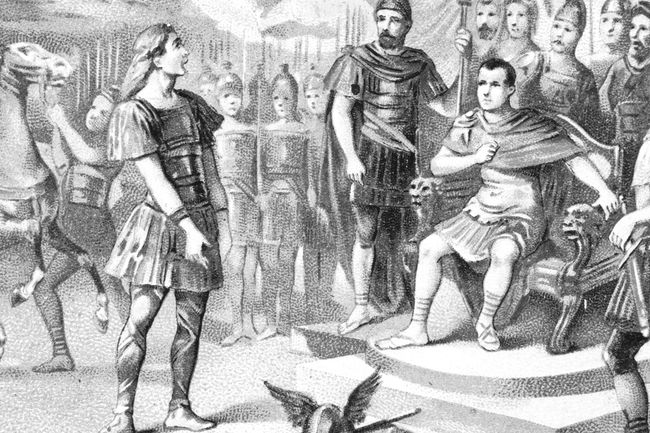
  • Commodus at the Colosseum
Commodus at the Colosseum
Credit: World History Archive/ Alamy Stock Photo
Author Bennett Kleinman

December 6, 2024

Love it?

The first known gladiator competition in ancient Rome occurred in 264 BCE at the funeral of Brutus Pera, where three sets of combatants fought to the death. Before long, gladiator fights became extremely popular among the Roman public and were treated as entertaining spectacles despite the brutal violence displayed. 

As the sport gained popularity, the number of gladiators grew, peaking in the year 107 CE when the Roman Emperor Trajan welcomed around 5,000 pairs of gladiators to perform during a 123-day series of celebrations throughout the city of Rome. Many of these battles took place at the Colosseum, which was built between 70 and 72 CE, and served as the site for the grandest gladiatorial contests. But there were also various smaller arenas and amphitheaters throughout the Roman Empire that played host to these competitions. 

The gladiators of ancient Rome came from all kinds of backgrounds; some participated for the thrill of the sport and to earn the adoration of their fellow Romans, though most were enslaved people or prisoners fighting for their freedom. But regardless of social standing, successful fighters were often considered heroes throughout Roman society. While most of these gladiators have been forgotten to the annals of history, a few warriors are still known by name and discussed today. In honor of the 2024 release of Ridley Scott’s Gladiator II, the sequel to his Oscar-winning 2000 film Gladiator, here are five famous real-life Roman fighters who deserve their own movies.

Credit: Chronicle/ Alamy Stock Photo

Spartacus

Spartacus is the one gladiator on this list who already has his own movie, the eponymous 1960 film starring Kirk Douglas. That’s in part because Spartucus’ fame came not from his success in the arena, but from leading a major revolt of enslaved people against the Roman Republic from 73 to 71 BCE. 

The details of Spartacus’ early life are murky. Some historians suspect he served as a soldier before abandoning the Roman army,  and was later caught, sold into slavery, and sent to a Capuan gladiatorial training school. Spartacus never fought gladiatorial fights in the Colosseum, which wasn’t built until nearly 150 years after his death. Instead, he fought most of his battles with fellow trainees — that is, until he and around 70 fellow students escaped gladiatorial school and fled to take refuge on nearby Mount Vesuvius.

As leader of this new rebel alliance, Spartacus led raids against his former oppressors, pillaging various locations throughout the Roman countryside. His exploits attracted the attention of other escaped enslaved people, who went to Mount Vesuvius to join the rebellion, and in time, the group eclipsed 90,000 members. The guerrilla attacks continued, and the conflict became known as the Third Servile War, or Gladiatorial War. Spartacus and his men traveled across the Roman Empire amassing victory after victory, fighting against the oppressive rule that had forced them into slavery. These revolts came to an end in 71 BCE at a battle roughly 35 miles southeast of Naples, Italy, the likely location of Spartacus’ death. 

You may also like

6 Unusual Gifts Given to U.S. Presidents

  • George H.W. Bush
George H.W. Bush
Credit: Consolidated News Pictures/ Archive Photos via Getty Images
Author Tony Dunnell

December 5, 2024

Love it?

Throughout the history of the United States presidency, the office has been the recipient of all manner of curious and unexpected gifts from both foreign dignitaries and American citizens. And we’re not just talking flowers and boxes of chocolates. Some gifts have been extravagant beyond belief, such as the numerous jewel-encrusted swords, goblets, and crowns presented to various U.S. presidents. Others have been less lavish but equally fascinating, whether for their uniqueness or for being downright strange. 

Due to the Foreign Gifts and Decorations Act of 1966, most of these treasures are not kept by the president — many are transferred to the National Archives by the Gift Unit (Grinch-like as that may be) — but it’s the thought that counts. Here are six of the most interesting and bizarre gifts given to U.S. presidents. 

Credit: ChiccoDodiFC/ Shutterstock

Giant Wheel of Cheese Given to Thomas Jefferson

One of the cheesiest gifts ever presented to a U.S. president must be the one given to Thomas Jefferson on New Year’s Day in 1802. The citizens of Cheshire, Massachusetts, gave the president a gigantic wheel of cheese, dubbed the “mammoth cheese,” which measured more than 4 feet in diameter and weighed an estimated 1,235 pounds. Given to Jefferson in honor of his republican ideals and his support of religious liberty, the cheese was engraved with the words, “Rebellion to tyrants is obedience to God” — an incongruously weighty inscription to put on a dairy product, no matter its size.  

You may also like

5 Discontinued Snacks We Wish Would Come Back

  • Chocolate cookie with cream filling
Chocolate cookie with cream filling
Credit: sulhanul khoir/ iStock
Author Mark DeJoy

December 5, 2024

Love it?

As far as ephemera is concerned, few things are as temporary as snack foods from the past. Snacking itself is an evanescent experience, a fleeting moment of between-meal indulgence or an inattentive nosh during a spectator event. But snacks are also a major part of American culture; snacking has doubled since the late 1970s, and according to the 2024 USDA survey “What We Eat in America,” 95% of American adults have at least one snack on any given day.  

The idea of snacking has distinctly 20th-century origins. Eating between the traditional three meals per day was frowned upon during the 19th century, and proto-snack street foods of the time (such as boiled peanuts) were considered low class. But the Industrial Revolution, combined with a more enterprising spirit around the turn of the 20th century, created business opportunities for packaged, transportable foods, which were often marketed as novel expressions of modern technology. 

As the nascent snack market emerged and grew, companies introduced countless products with varying degrees of success. Some, such as Cracker Jack (which debuted in 1896) and Oreos (which debuted in 1912 as a nearly exact imitation of the earlier Hydrox cookies), endure to this day. But history is littered with the wrappers of discontinued snacks. Here are some long-gone treats we’d love to see make a comeback.

Credit: georgi1969/ iStock

Cherry Humps

The Schuler Candy Company made this distinctive chocolate and cherry candy bar from 1913 to 1987. Each Cherry Hump bar contained two cherries, cordial, and fondant, and was double-coated in dark chocolate. In an unusual final step in their production, the bars were aged for six weeks, in order for the runny cordial and thicker fondant to meld and reach a cohesive state. Despite the cohesion achieved by aging, the filling of the candy bar still contained a more liquid texture than other candies, and this ended up being its undoing. 

When Schuler became a subsidiary of Brock Candy Company in 1972, Brock sought to update the production and distribution methods of Cherry Humps, and chose bulky high-volume pallet shipments instead of the previous method of fanning out multiple shipments to smaller distribution lots. What made sense on paper for efficiency was disastrous in practice for a product as fragile as Cherry Humps: The candy often arrived at its destination badly damaged, with visibly sticky packaging from leaking cordial. 

Instead of shoring up the candy’s packaging to protect it, or adjusting the shipping method, Brock changed the candy’s recipe to make it sturdier. The new recipe did away with the enticingly juicy cordial and fondant filling, instead setting firmer cherries in a layer of dense white nougat. There was no more gooeyness to speak of, and in turn, no more of the candy’s signature appeal. Sales steadily declined and Cherry Humps were discontinued.

You may also like

How Did Early Humans Survive Winter? 

  • Early humans making fire
Early humans making fire
Credit: gorodenkoff/ iStock
Author Tony Dunnell

December 5, 2024

Love it?

For our prehistoric ancestors, the arrival of winter posed a daunting challenge to their very survival. As temperatures plummeted and snow blanketed the landscape, early humans faced a relentless battle against the elements. But through a remarkable combination of ingenuity, cooperation, and adaptation, they not only endured these harsh winter months, but in some cases even thrived during them. 

The strategies our forebears developed to survive the cold provide fascinating insights into the resilience and resourcefulness of our species. From constructing sturdy shelters to harnessing the power of fire, early humans demonstrated an uncanny ability to overcome the trials of winter — and more often than not, their success was not a testament to individual survival, but rather the product of tight-knit communities working together to ensure the well-being of all.

Credit: Bettmann via Getty Images

Sheltering From the Cold

As winter temperatures dropped and snowfall accumulated, our early human ancestors faced a serious test of survival. One of the key ways they adapted was by finding or constructing reliable shelter to protect themselves from the elements. Caves were one option, although the notion of the prehistoric “caveman” is largely misguided. There is evidence that in the Paleolithic period (the Old Stone Age), people used caves — they slept in them, cooked in them, and sometimes put cave art on the walls — as they moved from place to place with the seasons. But while these caves could make convenient shelters for both humans and animals, they were far from being the sole refuges of our early ancestors. 

Early humans developed more sophisticated housing structures, including hide-covered tents and rudimentary huts made from wooden frames and packed snow or mud. The first known human shelters were constructed around 400,000 years ago by hunter-gatherers, probably the species Homo heidelbergensis, on a beach in what is now France. The largest hut was about 30 feet long — a far more technical achievement than living in a cave. These dwellings allowed humans to create microclimates that were significantly warmer than the freezing outdoor conditions. 

You may also like

The U.S. Government’s Strangest Secret Ops

  • Waving American flag
Waving American flag
Alexander Grey/ Pexels
Author Tony Dunnell

December 5, 2024

Love it?

Throughout history, governments have engaged in secret operations that range from the strategically sublime to the undeniably absurd. The U.S. government, in particular, has taken part in numerous clandestine projects — now declassified — that continue to inspire fascination and incredulity alike. 

These operations tend to reflect the tensions (and prejudices) of the times, as well as the eccentricities of military and intelligence strategy. They underscore the lengths to which governments will go to maintain national security or undermine their rivals, while also highlighting a very particular intersection of imagination, fear, and ambition. Here are five of the strangest secret U.S. government operations. 

Credit: AngelaLouwe/ Shutterstock

Glowing Foxes

World War II saw an almost endless array of secret ops that ranged greatly in scope and levels of success. One of the most bizarre ideas was a program called Operation Fantasia, which aimed to scare the Japanese people with glowing foxes. It was the brainchild of Ed Salinger, a psychological warfare strategist at the Office of Strategic Services (OSS), who ran an import/export business in Tokyo before the war. 

Salinger believed that Japanese morale could be devastated by exposing soldiers and civilians to “real-life” kitsune — fox-shaped, shape-shifting spirits with magical abilities from Japanese folklore, considered tricksters and potential portents of doom. Salinger outlined his idea in a discriminatory memo, arguing that Japanese people were “subject to superstitions, beliefs in evil spirits and unnatural manifestations which can be provoked and stimulated.” 

Carrying out this xenophobic plan was another matter altogether. One idea involved launching fox-shaped balloons, which had whistles that simulated fox sounds and released a custom-made fox odor, to fly over Japanese villages. Understandably, this idea was deemed impractical — but the OSS didn’t stop there. They then planned on catching live foxes, spray-painting them with glowing paint, and releasing them throughout Japan. The idea made it to the testing stage, when 30 glowing foxes were released in Washington, D.C.’s Rock Creek Park to gauge the reactions of the locals. The project grew ever more bizarre and unfeasible, until it was eventually abandoned.

You may also like