
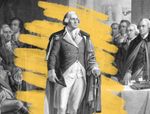


‘Take Me Out to the Ball Game’ has a feminist twist.

  • Feminist TRIXIE FRIGANZA
Feminist TRIXIE FRIGANZA
Credit: Pictorial Press Ltd/ Alamy Stock Photo
Author Nicole Villeneuve

July 2, 2024

Love it?

Baseball is known as “America’s pastime,” a tradition so embedded in U.S. culture that the songwriters who penned “Take Me Out to the Ball Game” in 1908 did so even though they had never actually seen a game themselves. The song’s familiar chorus about snacking on Cracker Jack and rooting for the home team is often sung during the seventh-inning stretch at baseball games, but the tune’s lesser-known verses have a surprisingly feminist twist.

The song tells the tale of a baseball-loving woman named Katie Casey, described in the lyrics as “mad” for the sport. Katie saw every game, knew all the players, and was confident enough in her knowledge of the rules to “[tell] the umpire he was wrong.” The portrayal of a passionate female sports fan was progressive for its time, but it was not exactly factual. Instead, the lyrics are believed to have been inspired by actress and activist Trixie Friganza, who songwriter Jack Norworth was believed to be having an affair with at the time. Friganza was involved in New York’s suffrage movement, and was reportedly a fan of the New York Giants. Her image also appeared on two early editions of sheet music for the song. In 1927, long after his alleged affair with Friganza had ended and seven years after women won the right to vote, Norworth slightly reimagined some of the lyrics to the famous song. He did keep his female protagonist, but inexplicably changed Katie Casey’s name to Nelly Kelly.

Ancient Egyptians shaved their eyebrows when their cats died.

  • Ancient Egyptian cat
Ancient Egyptian cat
Credit: Corey Ford/ Alamy Stock Photo
Author Michael Nordine

July 2, 2024

Love it?

Though ancient Egyptians didn’t literally worship cats, they did see them and other animals as symbols of the gods’ divine qualities. They admired felines as much for their hunting prowess as they did for the way they nurtured their young, and both aspects factored into their reverence. Their devotion was so fierce, in fact, that they shaved their eyebrows when their own cats died — the beginning of a mourning period that didn’t end until their eyebrows grew back. Keeping a cat in one’s home was considered a way of both attracting good fortune and warding off evil spirits, and a cat’s passing was considered a significant loss — many Egyptians even mummified them.

This royal treatment began not with commoners but with the actual royalty, who let their cats eat from their plates in addition to adorning them in gold jewelry. Perhaps the most important feline deity was Bastet, a goddess of the home, fertility, childbirth, and, yes, cats themselves. Bastet was first depicted as a lioness before later being portrayed as a small domestic cat. Sekhmet, a lioness goddess of war who defended the sun god Ra from his enemies, represented the other half of cats’ most revered qualities. Statues of these “divine felines” remain to this day in museum collections.

Old West cowboys and outlaws preferred bowler hats.

  • Old west bowler hat
Old west bowler hat
CREATISTA/ iStock via Getty Images Plus
Author Anne T. Donahue

November 8, 2023

Love it?

Conjuring the traditional image of Wild West cowboys and outlaws is easy. Typically, they’re shown in leather chaps, a vest, and denim pants, accompanied by boots, spurs, and holsters. Most importantly? There’s a cowboy hat: a tall, wide-brimmed head-covering that’s become synonymous with gun-slinging legends such as Billy the Kid, Buffalo Bill, or Hollywood’s John Wayne. Yet surprisingly, many cowboys and outlaws in the Old West (around 1865 to 1900) actually preferred bowler hats. The casual counterpart to the more formal derby hat, the bowler was designed by London hatmakers and commissioned by English nobility. Domed and hardened by shellac, the felt cap was reliable and sturdy; according to some accounts, it was designed for gamekeepers who kept losing their top hats to low-hanging branches. 

A world away from lush English estates, the bowler became a natural choice for life in the American West: The hats didn’t fly off in the wind, their durability withstood the elements, and they could be worn for almost any occasion. Favored by the likes of gambler and gunslinger Bat Masterson and the outlaws known as Butch Cassidy and the Sundance Kid, the bowler hat maintained its hold on the Western frontier until the famous Stetson took over as the hat of choice. With a wider brim to help block the sun — and the boost Buffalo Bill Cody gave the hat after wearing it in his Wild West shows — the “Boss of the Plains” solidly replaced its British predecessor by the end of the 19th century, and became the hat commonly associated with the Old West today.

Thomas Jefferson kept grizzly bears at the White House.

  • Two grizzly bear cubs
Two grizzly bear cubs
Credit: jared lloyd/ Moment via Getty Images
Author Michael Nordine

December 23, 2025

Love it?

The most common presidential pets have historically been cats and dogs, but the White House has also been home to considerably more exotic creatures. Calvin Coolidge alone had raccoons, a donkey, and a bobcat; Martin Van Buren was gifted a pair of tiger cubs (though they were confiscated by Congress and sent to the zoo); and Theodore Roosevelt had a badger named Josiah and a hyena named Bill, among many other animals. Most fearsome of all the presidential pets, perhaps, were the two grizzly bears Thomas Jefferson received from an American explorer named Zebulon Pike in 1807.

The two cubs didn’t call the White House home for long, alas. Jefferson realized that housing them on the grounds would be impractical, writing in a letter to his daughter, “These are too dangerous & troublesome for me to keep.” He knew just who to send them to: Charles Willson Peale, an artist who had a museum in Philadelphia. In a letter to his friend, Jefferson assured him that the cubs were “perfectly gentle” and “appear quite good humored” in addition to not eating much. Before sending them on their way, the nation’s third president briefly kept the bears on the White House lawn.

Some U.S. states had laws requiring margarine to be dyed pink.

  • Spreading margarine
Spreading margarine
gemredding/ iStock
Author Sarah Anne Lloyd

November 8, 2023

Love it?

Margarine developed an unsavory reputation very quickly after it first arrived in North America from Europe in the 1870s. Both the dairy lobby and popular media maligned the butter substitute (then made from surplus animal fats), claiming that it was unhealthy, prepared under unsatisfactory conditions, and full of harmful chemicals. Twenty states regulated margarine’s labeling, and seven more banned it outright before Congress stepped in and passed the 1886 Oleomargarine Act, which, among other things, heavily taxed the manufacture and sale of margarine. Retailers tried to get around the law by selling margarine as butter, which only intensified the anti-margarine crusade.

To make the difference between margarine and butter more obvious, 32 states passed legislation regulating the color of margarine. Most of those states banned the color yellow, but at least five states (Minnesota, South Dakota, Vermont, and West Virginia) went a step further and required that margarine be dyed pink to highlight its artificiality. The Supreme Court struck down pink margarine requirements as unconstitutional in 1898, but bans on yellow margarine remained in effect. In 1902, Congress even amended the Oleomargarine Act to increase taxes on artificially colored yellow margarine. But when the price of butter skyrocketed in the 1940s, public opinion shifted. The Oleomargarine Act was repealed in 1950, and state regulations started to follow suit. The last bans on yellow margarine were in Minnesota and Wisconsin, and both were repealed by 1967.

Australia used to be called New Holland.

  • New Holland map
New Holland map
Credit: The Picture Art Collection/ Alamy Stock Photo
Author Kerry Hinton

July 2, 2024

Love it?

In 1606, toward the end of Europe’s age of exploration, Dutch explorer Willem Janszoon landed on the western side of Australia’s Cape York Peninsula, believing he was on the shores of New Guinea, which is separated from mainland Australia by the Torres Strait. He mapped 186 miles of coastline before departing later that year. Other Dutch navigators followed suit, charting the northern, western, and southern coasts of the landmass. Despite the fact that the Dutch never never colonized Australia, by the late 17th century the continent was known as New Holland (Nieuw-Holland in Dutch) — but the name didn’t last.

In 1768, British explorer James Cook made the first of his three voyages to Australia. Two years later, he claimed the eastern half for Britain and renamed it New South Wales. A secret goal of Cook’s first voyage was to discover what was listed on ancient maps as Terra Australis Incognita (Latin for Unknown South Land), a hypothetical vast landmass that the Greek philosophers theorized must exist in the Southern Hemisphere to counterbalance Asia. By the end of Captain Cook’s third voyage, he had seen portions of Antarctica and mapped enough of New Zealand (also named by Dutch explorers) to disprove that Australia was part of the fabled Terra Australis; rather, a separate southern continent was located in the icy polar region.

In 1803, British navigator Matthew Flinders became the first person to circumnavigate the coast of Australia, charting unknown parts of the coastline and proving that Australia is a single continent. In his journals and maps of the expedition, he harkened back to Terra Australis when naming the continent, but shortened it to Australia. This time, the name stuck. As Flinders wrote in A Voyage to Terra Australis (1814), the new, abridged moniker was “more agreeable to the ear.”

Early cars came with a vase for flowers.

  • Sterling silver auto vase
Sterling silver auto vase
Credit: SBS Eclectic Images/ Alamy Stock
Author Sarah Anne Lloyd

December 23, 2025

Love it?

Imagine riding in a car in the 1920s. There was no air conditioning, the smell of auto exhaust was overwhelming, and the modern air freshener hadn’t been invented yet. Fortunately, many early automobiles had a pretty, fragrant feature: flower vases mounted to either the dashboard or the passenger-side window.

Automotive vases date back to at least the late 19th century and emerged in the United States by 1909, when Ward’s Automobile Topics noted that limousines on New York City’s ritzy Fifth Avenue had adopted the “Parisian notion.” In 1913, Popular Mechanics also credited France with the origin of the trend and published a perhaps-apocryphal origin story of a French automobile manufacturer that appeased an impatient American customer by adding a bouquet holder.

These vases came in all kinds of materials and designs, from sterling silver to glowing uranium glass. Some had brackets for mounting, while others included chains for hanging. Initially, they were a luxury item, but by the 1920s they were more accessible to the average consumer. Aftermarket models were widely available in jewelry stores or the Sears catalog. And Henry Ford was so taken with them that he even added them to his assembly line. 

Today, dashboard flowers are more widely associated with Volkswagen vehicles, although the manufacturer didn’t start offering them as an option until the 1950s (a tradition that continued into the 1970s). When the company rebooted the VW Beetle in 1998, one of its many quirky vintage touches was an acrylic vase in the dash.

Warren G. Harding’s dog sat in on Cabinet meetings. 

  • Harding’s dog, Laddie Boy
Harding's dog, Laddie Boy
Credit: Glasshouse Images/ Alamy Stock Photo
Author Michael Nordine

July 2, 2024

Love it?

It isn’t uncommon to see pets in Zoom meetings these days, as some cats and dogs can’t help being the center of attention while their humans attempt to check in with their co-workers. Even so, the fact that Warren G. Harding’s dog sat in on Cabinet meetings sounds especially distracting (albeit in an adorable way) for such important positions as, say, the secretary of state. Laddie Boy, who’s been called the White House’s first celebrity dog, was an Airedale terrier whom the 29th president of the United States deeply adored. In addition to fetching the newspaper and joining the first lady at fundraisers, he had his own seat at Cabinet meetings and was written about in the press on a near-daily basis.

Sometimes, Laddie Boy even “wrote” back. “So many people express a wish to see me, and I shake hands with so many callers at the Executive Mansion,” read one such letter, “that I fear there are some people who will suspect me of political inclinations. From what I see of politics, I am sure I have no such aspirations.” The presidential pup remained popular even as Harding did not (he’s routinely ranked among the worst heads of state in American history). Following Harding’s untimely death in 1923, a poem by Edna Bell Seward titled “Laddie Boy, He’s Gone” was set to music by composer George M. Seward in order to console the faithful dog.

Benedict IX served as pope on three different occasions.

  • Pope Benedict IX
Pope Benedict IX
Maidun Collection/ Alamy Stock Photo
Author Bennett Kleinman

November 8, 2023

Love it?

Benedict IX was an 11th-century Catholic pope notable for being the only person to hold the papacy on multiple occasions — in his case, three different times. Born Theophylactus to a powerful Roman family, the future pope was the nephew of two prior popes, Benedict VII and John XIX. Upon the latter’s death in 1032, Benedict IX was chosen by the powerful Tusculani family as the successor, despite being just 20 years old (though some sources claim he was as young as 12). Benedict IX’s first pontificate came to an end in 1044, when he was deposed amid accusations of living an unsavory lifestyle, and replaced by Sylvester III.

Sylvester’s time as pope was brief, as supporters of Benedict IX expelled Sylvester from the role, allowing Benedict to return in April 1045. But Benedict’s second pontificate lasted only until the following month, as he notoriously sold the papacy to his grandfather Gregory VI. This act landed Gregory in hot water; he was deposed in December 1046 and replaced by Clement II. Clement met an untimely demise a few months later, allowing Benedict to seize the papacy for a third and final time in October 1047. Benedict IX remained pope until July 1048, when he was driven away by forces under the control of Holy Roman Emperor Henry III. 

Russia once banned vodka.

  • Crystal bottle and cup
Crystal bottle and cup
Credit: Winston Springwater/ Shutterstock
Author Michael Nordine

June 6, 2024

Love it?

There’s a Russian proverb that speaks to the country’s love affair with a certain spirit: “Vodka is our enemy, so we’ll utterly consume it.” Russia and vodka are almost synonymous with each other, for better or, sometimes, worse. The problems associated with overconsumption have been known to Russia’s leaders for a long time — so long, in fact, that Tsar Nicholas II announced his intention to ban the liquor on September 28, 1914, in a telegram that read simply, “I have already decided to abolish forever the government sale of vodka in Russia.” He did so at considerable financial risk, as the government’s centuries-old vodka monopoly was responsible for a third of its revenue, but he felt it was important that the treasury was no longer “dependent on the ruination of the spiritual and economic forces of the majority of My faithful subjects.”

The tsar’s motivations weren’t purely altruistic, however. Russia’s 1905 loss in the Russo-Japanese War was attributed in part to soldiers’ drunkenness, and Nicholas II didn’t want to see a repeat of that in the looming conflict we now know as World War I. It didn’t work: Vodka prohibition stunted the country’s finances, infrastructure, and morale at a time when all three were of the utmost importance, and Russia was defeated in WWI as well. The prohibition law was repealed following the ascendance of Joseph Stalin, who reinstated the government monopoly in 1925.