


Was Lady Godiva Real?
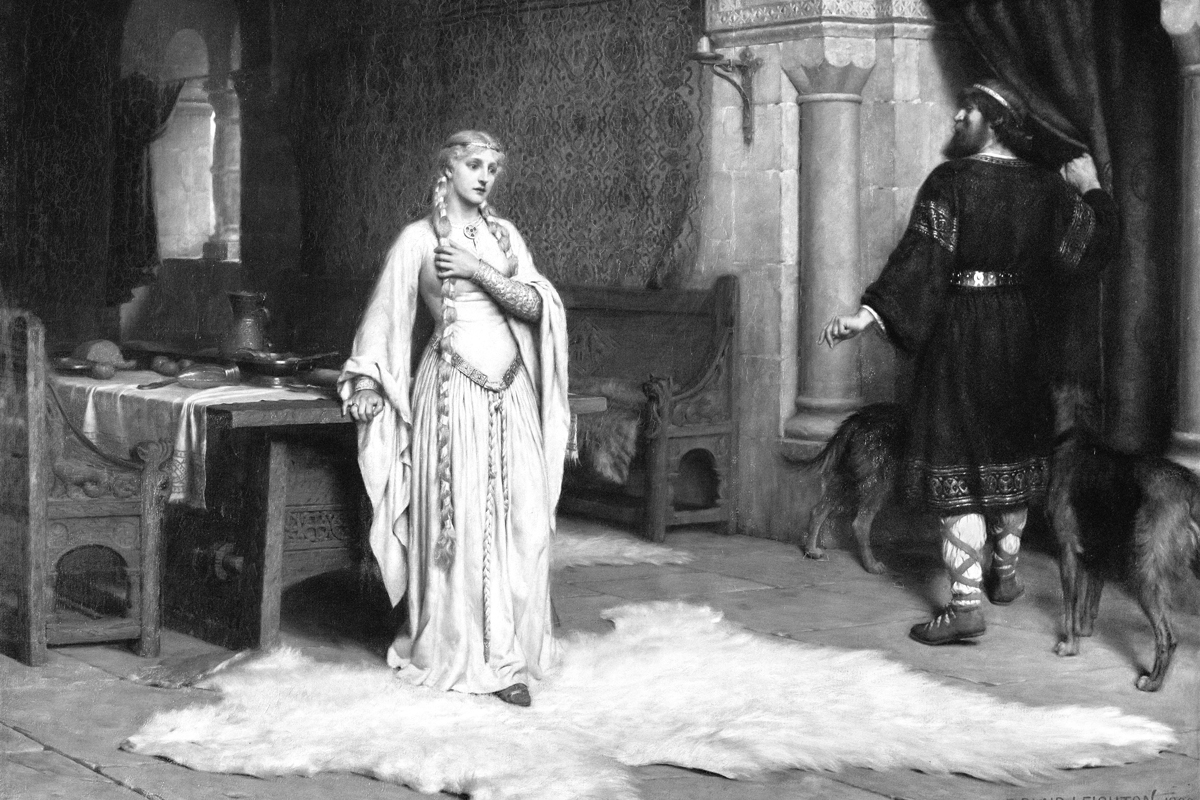
Britain is a land of countless myths and legends, including King Arthur and the Knights of the Round Table, Robin Hood and his band of Merry Men, and King Canute commanding the tide not to rise. Many of these staples of British folklore mix fact and fiction, blurring actual historical realities and often leaving readers somewhat confused as to which parts are based on truth.
The legend of Lady Godiva is no exception. It’s a compelling tale of noble sacrifice and protest that has captivated the public imagination for centuries. And it’s a tale that blends historical fact with creative embellishment, which has led historians to debate what exactly happened. The most pertinent question, of course, regards our central character, Lady Godiva. Was she real? Did she actually exist? And if she did, did she ride naked through the streets of Coventry? Let’s take a look at this enduring legend and sort the facts from the fiction.
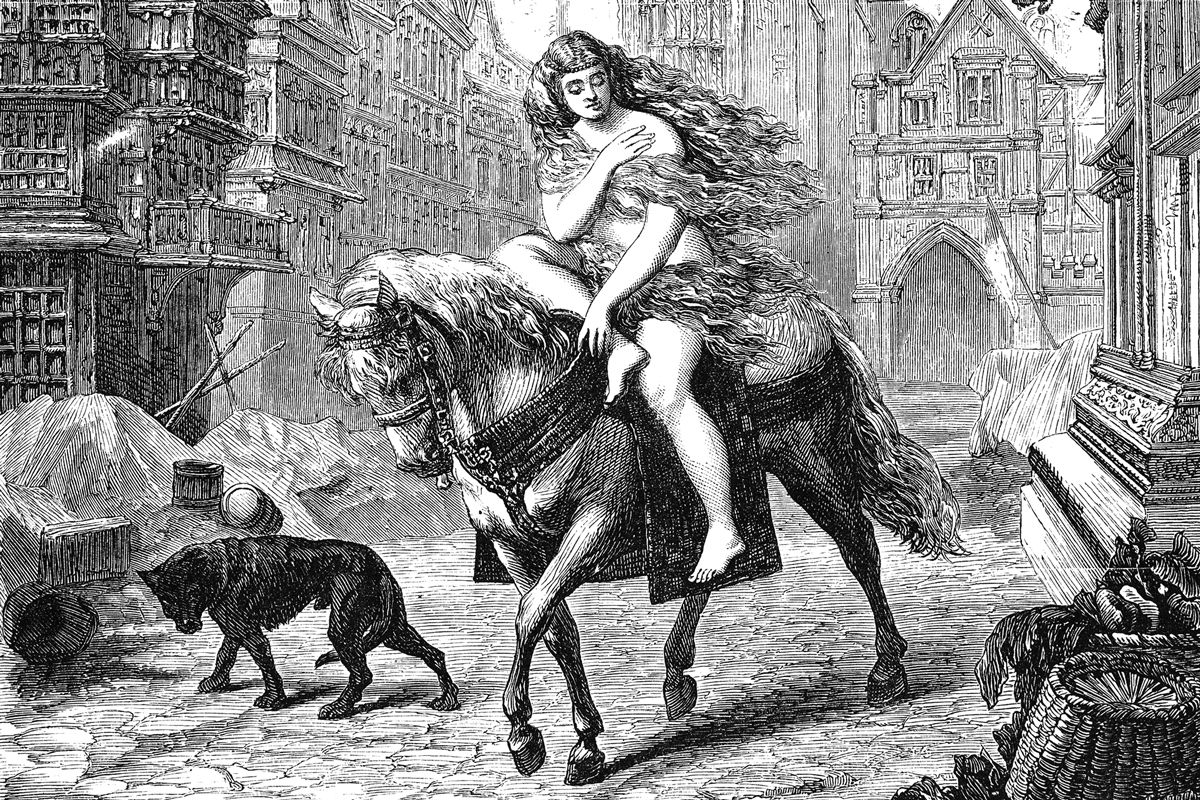
Lady Godiva’s Naked Horseback Ride
According to popular legend, Lady Godiva, an 11th-century Anglo-Saxon noblewoman, was disturbed by the heavy taxation that her powerful husband, Leofric, Earl of Mercia, had imposed on the citizens of Coventry, England. She repeatedly pleaded with him to reduce this burden on the townspeople. After numerous refusals, Leofric finally agreed to lower the taxes but only if his wife accepted what he considered an impossible condition: She would have to ride through the streets of Coventry in the nude.
Lady Godiva called her husband’s bluff and took up his challenge. She issued a proclamation that all citizens must remain indoors with their windows shuttered on the appointed day. She then mounted her horse, naked save for her famously long hair, which covered her body as she rode through the silent streets of Coventry. Impressed by his wife’s bravery and devotion to her people, Leofric kept his promise and abolished the oppressive taxes.
Later versions of the legend introduced another character who has endured to this day, and whose name has become a common expression in the English language: Peeping Tom. Tom, according to folklore, was a tailor who, unlike his fellow townsfolk, couldn’t resist looking at the beautiful Lady Godiva as she rode by his window. For this violation, he was allegedly struck blind instantly — a divine punishment for disrespecting Godiva’s noble sacrifice.
More from our network






The Real Lady Godiva
So did these events really take place? We can at least say for sure that Lady Godiva was unquestionably real. Her husband, Leofric, appears more often than Godiva in the historical record, and we know a fair amount about his life. He was a powerful earl who was influential in public affairs during the reign of King Canute, and he helped avert a civil war when he mediated between the quarreling Edward the Confessor and Earl Godwin in 1051.
Lady Godiva also appears in historical records, although her name is often written as “Godgifu,” the Old English form of Godiva, meaning “God's gift.” There’s less information about her life than Leofric’s, but we know she was a wealthy Anglo-Saxon noblewoman who lived during the mid-11th century. One of the most reliable pieces of evidence comes from the Domesday Book, William the Conqueror's great land survey of 1086. It lists Godiva as one of the few Anglo-Saxons, and one of the few women, to retain substantial landholdings after the Norman Conquest. This document confirms she held estates across Warwickshire and Leicestershire, including after Leofric’s death in 1057.
Thanks to a number of medieval chronicles, we also know that Leofric and Lady Godiva wielded considerable influence during the reign of Edward the Confessor — an Anglo-Saxon king and saint known for his piety — and that they were known as generous religious benefactors. The couple founded and endowed churches and monasteries, including the Benedictine monastery in Coventry around 1043. Around 1140 (after Godiva’s death sometime between 1066 and 1086), the English monk John of Worcester wrote this about the couple: “[Leofric] and his wife, the noble countess Godgiva, who was a devout worshipper of God, and one who loved the ever-virgin St. Mary, entirely constructed at their own cost the monastery there [in Coventry], well-endowed it with land, and enriched it with ornaments to such an extent, that no monastery could be then found in England possessing so much gold, silver, jewels, and precious stones.”
It’s important to note that none of these historic chronicles mentions any naked horse rides through Coventry. This silence around what would surely have been a remarkable event at the time suggests the legendary ride never happened.

An Enduring Legend
The first known written account of Lady Godiva’s naked ride appears in the chronicle of Roger of Wendover, a monk at St. Albans Abbey. In it, he presents the basic narrative that we’re familiar with today: Godiva’s pleas for tax relief, Leofric’s condition, and her subsequent ride that prompted him to abolish the onerous tax. However, the monk’s account was written sometime between 1215 and 1235, around 150 years after Lady Godiva’s death. The significant time gap between Godiva’s life and the first mention of her legendary ride is enough to raise questions about the story’s historical reliability.
Later accounts, such as that of the chronicler and Benedictine monk Ranulf Higden in the mid-14th century, added more details to the story. It was Higden who told how Leofric, after his wife’s ride, freed the town from all tolls except those on horses. The legend then continued to evolve over subsequent centuries. The character of Peeping Tom, for example, appears remarkably late, first mentioned in the 17th century.
These additions to the narrative show how the legend continued to develop long after Lady Godiva’s death. By the Victorian era, the story had become firmly entrenched in English culture, inspiring renowned paintings such as “Lady Godiva” by John Collier, and the poem “Godiva” by Alfred, Lord Tennyson.
Today, despite the enduring popularity of the Lady Godiva legend, most medieval scholars agree that the naked ride never took place. According to Daniel Donoghue, a Harvard professor and author of Lady Godiva: A Literary History of the Legend, the Benedictine monks at St. Albans developed the colorful narrative centuries after Lady Godiva’s death. As Donoghue put it, “Nobody knows quite why the legend was invented and attached to her name, but it does seem to function as a kind of myth of origin for the town of Coventry.”
Coventry still celebrates its connection to Lady Godiva with statues, annual festivities, and processions, showing its civic pride in a woman who appears to have been a remarkable historical figure. Regardless of whether she made her famous ride, Lady Godiva was a powerful woman whose philanthropic legacy endured even through the upheaval of the Norman Conquest.