


The Origins of the Beloved Teddy Bear

  • Teddy Bear with tag
Teddy Bear with tag
Credit: Hulton Archive via Getty Images
Author Nicole Villeneuve

April 16, 2024

Love it?

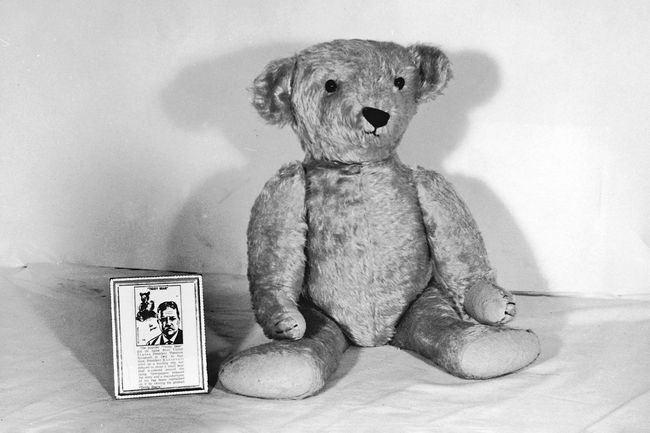
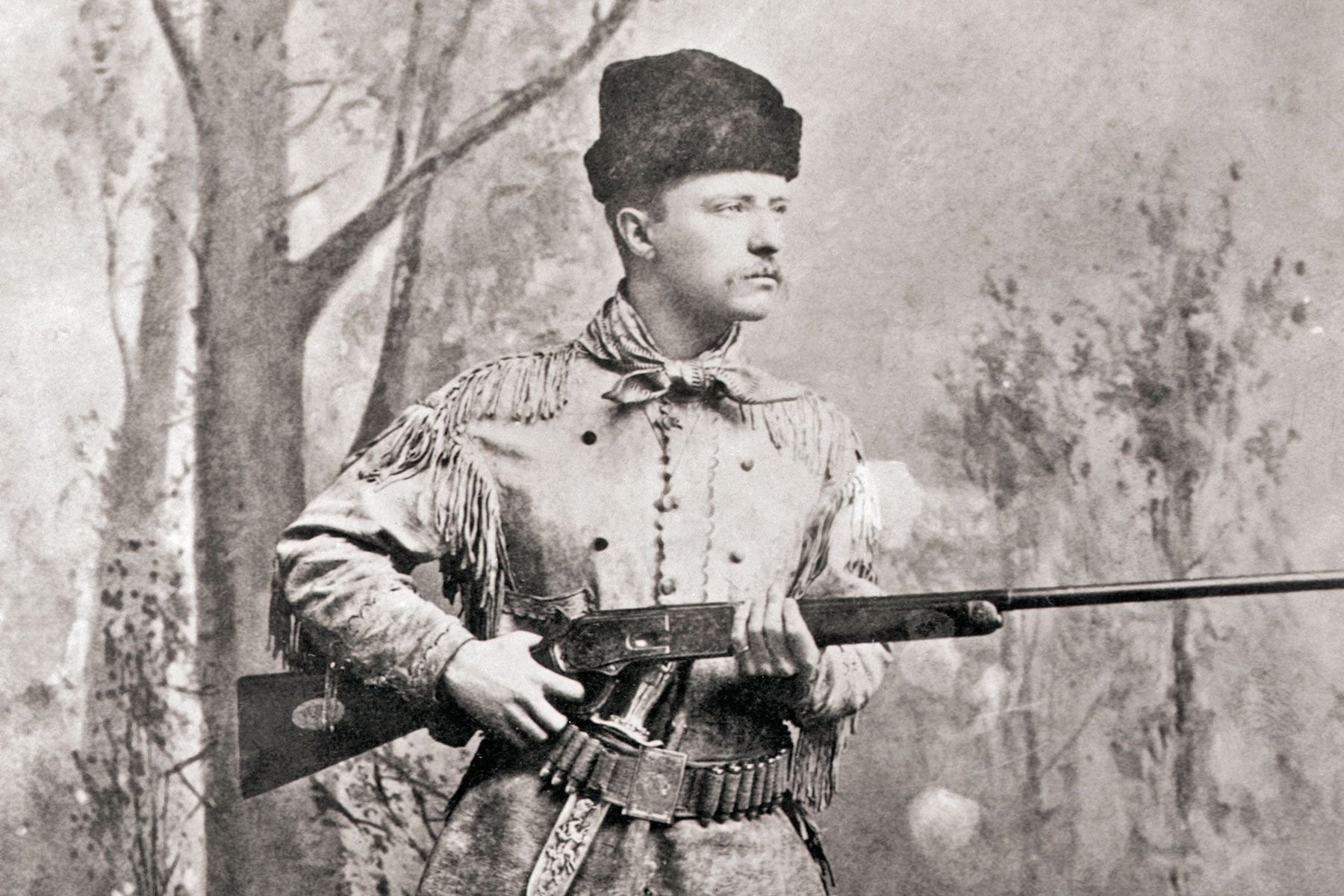
Theodore Roosevelt is known as the first conservationist President, having established national parks, wildlife refuges, and national forests during his time in the White House. It seems fitting, then, that one of the world’s most recognizable animal figures — the beloved teddy bear — was inspired by and named after the 26th U.S. President. 

Credit: Bettmann via Getty Images

In November 1902, Roosevelt joined Mississippi Governor Andrew H. Longino on a hunting trip in Mississippi. On the second day of the trip, Roosevelt’s aides — including guide Holt Collier, a skilled hunter in his own right — captured a bear, tied it to a tree, and presented it to the President, who was eager to start the trip off strong with a catch. Roosevelt, however, refused to shoot the restrained bear. He may have been an avid hunter, but he found it unsportsmanlike to harm a defenseless animal. 

The hunting incident attracted attention in the press. Washington Post cartoonist Clifford Berryman depicted Roosevelt refusing to shoot a small, tied bear in “Drawing the Line in Mississippi,” a cartoon that doubled as a commentary on the President’s handling of a state border dispute. The cute bear cub character became popular with Americans, and in the ensuing years, Berryman continued to use the bear as a symbol for President Roosevelt, who was commonly known as “Teddy,” short for Theodore.

You may also like

What Did People Use Before Toothbrushes?

  • Women brush their teeth
Women brush their teeth
Credit: Visual Studies Workshop/ Archive Photos via Getty Images
Author Bennett Kleinman

April 3, 2024

Love it?

Since the fourth millennium BCE, when urban civilizations first appeared in ancient Mesopotamia, humans have strived to achieve proper dental hygiene. Yet the nylon-bristled toothbrush we use today didn’t come along until the 1930s. For the thousands of years in between, people relied on rudimentary tools that evolved with scientific knowledge and technological advancements over time. Some of the earliest toothbrush predecessors date as far back as 3500 BCE. Here’s a look at how people kept their teeth clean before the modern toothbrush.

Credit: Glenn Losack MD/ Moment via Getty Images

Chew Sticks and Toothpicks

Sometime around the year 3500 BCE, the ancient Babylonians (located near modern-day Iraq) created a tool known as a “chew stick.” This simple, handheld piece of wood is considered the earliest known direct predecessor to the toothbrushes we use today. Chew sticks were simple wooden twigs cut to approximately 5 or 6 inches long. One end of the stick was then softened in boiling liquid to help separate the fibers, creating an almost brushlike effect. Individuals would chew on these sticks to freshen their mouths, as the frayed fibers would slide between the teeth and help loosen debris. Many early Arab cultures used a specific shrub called Salvadora persica (also known as the “toothbrush tree”) to create their chew sticks, which they called miswak. The shrub was particularly aromatic in nature and thought to have a stronger mouth-freshening effect than other plants.

Around this same time, civilizations in Mesopotamia, Egypt, and elsewhere in the ancient world also used early versions of a toothpick to keep their teeth clean. These were often made of thin pieces of wood, though in later years, wealthy individuals began crafting toothpicks from brass and silver for added opulence and durability. In ancient Greece, toothpicks were known as karphos, roughly meaning “blade of straw,” suggesting the Greeks may have used coarse fibers such as straw in addition to wood.
You may also like

The Fascinating History of Mail

  • Letters from the mail
Letters from the mail
Credit: sue hughes/ Unsplash
Author Kristina Wright

March 21, 2024

Love it?

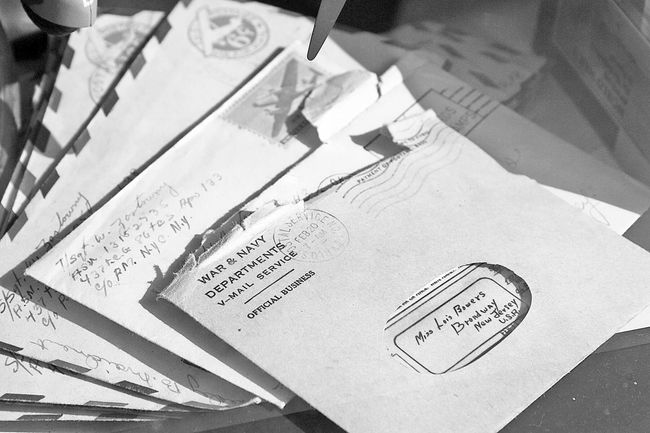
For many of us, sending and receiving mail is a routine part of our daily lives. But this seemingly mundane task has quite an interesting history. Postal systems have existed for nearly as long as humans have communicated through writing. Egypt holds the distinction of pioneering the earliest documented state-sponsored postal service, which dates all the way back to 2400 BCE, with the oldest known postal document dating back to 255 BCE. Initially used by pharaohs, emperors, and kings to disseminate information across their domain, postal systems eventually broadened their scope to transmit messages among religious and educational institutions. 

Relay stations were established along messenger routes to expedite the delivery of information across vast distances. As these systems evolved to become more efficient and inclusive, the opportunity to send messages via formal postal services was eventually made available to private individuals.

Since the earliest days of royal postal services, mail has been delivered via nearly all possible means: It’s been carried by couriers on foot, horse and wagon, mule, bicycle, train, steamboat, plane, motorcycle, and even dog sled. Here are more fascinating facts about the history of mail and how it has evolved over the centuries to keep us all connected.

Credit: Bettmann via Getty Images

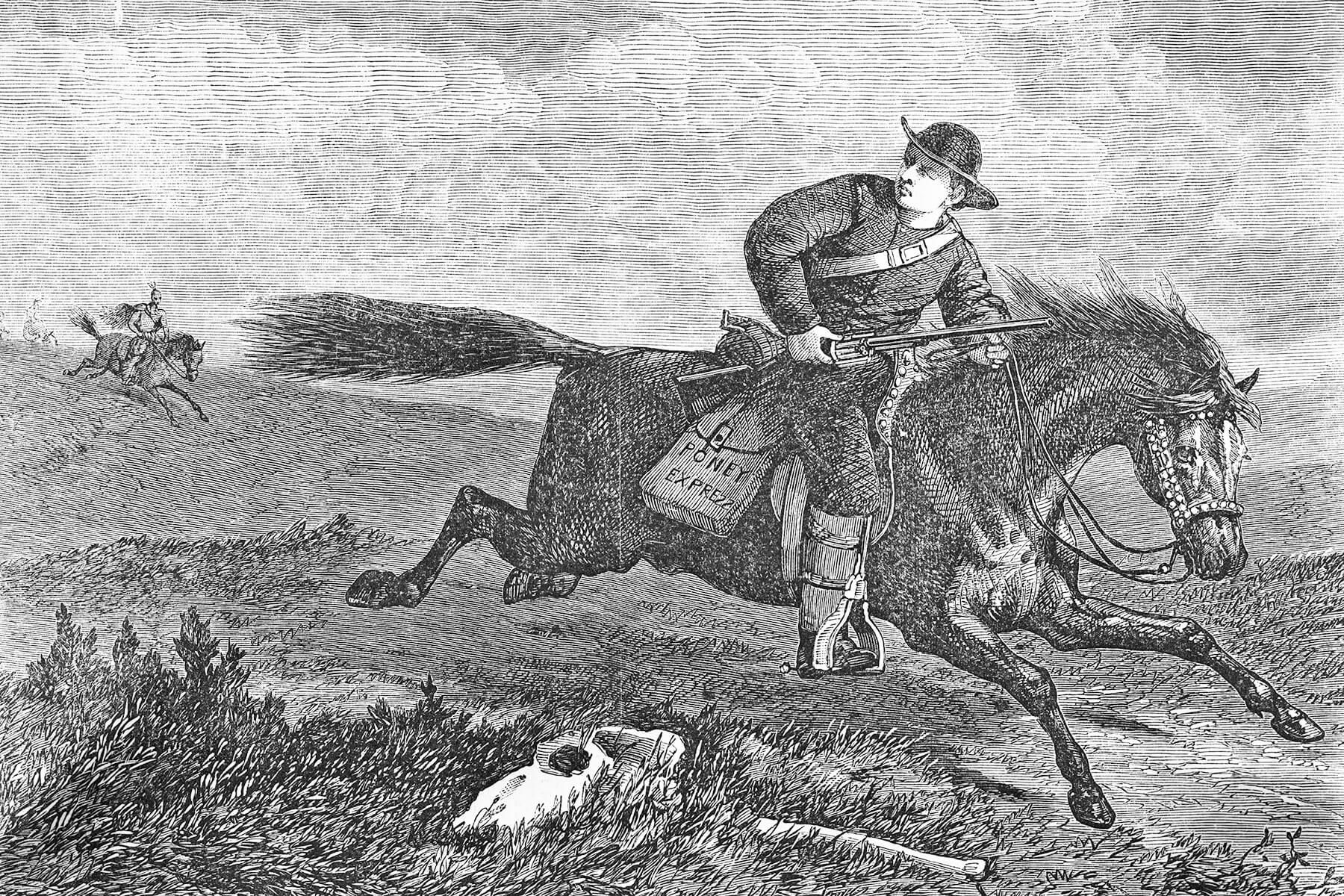
The Pony Express Operated for Just 18 Months

In the 1800s, mass migration westward via the Oregon Trail, the arrival of Mormon immigrants in Utah, and the California gold rush all played a role in the need for swift and reliable mail service beyond the Rocky Mountains. The Leavenworth and Pike’s Peak Express Company, which eventually became the parent company of the Pony Express, galloped in to fulfill this need in 1859.

Covering more than 1,900 miles in just 10 days, the Pony Express ran between St. Joseph, Missouri, and Sacramento, California. With horse-changing stations posted at 10- to 15-mile intervals along the route, each rider was able to cover an average of 75 to 100 miles before passing the reins to the next. 

However, it wasn’t long before the completion of the transcontinental telegraph system brought an end to the Pony Express. Although the equestrian delivery service looms large as an enduring symbol of the rugged American Old West, it really only ran from April 1860 to October 1861.

You may also like

What 6 Major State Capitals Looked Like 100 Years Ago

  • Nashville street in 1933
Nashville street in 1933
Chronicle/ Alamy Stock Photo
Author Mark DeJoy

February 14, 2024

Love it?

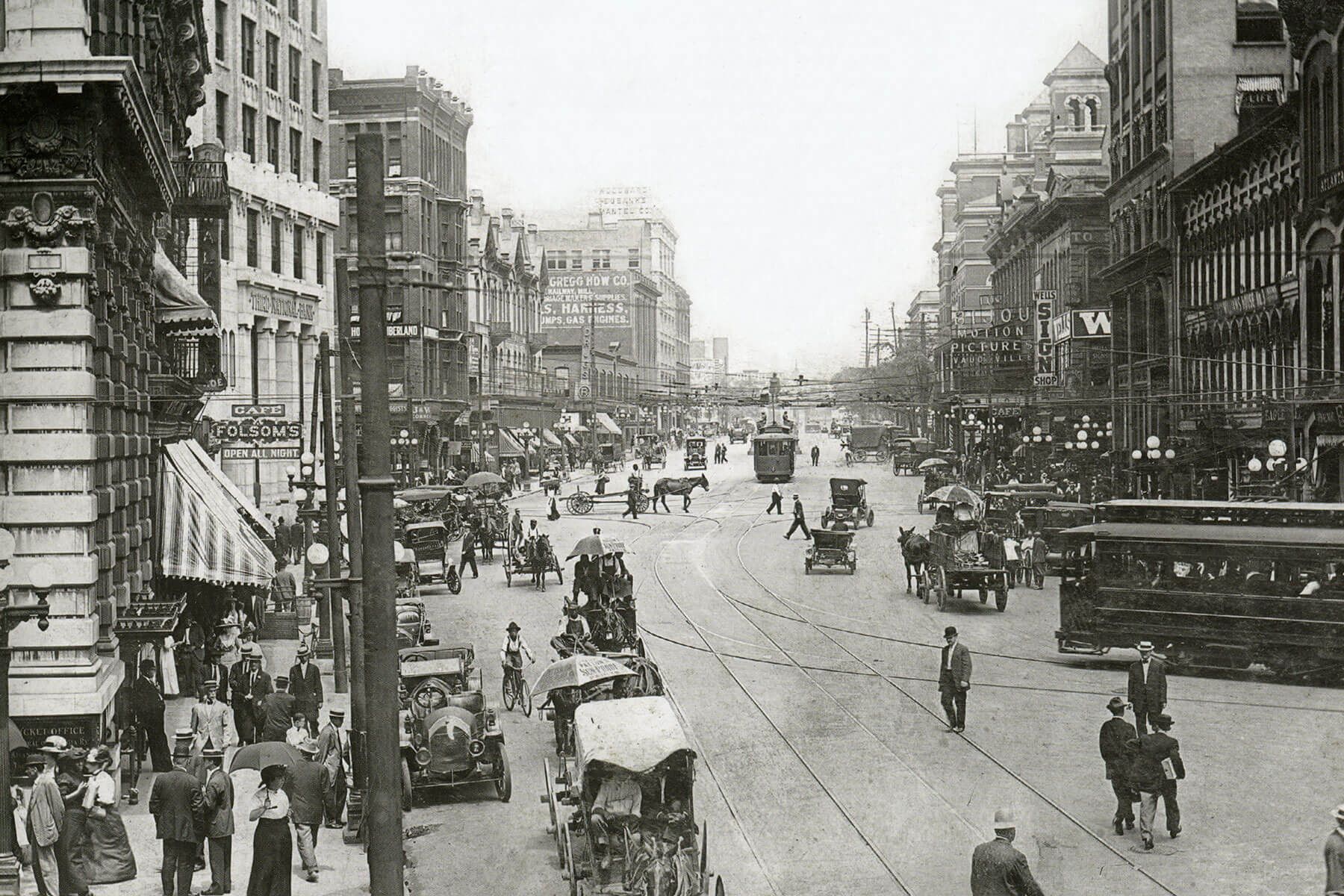
One hundred years is a long time in the life of a city. New technologies emerge and wane, people come and go, cultural factors ebb and flow. But not all cities change at the same rate; some stay comparatively similar to their older incarnations, while others become drastically different. Here’s a glimpse at what a few iconic state capitals looked like a century ago.

Credit: Buyenlarge/ Archive Photos via Getty Images

Atlanta, Georgia

Atlanta was named after the Western and Atlantic Railroad, for which it was a terminus. In the early 20th century, the city was well established as a major railway hub, and the downtown was built around its first train station. Hotels were concentrated in an area near the station (called, fittingly, Hotel Row) in order to serve train travelers, and by the 1920s, masonry high-rises created the city’s skyline.

Like many cities during this period, Atlanta was beginning to expand its roads in order to accommodate increasing numbers of cars. In the 1920s, the city built three major viaducts to allow traffic to bypass the high number of railroad crossings. The Central Avenue, Pryor Street, and Spring Street (later renamed Ted Turner Drive) viaducts not only improved vehicle safety, but also led to development outside the city’s downtown core. 

You may also like

7 Things You Would Find on a City Street 100 Years Ago

  • Model T Fords at beach
Model T Fords at beach
Minnesota Historical Society/ Corbis Historical via Getty Images
Author Tony Dunnell

December 20, 2023

Love it?

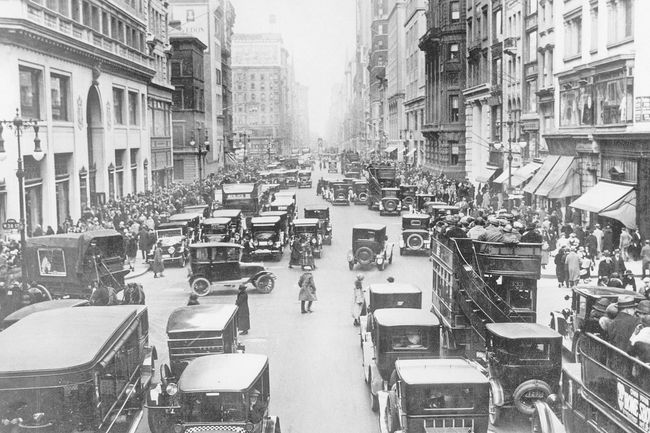
If we could travel back 100 years and land on a typical city street, we’d probably be mightily discombobulated. Some things would seem familiar: the buzz of the urban environment, people walking this way and that, and buildings with facades that could well still exist today. But looking around, we’d soon realize that we weren’t in Kansas anymore — or if we were, it would be Kansas City in the 1920s. 

A century ago, America was going through a monumental change. For the first time in U.S. history, more people were living in urban areas than in rural areas. The cities were booming, and for many middle-class Americans, the 1920s were a decade of unprecedented prosperity. People were earning more and spending more, advertising had reached new levels of sophistication, and the automobile was changing the way we live. 

So, before you step into that time machine, you’d better brace yourself. Here are seven things you’d find in a city street a century ago, back in the dizzying days of the Roaring ’20s. 

Photo credit: DEA / BIBLIOTECA AMBROSIANA/ De Agostini via Getty Images

Incandescent Street Lights

Before the development of practical light bulbs, street lights typically used piped coal gas, oil, or kerosene as fuel. The first electric streetlights were installed in Paris in 1878, but these used unwieldy and harsh arc lamps. Then came inventors such as Joseph Swan in the U.K. and Thomas Edison in the U.S., both of whom patented revolutionary incandescent light bulbs in 1880. Incandescent street lamps became the norm in many cities throughout the world, and the 1920s saw a wave of patents filed for innovative new street lighting. These electric lights, however, were often placed where they were needed rather than lining a whole street. So, 100 years ago, a city street at night would not have been as brightly lit as it is today, and pedestrians would often find themselves walking from one pool of yellowish light to the next. 

You may also like

6 Inventions That Came Out of the Victorian Era

  • Bike pneumatic tires
Bike pneumatic tires
Print Collector/ Hulton Archive via Getty Images
Author Tony Dunnell

December 14, 2023

Love it?

Queen Victoria ruled Britain from 1837 until her death in 1901. Her reign of 63 years and 216 days was longer than that of any of her predecessors, and was exceeded only by Elizabeth II’s time on the throne. This period, known as the Victorian era, saw the British Empire expand to become the first global industrial power. 

Fueled by the industrial revolution that began the previous century — which reshaped almost every existing sector of human activity — the era saw many breakthroughs in the arts and sciences (perhaps most notably, Charles Darwin’s theory of evolution) as well as great social change and political reforms. And, as people from the countryside began to move to urban industrial hubs in search of work, there was a rise in both education and affluence, further driving the wave of ideas and innovation.

Victorian-era Brits were avid inventors, and many of the creations from this time had a major impact not only in Britain but across the globe. That’s not to say that all Victorian innovations were a hit. The hat cigar holder, ventilating top hat, anti-garroting cravat, reversible trousers, and “corset with expansible busts” all rank among the less successful ideas. These failures, however, were far outweighed by the era’s many influential developments, some of which laid the foundation for our modern age, and are still used every day. Here are some of the greatest innovations of the Victorian era, from the telephone to the electric light bulb. 

Photo credit: Science & Society Picture Library via Getty Images

Telephone

Scottish-born inventor Alexander Graham Bell is considered the father of the telephone, but a degree of controversy remains over who exactly invented the world-changing device. The American electrical engineer Elisha Gray filed a patent on the exact same day as Bell, in Washington, D.C., on February 14, 1876. We’ll never quite know how things played out in the patent office, but Bell’s documents were filed first, and he was awarded the patent on March 7. A few days later, he made the first-ever telephone call. He called his assistant, Thomas Watson, with the now-famous words, “Mr. Watson, come here. I want you.” 

Bell, who had lived in Boston since 1871, was keen to introduce his invention to Britain, where, as a young man, he had received an expansive Victorian education in Scotland and London, and where he first began his experiments in sound. In August 1877, he toured Britain with his wife Mabel (it was supposed to be their honeymoon), promoting his invention as he went. He even  demonstrated the newly invented telephone to Queen Victoria herself, who was so impressed she asked to keep the temporary installation in place.

You may also like

History’s Most Ingenious Engineering Marvels 

  • The Great Wall of China
The Great Wall of China
William Olivieri/ Unsplash
Author Tony Dunnell

December 7, 2023

Love it?

Our planet is home to many talented engineers. Termites, for example, build complex structures that rise up to 10 feet in height, their “bricks” bonded by bio-cementation. Spiders, meanwhile, weave intricate webs, which, like suspension bridges, are capable of bearing heavy loads in even the stormiest weather. Then there are beavers and their well-engineered dams, bees and their cellular hives, and industrious ants whose largest recorded contiguous colony stretches a truly incredible 3,700 miles. 

Humans, of course, are in a league of their own when it comes to construction. For millennia, we have been building structures of awesome size and complexity: roads and bridges, cathedrals and stadiums, tunnels and skyscrapers. Among the innumerable structures built by humankind, some stand out for their sheer size and magnificence. Here are six of the greatest engineering marvels in history.

Photo credit: William Olivieri/ Unsplash

The Great Wall of China

The Great Wall of China is widely considered one of the greatest engineering feats of all time. Built continuously from the third century BCE to the 17th century CE, this series of walls and natural barriers stretches for around 13,000 miles. (Still, despite a persistent myth, it is not visible from the moon or space, at least not with the naked eye.) The Great Wall was originally the idea of Emperor Qin Shi Huang, the founder of the Qin dynasty and the first emperor of a unified China, who wished to protect the country from barbarian attacks from the north. 

Under his orders, many older, unconnected state walls and fortifications were removed and a number of existing walls were joined into a single system stretching from the eastern Hebei province to Gansu province in the west. The wall itself was 15 to 30 feet high, topped with ramparts of at least 12 feet, with guard towers distributed at regular intervals. Much of the Great Wall that we now see was constructed during the powerful Ming dynasty, starting from around 1474. Today, the most famous and iconic section of the Great Wall of China is located 43 miles northwest of Beijing. This section was rebuilt in the late 1950s and now attracts thousands of tourists every day.

You may also like

6 Inventions Often Credited to the Wrong Person

  • Telescope, circa 1620
Telescope, circa 1620
Hulton Archive via Getty Images
Author Tony Dunnell

November 9, 2023

Love it?

There’s nothing more frustrating than working your socks off only to see someone else get all the credit for your efforts. Spare a thought, then, for the minds behind some of history’s most significant innovations, who, despite months, years, or in some cases lifetimes of work, find someone else’s name ignominiously attached to their invention. 

Sometimes inventions are miscredited in the public consciousness simply because a more famous name becomes associated with the creation. For example, Thomas Edison and Henry Ford — two of modern history’s most well-known innovators — are often credited with things they didn’t actually invent, through no fault of their own. Then there are the more insidious misattributions. In some instances, an idea has been copied or outright stolen, robbing the true inventor of their glory; in others, a more senior or prominent member of a team is given credit despite not coming up with the original idea. See, for example, the Matilda effect, in which notable discoveries made by women have often been misattributed to the men they worked with. 

Here are some notable inventions in history that are frequently credited to the wrong person, from the flush toilet to the iPod. 

Photo credit: FLHC SP2/ Alamy Stock Photo

The Flush Toilet

No name in the history of toilets is more famous than that of plumber Thomas Crapper, partly because his name appeared on the once-ubiquitous Crapper brand of toilets, and partly because Crapper is a humorously appropriate name for a toilet (the slang word “crap” existed before Thomas Crapper). Crapper, however, did not invent the flushing device with which he is so associated. He did patent the U-bend and floating ballcock — key components of the modern toilet — in the late 1880s, but he never held a patent for the flush toilet. Much earlier, in 1596, John Harington, an English courtier and the godson of Queen Elizabeth I, described what can be considered the first flush toilet, which involved a 2-foot-deep bowl and a massive 7.5 gallons of water per flush. (Only two working models were made, one in Haringon’s own home and one in Queen Elizabeth’s palace.) The first patent for a flushable toilet was granted to the Scottish inventor Alexander Cumming in 1775. 

Photo credit: Bettmann via Getty Images

The Telescope 

The Italian polymath Galileo Galilei is often credited with inventing the telescope, and it’s easy to see why. He gave birth to modern astronomy with his telescope-assisted discoveries about our moon, the moons of Jupiter, and other celestial bodies. Galileo made his first telescope in 1609 after hearing about the “perspective glasses” being made in the Netherlands. But the first person to apply for a patent for a telescope was Dutch eyeglass-maker Hans Lippershey in 1608, a year before Galileo. His telescope could magnify objects only three times, but it was nonetheless a landmark in the history of optics. (By comparison, by the end of 1609, Galileo had developed a telescope that magnified objects 20 times.) Whether Lippershey should be credited as the inventor of the telescope remains an open debate, as it is entirely possible that others created similar devices before he filed his patent. 

You may also like

7 Fascinating Facts From the History of the World’s Fair

  • 1964 world’s fair view
1964 world's fair view
Bettmann via Getty Images
Author Paul Chang

October 24, 2023

Love it?

The first world’s fair, known as the Great Exhibition, took place in London in 1851. Held in the Crystal Palace — a massive exhibition hall made of glass and iron — the fair displayed marvels of industry and science as well as works of craftsmanship and art from around the world. Since then, more than 100 world’s fairs have been held in over 20 countries, and countless inventions have made their debut at these massive events, from the telephone to cotton candy. Though the world’s fair has declined in popularity in the United States, it remains popular throughout much of the rest of the world. Here are seven highlights from the history of these fascinating exhibitions.

Photo credit: Bettmann via Getty Images

One Fair Sparked a Frenzy for Plastic Pickles

The 1893 World’s Columbian Exposition in Chicago (named in honor of Christopher Columbus) was ripe with opportunity for food sellers. But H.J. Heinz — an American purveyor of pickles and ketchup — was frustrated with his booth placement. While the main floor showcased food exhibits from Germany, Great Britain, Mexico, and other nations, Heinz was stuck on the second floor where there was little foot traffic. He devised a marketing plan that promised a free prize to anyone who visited his booth: a small green plastic pickle pin. The pins were a massive hit; the crowds that flocked to his booth were so large that the floor reportedly sagged around the display. By the end of the exhibition, Heinz had given away more than 1 million pickle pins, paving the way for his brand to become a household name.

Photo credit: Library of Congress/ Corbis Historical via Getty Images

Baby Incubators Started as a Carnival Attraction

The baby incubator — a lifesaving device in which premature or sick infants can develop — was invented in the 19th century by French obstetrician Stéphane Tarnier, who got the idea after seeing baby chicks being incubated at a zoo. The invention was widely adopted decades later, thanks to the work of two men, Pierre Budin and Martin Couney. Determined to popularize the groundbreaking technology, Budin and Couney displayed six incubators complete with real premature babies at the 1896 Great Industrial Exposition of Berlin, in an exhibit they dubbed “Child Hatchery.” The exhibit was so popular that Couney went on to set up a permanent exhibit in an unlikely location: the Coney Island amusement park in New York. For the next four decades, Couney managed a neonatal intensive care unit that saved thousands of babies while doubling as a carnival attraction. Despite not being a licensed doctor, Couney is now widely credited with the adoption of the baby incubator into mainstream medicine.

You may also like

7 Innovations That Came Out of World War II

  • Penicillin vials
Penicillin vials
Anthony Potter Collection/ Archive Photos via Getty Images
Author Tony Dunnell

August 31, 2023

Love it?

It’s often said that wars bring about a wave of innovation — necessity being the mother of invention, as the old adage goes. In reality, that’s not necessarily true. According to some studies, there tends to be a significant decline in inventiveness immediately after the outbreak of a war, followed by a marked surge, the net result being a fairly standard rate of innovation overall. Creation through necessity or even desperation certainly happens, but prosperous, peaceful, and free societies tend to be just as inventive, if not more so.  

That said, plenty of technological innovation took place during World War II, especially in fields that had military applications. Here are some of the most pivotal, successful, and enduring inventions to come out of the war, from handy tools used by millions of people to miracle drugs that have saved countless lives.

Photo credit: valerii vysotkov/ Shutterstock

Duct Tape

In 1943, Vesta Stoudt, an Illinois woman with two sons serving in the U.S. Navy, was working in an ordnance plant when she noticed a problem with the ammunition boxes she was packing. The boxes were sealed with paper tape with a tab to open them, but this tab could easily tear off, leaving soldiers potentially scrambling to open the boxes in life-threatening situations. So, Stoudt came up with the idea of a waterproof fabric tape with which to seal the boxes — an idea she sent to none other than President Franklin D. Roosevelt. Impressed, the President sent her letter to the War Production Board, which soon came up with what we now know as duct tape. Not only was it easy to apply and remove on ammo boxes, but it also turned out to be endlessly handy for quickly repairing military equipment, including vehicles and weapons. 

Photo credit: zef art/ Shutterstock

Radar

The fundamental principle underlying modern radar (which is actually an acronym for “radio detection and ranging”) was first observed in 1886 by physicist Heinrich Hertz, who found that electromagnetic waves could be reflected from various objects. It was during World War II, however, that modern, practical radar was developed. Britain had already established a chain of radar stations along its south and east coasts by the outbreak of the war, allowing for the detection of enemy aircraft at a range of 80 miles. The British then invented the cavity magnetron in 1940, paving the way for far more compact, powerful, and sensitive radar units (and, as it happens, microwave ovens). 

You may also like