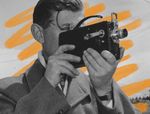

J.R.R. Tolkien worked on the Oxford English Dictionary.

  • J.R.R. Tolkien
J.R.R. Tolkien
Album/ Alamy Stock Photo
Author Darren Orf

August 17, 2023

Love it?

John Ronald Reuel Tolkien is the grandfather of modern fantasy; his books The Hobbit and The Lord of the Rings formed the foundation of the genre. But before the renowned writer and philologist crafted the world of Middle-earth, he spent some time working on another vital text, the Oxford English Dictionary. After being discharged from the British army due to illness, he got a job on staff at the OED from 1919 to 1920. During that time, he worked on words near the beginning of the “w” section, from “waggle” to “warlock.” (Tolkien might’ve been assigned this section because many “w” words, including “walnut,” “walrus,” and “wampum,” have difficult etymologies.) The famous author once said that he “learned more in those two years than in any other equal period of my life.”

Although Tolkien’s tenure at the preeminent dictionary was a short one, his influence on linguistic tome continued for years to come. In 1969, when an OED editor reached out to Tolkien for comment on the addition of the word “hobbit” to the dictionary, the author responded with a definition twice as long as the original — the dictionary printed Tolkien’s version almost verbatim.  The OED eventually added many more words from Tolkien’s famous high fantasy series — including gems such as “mithril,” “Orcish,” and “troll.” 

Paul Revere never actually shouted, “The British are coming!”

  • Paul Revere in Lexington
Paul Revere in Lexington
North Wind Picture Archives/ Alamy Stock Photo
Author Adam Levine

August 17, 2023

Love it?

In the popular imagination of many Americans, few aspects of the Revolutionary War are more iconic than the event that came to be known as “Paul Revere’s midnight ride.” On the evening of April 18, 1775, the Patriot leader rode from Boston to Lexington, Massachusetts, warning the rebelling colonists that British soldiers stationed in Boston were planning to march into the countryside surrounding Lexington and Concord. However, while Revere’s midnight ride was, in fact, a significant moment in the American Revolution, some details that found their way into the popular retelling have been subject to a bit of dramatic embellishment. Namely, Revere never actually shouted the now-legendary warning, “The British are coming!” In fact, if he had shouted this, it would have been detrimental to his mission.  

For one, at the time, colonists still considered themselves to be British subjects, and although they were rebelling against the British crown, American revolutionaries did not consider “the British” to be a separate, hostile nation. What’s more, as a known revolutionary agent riding through a region full of British troops, Revere needed to complete his ride with as much discretion as possible. His actual journey was one of secrecy and narrow escapes, including a clandestine boat ride across the Charles River, during which he narrowly avoided capture from a British patrol ship before continuing his covert ride by horseback on the other side of the river. Revere did deliver crucial warnings about the British military’s impending advance on Lexington, but these warnings were quietly given to revolutionaries at individual households along his route.

In 1973, Jimmy Carter reported seeing a UFO.

  • President Jimmy Carter
President Jimmy Carter
Keystone Press/ Alamy Stock Photo
Author Michael Nordine

August 23, 2023

Love it?

In addition to having one of the most remarkable post-White House lives of any president, Jimmy Carter had one of the most interesting trajectories toward the Oval Office. That includes not only being a peanut farmer but also reporting seeing a UFO in 1973, at which time he was governor of Georgia and three years away from being elected to the nation’s highest office. The actual sighting took place in 1969, while Carter was visiting the Lions Club in Leary, Georgia. In his report, he wrote that “a kind of green light appeared in the western sky. This was right after sundown. It got brighter and brighter. And then it eventually disappeared. It didn’t have any solid substance to it, it was just a very peculiar looking light. None of us could understand what it was.”

An amateur astronomer with a strong knowledge of physics stemming from his time in the U.S. Navy’s nuclear submarine program, Carter insisted that what he saw wasn’t Venus, as some skeptics suggested, and that 10 to 12 others witnessed it as well. He also vowed to encourage the government to release “every piece of information” about UFOs to the public if he were to become president, though he ultimately opted not to do so for fear that the information could have “defense implications” that might risk national security.

The fall of the Berlin Wall was partly due to a bureaucratic mistake.

  • Crowd at the Berlin Wall
Crowd at the Berlin Wall
Joanna Kearney/ Alamy Stock Photo
Author Michael Nordine

August 23, 2023

Love it?

The Berlin Wall stood for 28 years, separating East and West Berlin from 1961 to 1989. Had it not been for a bureaucratic mistake, it might have stood a little longer. Facing mounting pressure, East Germany announced on November 9, 1989, that its citizens could begin visiting the West, though the policy wasn’t meant to take immediate effect. Instead, it was supposed to be rolled out gradually and involve a visa application. However, that’s not what an unprepared politburo member named Günter Schabowski said when asked at a press conference that evening about the timeline for East Germans to begin their visits — his answer was “immediately, without delay.” 

Excited by the news, thousands of East Germans descended on the wall to both celebrate and make the crossing they’d been waiting so long for. This was especially overwhelming to Harald Jäger, a guard at the Bornholmer Strasse checkpoint. Receiving little in the way of helpful guidance from his superiors and faced with a growing crowd — to say nothing of the fact that he was waiting on results of a cancer test — he opened the gate. Other checkpoint guards did likewise, and this vital part of the Iron Curtain was finally torn down.

The first official presidential aircraft was nicknamed the “Sacred Cow.”

  • FDR’s “Sacred Cow” plane
FDR's "Sacred Cow" plane
Everett Collection Historical/ Alamy Stock Photo
Author Adam Levine

August 23, 2023

Love it?

Today, the airplane carrying the U.S. president is known as Air Force One, but the original presidential aircraft had a slightly more colorful name: the Sacred Cow. The plane was specially designed for Franklin D. Roosevelt to meet the president’s increased needs for international travel during World War II. Though it was officially named the Flying White House, the White House press corps began calling the aircraft the “Sacred Cow,” a name inspired by the heavy security that was dedicated to keeping the plane and its VIP passengers safe. The Sacred Cow featured a conference room, windows made of bulletproof glass, and an elevator so that Roosevelt, who used a wheelchair, could easily board and deplane. For added convenience, the elevator even lifted the President directly into a private office on the plane. Although the aircraft had been customized for his personal use, Roosevelt ended up flying on the Sacred Cow just one time, when he used it in 1945 to fly to the Yalta Conference, a wartime meeting in Crimea during which Roosevelt, British Prime Minister Winston Churchill, and Soviet Premier Joseph Stalin discussed the final stages of World War II and the future of the postwar world.

Roosevelt’s successor, President Harry Truman, continued to use the Sacred Cow from 1945 to 1947, at which point the aircraft was reassigned for other functions before being officially retired in 1961. Notably, Truman was flying on the Sacred Cow when he signed the National Security Act of 1947, which established the Air Force as an official, independent department of the U.S. military — the Sacred Cow has even been called the “birthplace of the Air Force.” The call sign “Air Force One” was first used to identify the presidential airplane in 1953, and the term became the official designation in 1962.

Thomas Edison wanted the Statue of Liberty to talk.

  • Statue of Liberty
Statue of Liberty
AXP Photography/ Unsplash
Author Bennett Kleinman

August 29, 2023

Love it?

Thomas Edison revolutionized the audio world in 1878 when he obtained a patent for his latest invention, the phonograph. The audio player was designed for at-home use, but Edison also had larger-than-life plans for the product, in a very literal sense: He aspired to install a massive phonograph inside the Statue of Liberty to make Lady Liberty capable of speech. Edison revealed his intent to design a “monster disc” to produce audible messages, to make it sound as if the statue were uttering the words herself. He informed reporters that the phonograph could not only be used to alert ships during heavy fog, but also, if amplified properly, create a loud enough sound to produce words that could be heard as far as northern Manhattan and across New York Harbor. Despite Edison’s optimistic and ambitious ideas, the project never came to fruition, and the statue remained silent.

While Edison failed in making Lady Liberty talk, he succeeded on a much smaller scale by creating the first talking doll toy. In April 1890, Edison’s factory produced a set of 22-inch-tall dolls with miniature phonographs embedded in the torso. Some 500 were sold. Unfortunately, the dolls were returned in droves, as their fragile voice boxes were easily destroyed upon being played with. What’s more, the dolls sang songs such as “Twinkle, Twinkle Little Star,” but the sound was eerie and distorted due to the rudimentary phonographic technology. The toy was a massive flop for Edison, though it inspired future generations of successful talking dolls.

The U.S. Army created a “Ghost Army” to deceive the Germans in WWII.

  • U.S. Army in battlefield
U.S. Army in battlefield
Credit: Johncairns/ iStock
Author Rachel Gresh

February 27, 2024

Love it?

At first glance, the base of the U.S. “Ghost Army” would have resembled a movie set, with artists painting dummy airplanes, actors reciting fake radio broadcasts, and soundtracks playing on repeat. But this was a real World War II military operation, officially known as the 23rd Headquarters Special Troops. It had one mission: to trick German intelligence by any means necessary. The first of its kind, the 1,100-person covert unit was a mix of artists, radio broadcasters, sound engineers, actors, architects, and, of course, professional soldiers. This special unit staged no fewer than 22 deceptions in some of the most volatile areas of Europe between January 1944 and the end of the war in 1945. 

The Ghost Army operated near the front lines. They set up dummy artillery on Omaha Beach following D-Day, erected dozens of fake tanks to inflate troop numbers during sieges, and helped draw German forces away from General George Patton’s troops during the Battle of the Bulge. Sometimes, the con artists took their acting talents into local bars and cafés, spouting off inaccurate information for German spies to take back to their commanders. Loudspeaker broadcasts of military drills and rumbling tanks (which could be heard from 15 miles away) gave the illusion of massive numbers of troops. The army’s deception skills allowed them to mimic forces of 40,000 men, misleading German intel. By some estimates, these ploys saved the lives of up to 30,000 American troops. However, it wasn’t until recently that these heroic efforts were brought to light. Military records of the Ghost Army weren’t declassified until the mid-1990s, and it wasn’t until 2022 that the 23rd Headquarters Special Troops were awarded the Congressional Gold Medal for their role in the Allied victory.

Hurricanes used to only be named after women.

  • Hurricane the Atlantic
Hurricane the Atlantic
Credit: Elen11/ iStock
Author Kerry Hinton

August 7, 2024

Love it?

Before the 20th century, there was no uniform method for naming hurricanes in the U.S., though some other parts of the world saw creative naming conventions. Residents of the West Indies, for example, named hurricanes after patron saints. And 19th-century British meteorologist Clement Wragge used characters from Greek and Roman mythology, as well as the last names of his political enemies, for typhoons in the Pacific Ocean. He also began a tradition that eventually made its way across the Atlantic: using women’s names for hurricanes.

Until the 1940s, hurricanes in the U.S. were generally referred to simply by the year and/or place they occurred, such as the “Great Miami Hurricane of 1926.” That changed during World War II, when Navy and Air Force meteorologists began to name the tropical storms they tracked after their girlfriends and wives for easier reference. For a time, the U.S. military also experimented with naming storms after its phonetic alphabet — Able, Baker, Charlie, and so on — but this was replaced with a system thought to be less confusing and easier for the public to remember. In 1954, the National Weather Bureau chose to use women’s names as the standard for hurricanes; that year saw Alice, Barbara, Carol, and others. 

But why women’s names, specifically? The decision was partially inspired by the trend that began during the war, though it was also rooted in sexist stereotypes about the temperamental nature of women. The practice continued in the U.S. until the 1970s, when members of the women’s movement spoke out against the negative characterization of women that pervaded every facet of society, including storm-naming. In 1979, the National Weather Service and the World Meteorological Association changed the naming convention to include an even split of women’s and men’s names, using six groups of 26 names that rotate annually.