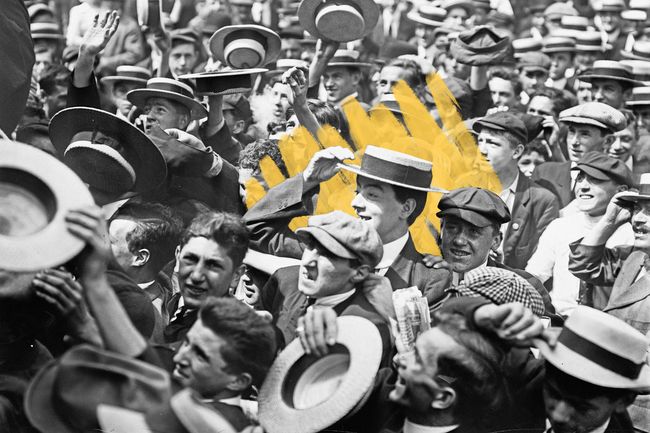



During World War II, people ate mock bananas made from parsnips.

  • Little girl eating a banana, 1945
Little girl eating a banana, 1945
Credit: © PA Images/Alamy
Author Bess Lovejoy

March 26, 2026

Love it?

In 1940, as Britain endured the Blitz and struggled under strict food rationing, one unexpected loss loomed large in the national imagination: the banana. Before the war, the island imported roughly 20 million tons of food a year, including most of its fruit. But when German naval attacks threatened supply routes — and refrigerated ships were diverted to military use — the Minister of Food ordered a complete halt to banana imports. For many children, who had grown up with the fruit as a sweet staple, the ban felt especially cruel.

Enter Marguerite Patten, a home economist hired by the Ministry of Food to teach Brits how to cook under wartime constraints. Patten became famous for her “mock” recipes — mock sausages made with lentils, mock oyster soup built on artichokes, and, notably, mock bananas.

Her substitute relied on a humble root vegetable: the parsnip. Boiled or roasted until soft, then mashed with sugar and a splash of artificial banana essence, the mixture took on a surprisingly banana-like texture and taste (though it was still far from the real thing). Some thrifty cooks even tinted the result yellow. Children who had never tasted a real banana often believed the ruse; adults tended to be less convinced. One wartime diarist recalled her husband eagerly devouring the treat — until he learned the truth and refused to eat it again.

When the first postwar shipment of bananas — 5 million of them — arrived in 1945, the country staged a celebratory parade. Children were the first allowed a taste. After years of ersatz fruit fashioned from parsnips, the real thing was nothing short of magical.

The U.S. government paid farmers not to grow crops.

  • Farmers wait in line to receive AAA checks
Farmers wait in line to receive AAA checks
Credit: © nsf/Alamy
Author Bess Lovejoy

March 24, 2026

Love it?

In the early 1930s, American farmers faced a crisis — not of scarcity, but of surplus. Years of increased production (encouraged by high demand and new technology), combined with the economic collapse of the Great Depression, caused U.S. crop prices to plunge. Farmers were growing more and more food but earning less and less for it.

The federal government’s solution was counterintuitive. Under the 1933 Agricultural Adjustment Act (AAA) — part of Franklin D. Roosevelt’s New Deal — the government paid farmers to produce less. The idea was simple: Reduce supply, and prices would rise. 

Farmers were offered subsidies to leave portions of their land unplanted. In some cases, the government went further, overseeing the destruction of existing crops and livestock. Millions of acres of cotton were plowed under and millions of animals slaughtered, all in an effort to shrink the glut of agricultural goods flooding the market.

The policy did help push prices upward, but it also sparked outrage. At a time when many Americans were unemployed and hungry, the spectacle of food being destroyed — and the fact that farmers were being paid not to grow it — struck many as deeply unjust. 

Parts of the original law were ruled unconstitutional in 1936, but a revised version that passed in 1938 kept many of its core ideas. Farmers continued to receive payments for limiting production, sometimes by leaving land fallow or following crop quotas, although efforts were framed more around soil conservation in the wake of the Dust Bowl. (Years of intensive plowing, combined with drought, had stripped the Great Plains of its topsoil, demonstrating the need for more careful soil management.)

Variations on the idea behind the AAA persist today, including programs that pay farmers to take environmentally sensitive land out of cultivation. What started as a widely criticized policy has, over time, come to include ideas that align with sound ecological practices and help ensure there are good crops for generations to come. 

The Mongol Empire is the largest contiguous land empire in history.

  • Statue of Genghis Khan
Statue of Genghis Khan
Strelyuk/ Shutterstock
Author Michael Nordine

December 7, 2023

Love it?

There was a time when the sun never set on the British Empire and all roads led to Rome, but there has never been a larger contiguous land empire than that of the Mongols. Established in 1206 by Genghis Khan — who was born Temujin and whose name, also transliterated as Chinggis, means “universal ruler” — the empire eventually reached a size of at least 9 million square miles. To call this unlikely would be an understatement. Temujin rose to power from a tumultuous childhood, and the Mongols were a nomadic people whose territorial expansion came about largely due to brutal military tactics and fierce pragmatism.

At its peak, the empire included all of modern-day China and Mongolia in addition to parts of Armenia, Georgia, Russia, Ukraine, Romania, Iran, Iraq, Pakistan, Uzbekistan, Afghanistan, and Korea, among others. (This map offers a sense of its vastness.) For all of Genghis’ savvy, however, his descendants proved a fractious bunch who fought among themselves and oversaw his empire’s decline; with the exception of his grandson Kublai Khan, few others in the dynasty are recalled fondly. Even so, Genghis’ massive effect on the world might best be summarized by two staggering statistics: He was responsible for the deaths of as much as 11% of the world’s population at the time, and 1 in every 200 men living today are his direct descendants.

The myth that carrots improve your eyesight comes from WWII.

  • A bunch of carrots
A bunch of carrots
Credit: Mike Kenneally/ Unsplash
Author Michael Nordine

October 24, 2024

Love it?

Carrots offer many health benefits, but improved eyesight isn’t one of them. The myth that superhuman vision is attainable if your diet resembles that of Peter Rabbit persists all the same, and it has a surprising origin: World War II. While it’s true that everyone’s favorite orange vegetable is good for your eyes if you’re deficient in vitamin A, this truth was stretched past its breaking point by British propaganda during the war. 

With meat, sugar, and other foods rationed for the war effort, carrots were among the vegetables that citizens were encouraged to grow and eat more of in their victory gardens, and Britain ended up with a large carrot surplus. This resulted in a promotional campaign led by Doctor Carrot, “the children’s best friend” who encouraged Britons to cook vegetable-heavy recipes and reduce the surplus, and a Disney cartoonist went so far as to create an entire family of anthropomorphic carrots based on the character. Britain’s Food Ministry told citizens that carrots could help them see in the dark during blackouts, which were common at the time in order to avoid German bombers. The myth may have served another purpose, too. It’s often reported that in order to conceal the invention of on-board Airborne Interception Radar from the Germans, the British attributed their pilots’ skills — particularly, the ability to hit targets in darkness — to the habit of eating lots of carrots. 

Communal sleep was the norm in the Middle Ages.

  • 15th-century couple in bed
15th-century couple in bed
Credit: PRISMA ARCHIVO/ Alamy Stock Photo
Author Michael Nordine

October 17, 2024

Love it?

If you miss sleepovers, you may have been born in the wrong century. Communal sleep was commonplace during the Middle Ages, with entire families sharing the same bed. There was even a standard arrangement in some families, though it wasn’t always adhered to: In many Irish households, for instance, it was typical for mom and dad to be in the middle, daughters on the side of the bed closest to the wall, and sons on the other side. The youngest would be closest to the parent they were nestled next to. Visitors, servants, and friends might join in as well — there wasn’t exactly a surplus of memory-foam mattresses at the time, so sleeping under the same roof tended to mean sleeping in the same bed.

The practice extended to inns and other roadside accommodations, where the individual rooms we enjoy today were much less common and complete strangers were often strange bedfellows for the night. This certainly came with its downsides — you never know how hygienic a fellow traveler might be, to say nothing of whether or not they snore — but “social sleeping” also led to many a late-night conversation that even nobles who could afford their own beds actively sought out. 

Marie Antoinette had several adopted children.

  • Marie Antoinette and her children
Marie Antoinette and her children
Credit: © The Print Collector—Heritage Images/Alamy
Author Michael Nordine

March 17, 2026

Love it?

Marie Antoinette never said “Let them eat cake” about the people of France, but she might have said it about her adopted children — of which she had several. The Austrian-born queen of France had four biological children with King Louis XVI, only one of whom survived childhood, and adopted several others. 

The couple adopted Armand Gagné (born François-Michel Gagné) in 1776, when the boy was 5, after the queen’s carriage nearly ran him over and she learned he was an orphan. Jean Amilcar was born in 1781 in French Senegal, enslaved as a child, and given to Marie Antoinette as a gift; she freed, baptized, and adopted him.

Ernestine Lambriquet’s parents were servants at Versailles, which led to her being a playmate of the king and queen’s daughter Marie-Thérèse; after the girl’s mother died in 1788, she was also adopted by the monarchs. So, too, were Jeanne Louise Victoire (better known as Zoë) and her two older sisters, whose father was an usher for the king and who were orphaned and then adopted in 1790. Only Armand, Ernestine, and Zoë actually lived with Marie Antoinette and Louis XVI, however — the rest were more akin to foster children whom the royal family supported financially.

The ‘Mona Lisa’ used to have eyebrows.

  • The “Mona Lisa” at the Louvre
The "Mona Lisa" at the Louvre
Credit: © Torval Mork/stock.adobe.com
Author Michael Nordine

March 24, 2026

Love it?

There’s a reason you’ve heard of a “Mona Lisa” smile but not “Mona Lisa” eyebrows: She doesn’t have any. The world’s most famous painting was created by Leonardo da Vinci at the beginning of the 16th century. That was, to put it mildly, a long time ago — long enough for the eyebrows that Leonardo originally painted to have faded, according to at least one expert. French engineer Pascal Cotte made a 250-megapixel scan of the portrait in 2007 and spent an estimated 3,000 hours analyzing his data after being allowed to use the Louvre’s laboratory, concluding that the painting originally included both brows and lashes.

People (especially women) have been plucking and shaving their eyebrows for thousands of years based on fashion trends, but that doesn’t appear to be the reason that the subject of the “Mona Lisa” — widely thought to be Lisa del Giocondo — is sans eyebrows in her portrait. Her husband is believed to have commissioned the painting, which Leonardo ultimately kept; some historians have speculated that he was simply never paid for his work, while others believe he became personally attached to it. In any case, Cotte also concluded that the woman’s face initially appeared wider, and her smile more expressive, in the drafting stages, with her famously sedate, evocative look coming later.

Men used to wear corsets.

  • Men’s corset advertisement, 1880
Men's corset advertisement, 1880
Credit: Marcus Harrison - adverts/ Alamy Stock Photo
Author Sarah Anne Lloyd

October 10, 2024

Love it?

The classic lace-up, waist-cinching corset is endlessly versatile and an absolute mainstay of any Renaissance fair outfit. The historical garment is generally thought of as women’s wear — but it wasn’t always that way. During England’s Regency era at the turn of the 19th century — a setting you may be familiar with from Jane Austen novels or, more recently, the Netflix series Bridgerton — men’s fashion moved away from powdered wigs and elaborate, stiff fabrics. Dandyism came into style in Europe, and the most fashionable gentlemen went for a sleek, streamlined look as ornamentation took a backseat to precise tailoring. Collared linen shirts, fitted trousers, and waistcoats were all the rage.

Just like how some shapewear can make a dress drape just so, the cut of a bespoke jacket and breeches could be complemented by the right corset. To get the exact shape they were after, well-coiffed men would not only wear corsets, but also add padding around their chest and shoulders. The famously plump George IV was known to wear a corset, too — one almost made him faint at his 1821 coronation.

Exaggerated silhouettes remained in fashion until the 1830s, but corsets weren’t necessary for the increasingly understated mainstream menswear of the 1840s. While dandy culture never fully went out of style — famed dandies such as Charles Baudelaire and Oscar Wilde rose to prominence after 1840 — the Regency-era masculine corset did. 

One of the most popular breakfast cereals was invented by accident.

  • Bowl of Corn Flakes
Bowl of Corn Flakes
Credit: Hanasaki/ iStock
Author Timothy Ott

October 3, 2024

Love it?

Well before the name Kellogg became synonymous with milk-infused breakfast fare and animated tigers, it was associated with health. While serving as director of the Battle Creek Sanitarium in Michigan, physician John Harvey Kellogg earned widespread fame in the late 19th and early 20th centuries for his efforts to cure a range of illnesses. To treat digestive problems, Kellogg developed a concoction called Granula in the 1870s that was made from wheat flour, oatmeal, and cornmeal, baked at high temperatures, and crumbled into tiny pieces. Though it was a hit with patients, the food was a little too similar to what is now considered the first breakfast cereal, the identically named Granula created by nutritionist James Caleb Jackson in 1863, fueling a lawsuit that forced Kellogg to change his product’s name to Granola.

Around 1894, Kellogg and his associates, which included his wife, dietitian Ella Eaton Kellogg, and younger brother Will Kellogg, tried developing a new flaked cereal made from wheat dough. While the exact origin is unclear, several sources point to one batch of dough being left out longer than planned. This slightly moldy but fermented batch produced large, delightfully crispy flakes when baked, and the team debuted their creation, dubbed Granose, to a strong reception in the summer of 1895. Of course, the health-minded Dr. Kellogg refused to allow any sugar in this cereal; it was only after former patient C.W. Post hit it big with the 1897 launch of Grape-Nuts, a flavored spinoff of the Granola he saw produced in the sanitarium’s kitchen, that Will devised the sweeter, corn-based version of Granose that became ubiquitous on American kitchen tables as Corn Flakes.

The tradition of using three names dates back to ancient Rome.

  • Pantheon of ancient Rome
Pantheon of ancient Rome
Credit: Robert Ray/ iStock
Author Sarah Anne Lloyd

August 15, 2024

Love it?

Just like most Americans have a first, middle, and last name, many ancient Romans also used three names, especially upper-class men. (Women typically had two names, and enslaved people were called by just one.) But these ancient monikers weren’t a direct parallel to how we use middle names today. Roman full names started with a praenomen, or personal name, which often came from numbers or months, possibly noting the time or order of birth (such as “Quintus” or “Sextus”). The middle name, nomen gentilicium, came from a person’s gens, a broad family clan based on a patriarchal line. Names then ended with a cognomen, which could reflect a smaller family group or reference a specific attribute, such as a big head, pug nose, or left-handedness. These nicknames were passed down to children, and throughout a person’s life, they could have more than one cognomen.

Some Roman men, particularly aristocrats, had more than three names — often because they were adopted or accepted an inheritance, linking them to additional family members. One senator in the second century CE had a whopping 38 names, six of which came from his father. By the fifth century CE, multiple names had mostly fallen out of use, and after that Roman citizens typically went by just one name. Middle names came back into vogue in Renaissance Italy, when families would give their children Catholic saint names in hopes the saints would protect them. This paved the way for middle names as we know them today, although the practice didn’t catch on in Britain or the United States until the 19th century.