
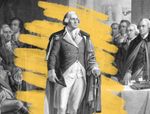


Frederick Douglass was once the most photographed American.

  • Portrait of Frederick Douglass
Portrait of Frederick Douglass
Credit: IanDagnall Computing/ Alamy Stock Photo
Author Michael Nordine

January 22, 2026

Love it?

Frederick Douglass once said, “It is evident that the great cheapness and universality of pictures must exert a powerful, though silent, influence upon the ideas and sentiment of present and future generations.”

He would know: The abolitionist, author, and civil rights leader was the most photographed American of the 19th century, having sat for more portraits than the likes of Abraham Lincoln, Mark Twain, and Thomas Edison. There are more than 160 pictures of Douglass taken during his lifetime, reflecting his unique stature in America’s cultural fabric.

Born into slavery in 1818, Douglass escaped at age 20 and later wrote that in freedom he “lived more in one day than in a year of my slave life.” He saw photography as a great leveler, a means of presenting himself in a dignified manner that undercut any preconceived notions his critics and peers might have of him. He illustrated this idea in his 1861 speech “Lecture on Picture,” saying, “The humbled servant girl whose income is but a few shillings per week may now possess a more perfect likeness of herself than noble ladies and court royalty.” 

Ronald Reagan had a space-based defense plan known as Star Wars.

  • Reagan addressing the Nation on the National Security Defense Initiative
Reagan addressing the nation on the National Security Defense Initiative
Credit: Everett Collection Inc/ Alamy Stock Photo
Author Michael Nordine

January 22, 2026

Love it?

Before there was Space Force, there was Star Wars. No, not the sci-fi franchise set in a galaxy far, far away, but the space-based defense plan proposed by Ronald Reagan on March 23, 1983. Officially known as the Strategic Defense Initiative (SDI), the program received its mocking nickname when Senator Ted Kennedy lambasted it as a “reckless Star Wars scheme.” Intended to defend the United States from the Soviet Union’s nuclear weapons, SDI relied on futuristic technology that didn’t yet exist. Chief among them was a laser system that could theoretically zap intercontinental ballistic missiles (ICBMs) out of the sky before they reached their target.

In announcing the program, Reagan called on the scientists who first developed nuclear weapons to “turn their great talents to the cause of mankind and world peace: to give us the means of rendering these nuclear weapons impotent and obsolete.” With hundreds of Soviet missiles aimed at America, the president wanted to neutralize the threat of those weapons of mass destruction. More than $30 billion was spent on the Star Wars initiative over the next decade, but the critics who dismissed it as overambitious proved right. SDI never came to fruition and was officially canceled by Bill Clinton in 1993.

Only two people have received the Presidential Medal of Freedom twice.

  • Presidental Medal of Freedom
Presidental Medal of Freedom
Credit: Ilene MacDonald/ Alamy Stock Photo
Author Michael Nordine

July 25, 2024

Love it?

Alongside the Congressional Gold Medal, the Presidential Medal of Freedom is the highest civilian award in America. An average of roughly 10 awards per year have been bestowed since the honor was first created by John F. Kennedy in 1963 (though some presidents award more medals than others), and only two people have received more than one: Ellsworth Bunker and Colin Powell. The former, a career diplomat who served six different U.S. presidents as the ambassador to Argentina, Italy, India, and South Vietnam, received his in 1963 and 1967, both of them with distinction — an additional level of veneration reserved for approximately 8% of recipients. 

Powell, meanwhile, earned his awards in 1991 and 1993, the second with distinction. He received the first from George H.W. Bush and the second from Bill Clinton, both of whom he served under as chairman of the Joint Chiefs of Staff; he had previously been Ronald Reagan’s national security adviser and later became secretary of state for George W. Bush. While presenting Powell with his first medal at the end of the Gulf War, the elder President Bush said, “Your commitment and good counsel, your deep compassion for every one of the thousands of men and women under your command, will always be remembered.”

‘Lord of the Flies’ was rejected as many as 21 times and was almost never published.

  • “Lord of the Flies” book
"Lord of the Flies" book
Credit: CBW/ Alamy Stock Photo
Author Sarah Anne Lloyd

January 22, 2026

Love it?

Sometimes a novel just needs to find the right editor — even novels that go on to exalted positions in the literary canon. When author William Golding finished his harrowing allegorical novel Lord of the Flies in 1953, he spent a lot of time and postage distributing it to publishers. His manuscript was returned over and over — according to some sources, including Golding’s obituary in The New York Times, as many as 21 times. 

The last publishing house to receive the novel, Faber and Faber, also initially marked it for rejection; the reader assigned to it called the work “absurd,” “dull,” and “pointless.” But a young editor at the firm named Charles Monteith, needing something to read on the train, grabbed it off the slush pile and realized its potential.

Lord of the Flies tells the story of a group of preadolescent boys stranded on a desert island after their plane is shot down while evacuating them from Britain during a fictional war. Over the course of the novel, the micro-society the children create devolves into violence. It was Golding’s spin on the 1857 children’s novel Coral Island, an adventure tale about three extremely pious shipwrecked boys. Golding came to believe after his time serving in the British navy in World War II that everyone had the potential for evil inside them, and he wanted that to be the main conflict of his story.

Golding’s original manuscript, titled Strangers From Within, initially led with more detail on the war, the evacuation, and how the boys became stranded. But Monteith, like the previous reader at Faber and Faber, found it dull. The original story also had prominent religious themes that didn’t make it into the final draft. The end result was a secular book that picks up right when two of the main characters meet on the beach after the crash. That revised version went on to be a staple of high school reading lists, and Golding went from a pile of rejections to winning the Nobel Prize in literature.

Shoelaces are older than most civilizations.

  • Oldest leather footwear
Oldest leather footwear
Credit: Ekaterina Kriminskaya/ Alamy Stock Photo
Author Sarah Anne Lloyd

January 14, 2026

Love it?

Shoelaces might seem like a modern convenience, but the basic idea of fastening footwear with laces is far older than most civilizations. The world’s oldest known leather shoe, complete with intact laces, dates to around 3500 BCE, during the Copper Age (between the Stone Age and Bronze Age). 

Archaeologists discovered the ancient shoe in 2008 inside Areni-1, a cave complex in Armenia. The remarkably stable, dry conditions there had preserved organic materials that would normally decay. (The thick layer of sheep dung atop the shoe likely also helped.) Fashioned from a single piece of cowhide and shaped specifically for the wearer’s right foot, the shoe features leather laces threaded through eyelets — a design so practical that similar construction methods survived in Ireland until the 20th century. When the artifact was unearthed, parts of the laces were still visible, astonishing the research team.

That puts shoelaces only slightly younger than the earliest known human civilizations. Ancient Mesopotamia emerged around 4000 BCE, with the earliest Sumerian city-states taking shape in the fertile lands between the Tigris and Euphrates rivers. The beginning of the ancient Egyptian civilization appears to date to roughly the same period, although archaeological research in both regions is ongoing. Every other major civilization — from the Indus Valley to ancient China and the cultures of the Americas — arose centuries or millennia later.

That means humans were tying their shoes before they were building pyramids (starting around 2700 BCE) or inventing writing (around 3300 BCE). Modern civilization would take thousands more years to arrive, but the humble shoelace was already doing its job. You might say humanity started out on the right foot.

At the height of the Berlin Airlift, a plane landed in Berlin every 30 seconds.

  • Berlin Airlift of 1948
Berlin Airlift of 1948
Credit: Everett Collection Historical/ Alamy Stock Photo
Author Kerry Hinton

July 17, 2024

Love it?

The first major international crisis of the Cold War began on June 24, 1948, known as the Berlin Blockade. After World War II, the German capital was divided into four occupation zones, controlled by the U.S., U.K., and France in the western part of the city, and the Soviet Union in the eastern sector. But tensions began to rise when the U.S. and U.K. combined their zones to form “Bizonia,” which the Soviets were concerned would pose a threat by concentrating power in West Berlin. This concern deepened in June 1948, when the Western Allies introduced a new currency, the deutsche mark, into Bizonia and the French zone without consulting the Soviet Union. In response, the Soviets issued their own currency, the ostmark, and blocked all rail, road, and water access to Berlin’s other three zones. More than 2 million civilians lost access to food, medicine, fuel, and electricity due to the blockade. 

Two days later, the United States and Britain initiated a counterblockade to prevent rail traffic from reaching East Berlin. They also found a way around the roadblocks: They took to the skies. So began the Berlin Airlift, also known as Operation Vittles, a 15-month air campaign to deliver food, fuel, and other supplies to West Berlin. Over the course of the operation, pilots and their crews made more than 270,000 air drops to the city. At the height of the airlift in the spring of 1949, an Allied supply plane landed in West Berlin an average of every 30 seconds. The Berlin Airlift was so successful that Soviet Premier Joseph Stalin lifted the blockade in May 1949, realizing the Western Allies could continue their supply missions indefinitely. The operation is now considered the largest humanitarian airlift mission in history.

Croquet was an Olympic sport.

  • The 1900 Olympic croquet tournament
The 1900 Olympic croquet tournament
Credit: FLHC 2021BB/ Alamy Stock Photo
Author Michael Nordine

January 13, 2026

Love it?

As the sport of breaking taught many viewers in 2024, some events only make it to the Olympics once. Among the more surprising athletic endeavors to receive that honor is croquet, which made its Olympic debut — and, it turned out, only appearance — at the 1900 Summer Games in Paris. A lot of unusual and short-lived events were held that year, including ballooning, water motorsports, and live pigeon shooting. Though usually associated with wealth and leisure today, croquet is believed to have originated with French peasants in the 13th century; the current form of the game traces back to England and Ireland in the 1830s.

As for why croquet appeared at the Olympics just once, well, only one spectator bought a ticket, and an official report from the 1900 Olympics claimed that the game had “hardly any pretensions to athleticism.” All 10 of the sport’s Olympians hailed from France, making it the only country to have medaled in croquet. Gaston Aumoitte won in both the singles (one ball) and doubles categories, with Georges Johin as his partner in the latter, and Chrétien Waydelich took home the gold in the singles (two balls) category.

New York City once had miles of hidden underground mail tubes.

  • Pneumatic tube, New York City
Pneumatic tube, New York City
Credit: ZUMA Press, Inc./ Alamy Stock Photo
Author Timothy Ott

January 13, 2026

Love it?

In October 1897, construction of a high-speed network designed to service an ever-expanding city was underway beneath the streets of Manhattan. No, it wasn’t the subway; that would take a few more years. This was a pneumatic tube mail system, developed using engineering principles that dated back more than two centuries and had already been put to the test with working models in London, Paris, and Philadelphia.

Built by the Tubular Dispatch Company and leased to the U.S. Post Office Department, the New York City system was powered by rotary blowers and air compressors that shot steel mail-carrying canisters through cast-iron tubes at speeds of approximately 30 mph. The tubes were largely installed between 4 and 6 feet underground, with a noticeable outlier following the length of the Brooklyn Bridge, while the canisters they supported measured approximately 2 feet long by 8 inches in diameter. The network eventually connected 23 post offices through 27 miles of tubing, its early success paving the way for systems in Boston, Chicago, and St. Louis.

As one might suspect, a canister would occasionally get stuck, shutting down that particular pathway until it could physically be removed. But a bigger problem was the exorbitant costs that came with the endeavor, an issue that became more pronounced as the network continued circulating the same volume of mail even as the need for a larger, faster system increased with the growing population. Postmaster General Arthur Summerfield finally put the kibosh on New York City’s mail tubes in late 1953, reasoning that the addition of two trucks would be just as effective and far cheaper to maintain, and this once-futuristic service was left to become a hallmark of the city’s past.

Albert Einstein hated wearing socks.

  • Albert Einstein at his Princeton home
Albert Einstein at his Princeton home
Credit: Pictorial Press Ltd/ Alamy Stock Photo
Author Sarah Anne Lloyd

January 14, 2026

Love it?

Albert Einstein’s outside-the-box thinking didn’t just lead to groundbreaking scientific thought — it also gave him his fair share of quirks. Among his most notorious eccentricities was his outright rejection of socks. Look closely at full-body portraits of the scientist and you’ll notice bare ankles above his wingtip shoes and a general preference for sandals. 

Einstein’s secretary noted that he didn’t even put on socks for a meeting with President Franklin D. Roosevelt. As he once wrote to his future wife Elsa, “Even on the most solemn occasions, I got away without wearing socks and hid the lack of civilisation in high boots.”

The explanation Einstein gave to both biographer Antonina Vallentin and photographer Philippe Halsman for his lack of socks was that he really didn’t like the holes his big toes made in them. But his letters reveal a deeper love for barefootedness. While spending eight weeks by the Baltic Sea in 1918, Einstein wrote to a colleague that he wanted to stay barefoot back home in Berlin. (According to biographer Albert Fölsing, it wasn’t until Einstein moved to the United States in 1933 that he started going barefoot full time.)

Overall, Einstein’s missing socks were part of a broader philosophy, one that scoffed at standard etiquette, didn’t put much stock in appearance, and valued simple things. When a photographer at Princeton asked about the socks, Einstein joked, “It would be an awful situation if the containers were of better quality than the meat.” And he told family friend Peter Bucky, “It is my feeling that the less that I can get along with in daily life, such as automobiles and socks, the freer I am from these drudgeries.” Bucky also noted that Einstein would read Emily Post’s Etiquette and laugh.

There are presidential M&M’s that are given out to guests.

  • Presidential M&M’s on Air Force One
Presidential M&M's on Air Force One
Credit: Abaca Press/ Alamy Stock Photo
Author Michael Nordine

January 14, 2026

Love it?

Flying on Air Force One would be memorable for a lot of reasons, not least of which is the opportunity to procure a box of presidential M&Ms. The candies come in just three colors — red, white, and blue — in boxes roughly the size of a cigarette packet; the package features the presidential seal and current leader’s signature on one side and a flag-bearing M&M character on the other. The prestigious snack has been given out to guests since 1988 as a replacement for actual cigarettes, which presidents including John F. Kennedy gave to members of the press and other guests on Air Force One. 

Ronald Reagan, a former smoker, switched to candy instead of cigarettes as part of the administration’s “Just Say No” anti-drug campaign. He initially opted for jelly beans (which he loved), but also requested custom boxes of M&M’s from Mars, Inc. in 1988. That year, First Lady Nancy Reagan saw the Moscow Summit as an opportunity to both ban smoking on Air Force One and use candy as a diplomatic tool. After arriving in the Russian capital, the first lady took boxes of M&M’s off Air Force One and gave them to schoolchildren. They’ve remained a presidential gift ever since, with Bill Clinton being the first to add his signature to the box and offering peanut M&M’s as an option.