




Why Doesn’t America Use the Metric System?
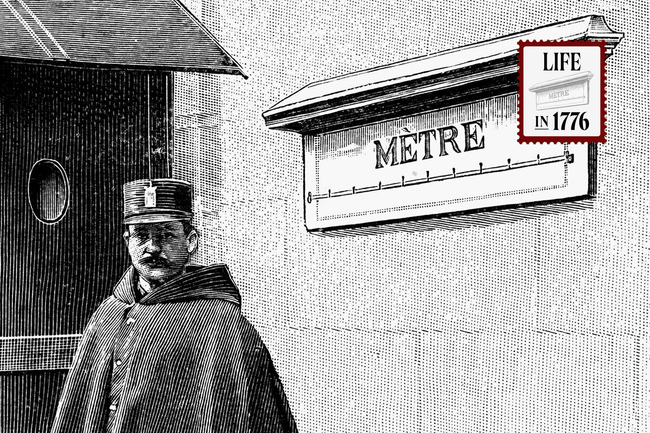
America’s relationship with measurement is not exactly as straight as a ruler. We buy soda in liters and milk in gallons. We run 5Ks but drive in miles. Weather forecasts use Fahrenheit, nutrition labels use grams, and rulers often list centimeters alongside inches, even if the “cm” side is frequently ignored.
To much of the world, this is puzzling, to say the least. Nearly every other country routinely uses the metric system, a method designed to make measurements easier to calculate and universally understandable. Meanwhile, Americans continue navigating a maze of feet, ounces, teaspoons, and miles that can feel less like a coherent plan than a series of historical accidents. The idiosyncrasy of the system is hinted at in its name: U.S. Customary Units. No grand logic here, the name seems to imply — we just use it because it’s always been so.
That’s not to say the U.S. hasn’t attempted a switch to the metric system, and indeed the current measurement mix is far from metric-free. So how did we get here?
Where the Metric System Came From
Before the metric system, measurements were often chaotic. Different regions — and sometimes different towns — around the world used their own units for weight, volume, and distance. In France alone, an estimated hundreds of thousands of local measurement units were in use before the late 18th century.
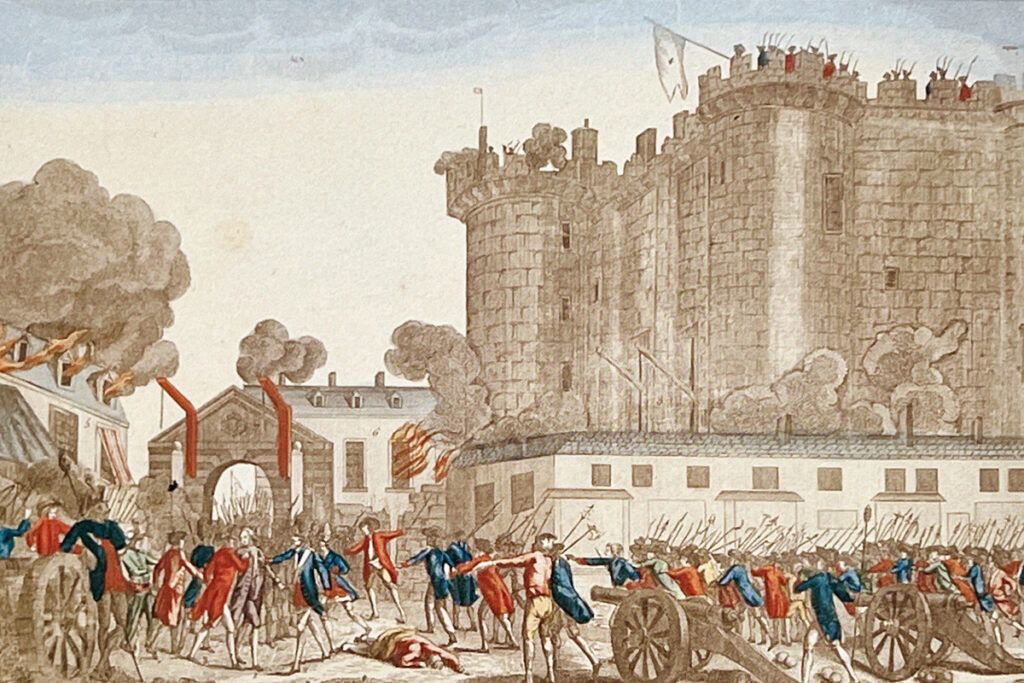
Scientists, merchants, and government officials found this deeply frustrating. During the French Revolution, reformers saw an opportunity to create something more rational: a universal measurement system based not on tradition, kings, or local customs, but on nature itself.
The result was the metric system. French scientists defined the meter as one ten-millionth of the distance from the equator to the North Pole along the meridian of longitude that passes through Paris. Other metric units followed from there. A liter, for example, represented the volume of a cube measuring 10 centimeters on each side.
Just as important, the entire system was decimal-based. Instead of awkward conversions — such as 12 inches in a foot, 3 feet in a yard, or 5,280 feet in a mile — the metric system moved cleanly by powers of 10. To Enlightenment-era thinkers, the system represented reason in action.
France officially adopted the metric system in 1795. Other countries followed over the next century, especially as science, engineering, and global trade increasingly demanded standardized measurements. Today, only two countries — Myanmar and Liberia — are often listed as fellow metric holdouts alongside the U.S.
More from our network





The U.S. Almost Went Metric
The United States was never as anti-metric as modern lore suggests. Thomas Jefferson, who helped establish the decimal-based U.S. currency system, was intrigued by metric ideas as early as the 1790s, when the U.S. was still using the customary system that came from Britain. The United States legalized the use of metric measurements in 1866, and in 1875 the nation became one of the original signers of the Treaty of the Meter, an international agreement that standardized measurement systems worldwide using the metric system.
But while scientists and government officials often favored the metric switch, everyday Americans largely stuck with the familiar system inherited from Britain.
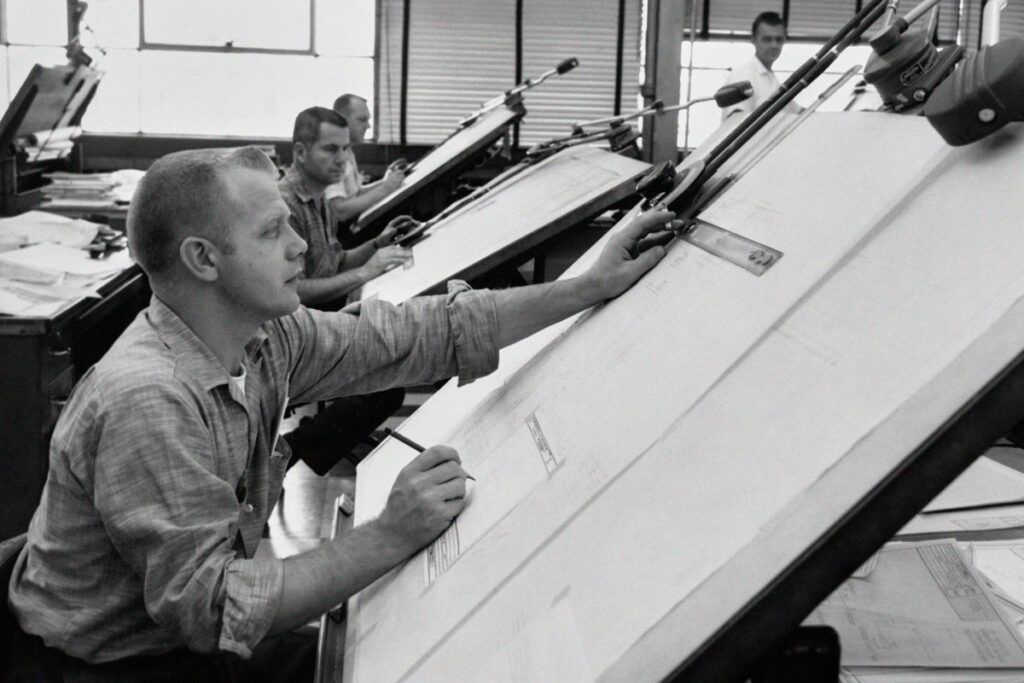
Timing played a big role. By the time the metric system was spreading internationally during the 19th century, the Industrial Revolution had occurred, and the United States had already built much of its infrastructure around customary units. Factories used inch-based machinery. Railroads measured distances in miles. Construction relied on feet and inches. Workers were trained in the existing system, and manufacturers saw little reason to change. After all, switching over would have been enormously expensive and disruptive: Every machine, blueprint, road sign, measuring tool, and educational resource would need updating. (Other nations faced similar challenges, but many smaller countries had stronger economic incentives to switch, whereas the U.S. was big enough to go it alone.)
There were cultural objections, too. Some Americans viewed the metric system as suspiciously foreign and elitist. And so feet, miles, and pounds stayed in use for decades. During debates over metric conversion in the 1970s, opponents sometimes framed the system as an attack on American traditions and the country’s very independence.
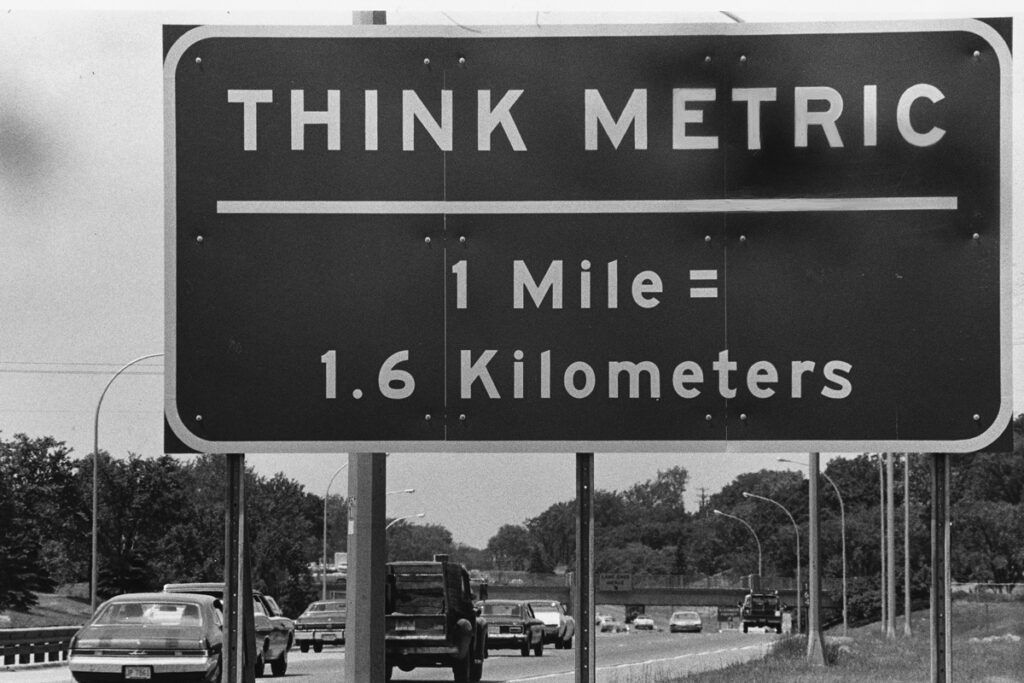
That decade marked the closest the U.S. ever came to a full conversion. Congress passed the Metric Conversion Act in 1975, declaring a national policy of voluntary metric conversion and establishing a U.S. Metric Board to help coordinate the effort. Schools began teaching metric units more heavily, some highway signs briefly included kilometers, and many people assumed a nationwide switch was inevitable.
But the law made conversion voluntary, not mandatory, and without strong enforcement, momentum faded. President Ronald Reagan later abolished the U.S. Metric Board in 1982, and the grand metric transition quietly stalled.
But America Does Use the Metric System
Despite appearances, the metric system is woven deeply into American life — although it may sometimes be hard to find.
In 1988, Congress amended the 1975 act to declare the metric system the “preferred” system of weights and measures for trade and commerce. Scientists, doctors, and the military rely heavily on metric units. Prescription drugs are measured in milligrams. Beverage bottles are sold in liters. Many packaged foods display grams alongside ounces. Wine and distilled spirits have been sold in metric volumes since the 1980s. International manufacturing and engineering also depend heavily on metric specifications.
Even customary units themselves are technically defined through metric standards. Since 1893, the yard and pound have been officially linked to the meter and kilogram (so, for example, if a U.S. pound needed to be defined in a legal or scientific context, it’s 0.45359237 kilograms). The National Institute of Standards and Technology describes this as a kind of hidden metric foundation beneath American life. Above the surface, Americans still see feet, pounds, and gallons. Underneath, many of those measurements are tied directly to the International System of Units, or SI (the official name of the metric system).
Some experts argue that this means the U.S. is not “non-metric” at all — it’s simply somewhere along a continuum of metrification that all countries have taken part in (yes, even Myanmar and Liberia).

Why the U.S. Probably Won’t Fully Switch
At this point, a complete national conversion seems unlikely. Americans already understand the current mixed system well enough to function day to day, and most industries that truly need metric measurements already use them. For many people, the benefits of a total conversion simply don’t seem worth the cost and inconvenience.
Customary units also remain deeply embedded in American culture and language. People talk about “giving an inch” or “going the extra mile.” Recipes rely on cups and teaspoons. Even Americans who prefer metric often think about body temperature or weather in Fahrenheit instead of the metric unit Celsius.
Most Americans have become strangely comfortable with the chaos. The country already switches between systems constantly, often without noticing. Schoolchildren may learn both systems at once, depending on the item being discussed. The result is an awkward but functional hybrid.
It may not be elegant. But after more than two centuries of half-conversions, compromises, and coexistence, America’s mixed-up measurement culture appears to be here to stay.


