




What Ancient Romans Used Instead of Toilet Paper
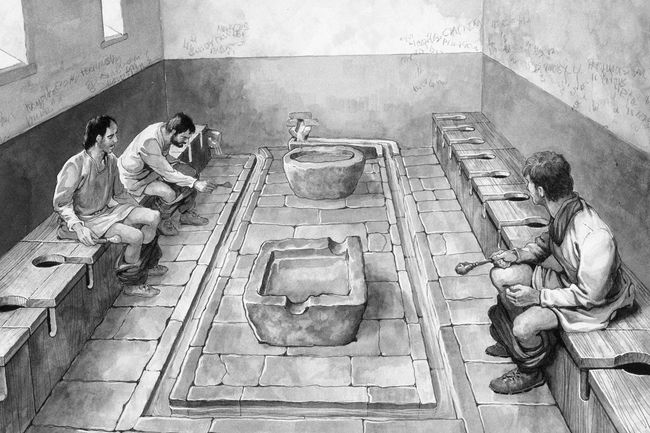
The ancient Romans rank among history’s greatest engineers. They built aqueducts that carried fresh water across many miles, roads that are still visible 2,000 years later, and sewage systems that helped keep the city clean. Having borrowed and improved upon techniques from the Greeks and the Etruscans, the Romans became the most sophisticated builders of their time.
That said, any admiration you might have for Roman ingenuity could be tested when you learn what historians think they used instead of toilet paper. Here we take a perilous dive into the world of Roman public latrines, and what our ancient ancestors used in lieu of modern TP.

Meet the Sponge Brush
The oldest known recorded use of paper for bathroom hygiene purposes dates back to China in the sixth century CE. But for most of recorded history, people around the world used whatever they could find, whether it be rags, grass, moss, or even corncobs. And when some kind of material wasn’t available, people could just wash with water, either from a bucket or a natural source such as a river or stream. The Romans, however, came up with a different solution — and it didn’t involve anything as prosaic as rags or paper.
According to many historians, the Romans’ answer to the rear hygiene question was the tersorium, also known by the Greek-derived term xylospongium. This was basically a sponge on a stick. They attached a sea sponge from the Mediterranean to the end of a wooden rod, similar to the back-washers sold in drugstores today.
It’s not a terrible idea — the sponge is absorbent and the rod gives extra reach. But here’s where things get a little sticky: The tersorium may have been for communal use.
Not everyone in Rome would have carried around their own sponge on a stick — so public latrines at bathhouses and other public spaces (the Colosseum, for example) would have had a shared tersorium that was rinsed between uses, normally by placing it into the channel of water that ran through the latrine, and perhaps also by dipping it into a bucket of water with added salt or vinegar.
More from our network






An Alternative Theory
Historical sources are vague when it comes to the tersorium — it seems that few Romans found it noteworthy enough to warrant a weighty text or treatise. This has caused some modern scholars to question the actual purpose of the tool. We know it was found in most public latrines, but was it used for the cleaning of numerous behinds or simply for scrubbing the latrine itself, much like a modern toilet brush?
The greatest proponent of the latter theory is Austrian archaeologist Gilbert Wiplinger. He argues that the popular idea that Romans used the tersorium to clean their behinds is incorrect. Having reviewed ancient textual sources, including Seneca and Martial, he notes that none of them clearly describes the sponge-on-a-stick being used for personal hygiene, and that a more logical — not to mention less gross — explanation would be its use as a toilet brush.
So if the Romans didn’t clean themselves with the tersorium, what did they use? Having examined scraps of cloth in an ancient septic tank in Herculaneum (an ancient city preserved in Campania, Italy), environmental archaeologist Mark Robinson concluded that fabric scraps were likely used instead of a sponge. Another option was to use pottery shards, known as pessoi (Greek for “pebbles”). This may sound almost as bad as using a shared sponge, but these pottery pieces — which were readily available in ancient Rome — were specially selected, with smooth edges.
The Romans likely had options when it came to bathroom hygiene — but whether that was in the form of a shared sponge-on-a-stick, scraps of fabric, shards of pottery, or a combination of all three (or more), it’s hard to know for certain. What we can say for sure is this: We should all be very grateful for toilet rolls and bidets.


