




5 Etiquette Rules People Followed in the 1800s
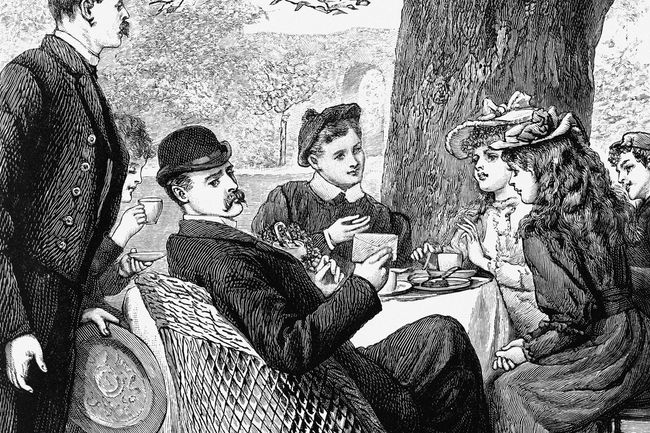
If you think modern etiquette can be fussy, 19th-century Americans would like a word. Everyday social interactions — from stopping by a neighbor’s house to eating dinner or greeting a friend — were governed by intricate, often unspoken rules. Many of these customs were designed to signal respectability and self-control, shaping how people navigated everything from social calls to public behavior. Here are a few etiquette expectations from the 1800s that offer a glimpse into that carefully ordered world.
Visiting Cards Were a Necessity
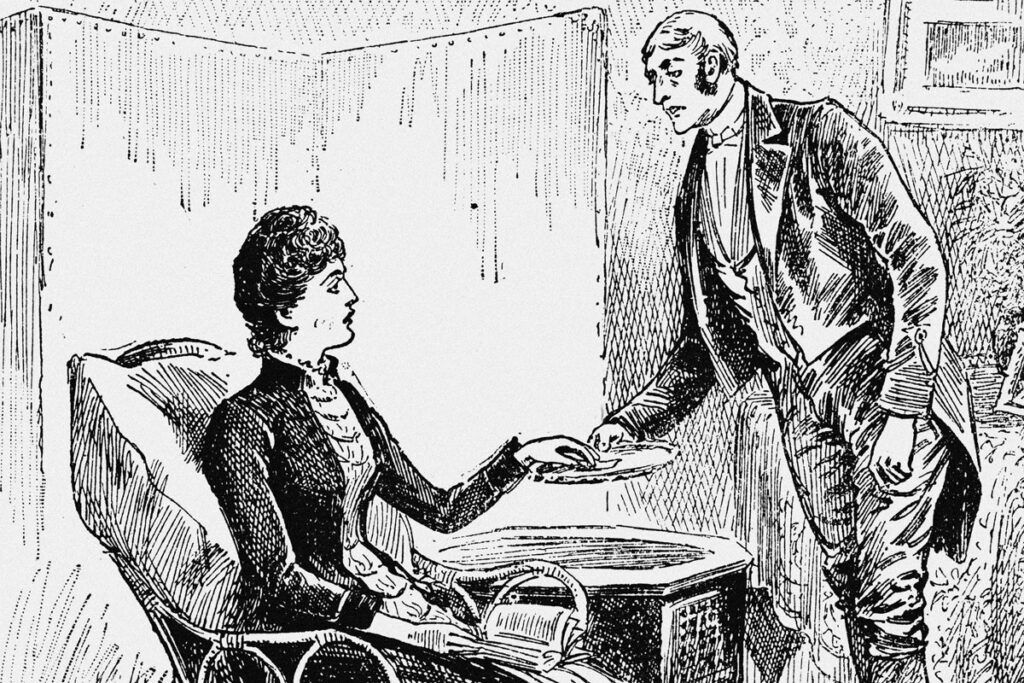
In the 19th century, stopping by someone’s house often meant not seeing them at all. Instead, you left a visiting card — sometimes several, each carefully allocated to members of the household. As The Habits of Good Society (an etiquette manual from 1859) explains, you were expected to leave “one for the lady of the house and her daughters … one for the master of the house,” and possibly another for a grown son, though “you must never leave more than three at a time.” The card itself could even carry coded meaning: Turning up a corner might signal that daughters were included in the call.
The rules doubled as a kind of social firewall, especially around gender. Married men often skipped the whole process — their wives left cards on their behalf — while young unmarried women were shielded from casual male callers. If a servant reported that only a daughter was at home, a gentleman was expected to leave a card and go. As The Habits of Good Society put it, young women did not receive calls from men unless they were “very intimate … or have passed the rubicon of thirty summers.” And despite all this attention to the household, the call itself was technically directed to one person: “Where there is a lady of the house, your call is to her, not to her husband, except on business.”
More from our network






There Was a Fork for Every Purpose
If visiting cards governed the doorstep, the dining table was its own stage, and one where even the smallest gestures were scrutinized. One of the most important moves was using the correct fork. In the 1800s, the multipronged silver fork was still gaining ground after centuries of a knife alone being the favored implement for eating. (When forks were first introduced, some saw them as tools of the devil.)
The Victorians devised forks for every food, including meat, fish, pie, salad, pastry, dessert, berries, ice cream, turtle, mango, lobster, lettuce, oyster, and oyster cocktails. There was an anti-fork contingent, however: One 19th-century American complained that “eating peas with a fork was like eating soup with a knitting needle.”
Using the right fork was far from the only rule at the 1800s dinner table, of course. Diners were told never to cut more than one bite of food at a time, to break bread with their fingers rather than bite into it, and to avoid any display that might seem excessive — loud laughter, animated gestures, or even too much enthusiasm for the meal. As Mrs. Beeton’s Book of Household Management put it, good manners at the table were less about enjoyment than about restraint, signaling refinement through self-control.

You Weren’t Supposed To Introduce Yourself
It’s hard to imagine in today’s far more casual world, but in 19th-century polite society, introducing yourself was a breach of etiquette. Social encounters depended on a formal intermediary, and without one, even basic conversation could be off-limits. As The Gentlemen’s Book of Etiquette makes clear, introductions were governed by a central rule: “to force no one into an acquaintance.” That meant you were supposed to quietly determine in advance whether both parties actually wanted to meet — and only then proceed.
Even the direction of the introduction mattered. A man was always introduced to a woman, never the reverse. The gentleman was considered inferior to the lady, and inferiors were supposed to be introduced to superiors. A slight bow to the superior party was considered correct. Without the proper introduction, you were expected to ignore acquaintances in public rather than risk overstepping.
Fortunately, if you were too busy to bother with introductions while at home and engaged in a task, it was socially acceptable to instruct your servant to tell visitors you were “not at home” — even when all parties involved knew this was just a convenient fiction.

Gloves Were Essential in Public
In the 19th century, stepping out in public without gloves wasn’t just a fashion lapse — it could read as outright impropriety. Etiquette manuals treated gloves as essential, particularly for women, whose bare hands were considered too intimate for public display. As The Ladies’ Book of Etiquette, and Manual of Politeness advised, a well-bred woman should always be gloved when visiting, shopping, or attending social events, removing them only in very limited circumstances (such as dining). Gloves also had to be clean, well-fitting, and appropriate to the time of day — dingy or ill-kept gloves could quietly undermine an otherwise respectable appearance.
The rules could get surprisingly specific. You weren’t supposed to shake hands with a bare hand if gloves were expected (better to keep them on than create an awkward mismatch), and pulling off your gloves too hastily could itself seem improper. Men, meanwhile, were expected to remove their gloves when greeting women or entering a private space, but not outdoors or during formal calls. Historians note that these customs weren’t just about hygiene or style; they helped maintain a carefully managed boundary between public and private selves. In a world attuned to subtle signals, even your fingertips had to follow the rules.

Widows Had To Stay Home for a Year
For a 19th-century widow, grief came with a strict social timetable — and for the first year, it meant near-total withdrawal. Etiquette dictated that a widow in “deep mourning” could not accept invitations, attend parties, or appear in places of public amusement; doing so was considered “the worst possible taste.” These expectations were widely observed in both Britain and the United States, reinforced by influential figures such as Queen Victoria but rooted in earlier mourning traditions. Only after a year and a day could a widow begin to reenter society, gradually transitioning into “half mourning” over the course of two years.
Mourning wasn’t just worn, either — it was also printed and circulated. Families sent out memorial cards after a death, often embossed with symbols such as lilies of the valley or wreaths, and enclosed in black-edged envelopes — a practice that grew out of earlier religious reminders to pray for the deceased. Personal correspondence followed suit: Mourning stationery featured black borders whose thickness could signal the recency of the loss. Together, these customs made bereavement highly visible, turning private grief into a carefully managed public identity.


