



Are These 6 Famous Nursery Rhymes Actually About Death?
Children’s rhymes are built to lodge themselves in the brain. Their rhythms, repetition, and playful nonsense are thought to help kids learn language, which could be why many adults can still recite nursery rhymes they haven’t heard in decades.
But alongside the familiar verses lies another enduring tradition: the belief that many nursery rhymes are secretly about something much darker, whether it’s the plague, religious executions, or blood-soaked rulers. The internet, in particular, has often encouraged stories around these darker origins. However, folklorists caution that many of these explanations emerged far more recently than the rhymes themselves, and most are sorely lacking in evidence.
That doesn’t mean nursery rhymes are entirely innocent. Most are centuries old, and they came from a world where death, disease, public executions, and child mortality were far more visible parts of everyday life than they are today. Some dark interpretations are probably modern myths — but others may contain at least a grain of historical truth. Take a look at the fascinating origins of six popular nursery rhymes.
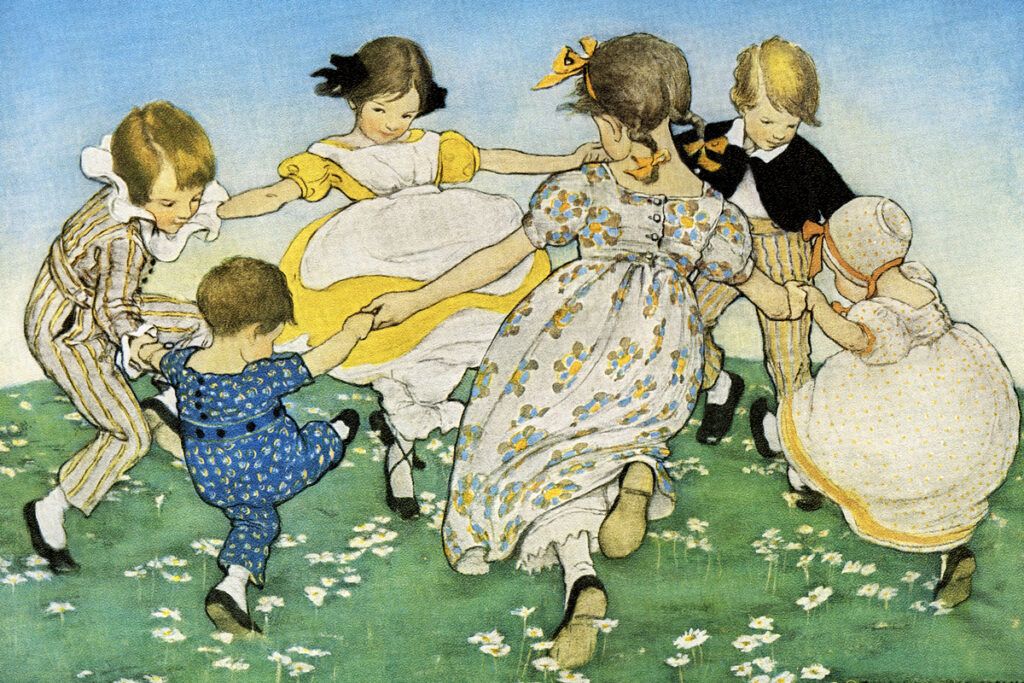
“Ring Around the Rosie”
Ring around the rosie
A pocket full of posies
Ashes, ashes
We all fall down
Few nursery rhymes have inspired more grim speculation than “Ring Around the Rosie.” According to popular belief, the rhyme is a coded reference to the bubonic plague: The ring is a red rash, the posies are flowers or herbs carried to ward off disease, and “we all fall down” means everyone dies.
It’s a memorably macabre explanation, but folklorists universally reject it. One major problem is timing. The rhyme itself was not recorded in print until the late 19th century, centuries after both the Black Death of the mid-1300s and London’s Great Plague of 1665. And scholars can find no evidence linking the rhyme to disease before the mid-20th century. It’s extremely unlikely that children would have been singing a song about the plague for centuries after the events without anybody noting it.
Versions of the rhyme also vary wildly. Some mention sneezing (“a-tishoo”), while others don’t. Some include “ashes,” while others add a “little Moses” or “a little Josie,” and still others have entirely different lyrics. In many versions, the children pop right back up after falling down — not exactly a convincing metaphor for mass death. Instead, folklorists generally classify the rhyme as a children’s singing game involving dancing in a circle, crouching, curtseying, falling dramatically, or all of the above. Similar ring dances appear across Europe, with no connection to plague at all.
Nevertheless, the plague theory has become so widespread that even some experts seem exhausted by it. In the 1980s, the famed nursery rhyme folklorists Iona and Peter Opie, a married couple, wrote, “We ourselves have had to listen so often to this interpretation we are reluctant to go out of the house.”
More from our network






“London Bridge Is Falling Down”
London Bridge is falling down, falling down, falling down
London Bridge is falling down, my fair lady
Unlike most supposedly sinister nursery rhymes, “London Bridge Is Falling Down” may contain a genuine echo of something ancient and unsettling. Early versions of the rhyme include additional verses proposing ways to rebuild the bridge — wood and clay, bricks and mortar, iron and steel, even silver and gold — before finally suggesting a different solution entirely: “Set a man to watch all night.” Some versions also mention an imprisoned person.
That last detail has long fascinated folklorists because stories about human sacrifices connected to bridges appear across Europe. According to old legends, bridges, walls, and gates sometimes required a living person (often a child) to be immured within the foundations so their spirit could guard the structure from a collapse brought on by angry river gods (or, in later versions, the devil himself). Iona and Peter Opie argued that “London Bridge” was unusual, calling it “one of the few [nursery rhymes], perhaps the only one, in which there is justification for suggesting that it preserves the memory of a dark and terrible rite of past times.”
To be clear, that doesn’t mean historians think medieval Londoners routinely imprisoned children inside bridges. Direct evidence connecting the rhyme to an actual sacrifice at London Bridge is lacking. Still, similar bridge legends appear from Germany to Greece, and stories of foundation sacrifices persisted well into the modern era. So, it’s entirely possible that the song does indeed have dark origins.

“Humpty Dumpty”
Humpty Dumpty sat on a wall
Humpty Dumpty had a great fall
All the king’s horses
And all the king’s men
Couldn’t put Humpty together again
Despite what you may read on the internet, “Humpty Dumpty” almost certainly does not conceal a tale about the English Civil War. One popular theory claims Humpty Dumpty was a massive cannon used by royalists that was toppled from a wall during the Siege of Colchester in 1648. Another says it was a siege engine (a device used to destroy heavy fortifications) employed during the Siege of Gloucester. Historians and folklorists generally dismiss both stories because there’s simply no evidence connecting the rhyme to either event.
The simpler explanation is also the oldest one: “Humpty Dumpty” was originally written as a “What am I?” riddle, and the answer was an egg. Early sources explicitly describe it that way, though modern readers often miss the joke because illustrations — especially after Lewis Carroll’s 1871 novel Through the Looking-Glass — turned Humpty Dumpty into an anthropomorphic egg. As folklorists Steve Roud and Jacqueline Simpson point out, generations of children’s books obscured the fact that listeners were originally supposed to guess the answer.
Once you know it’s a riddle, the strange details make more sense. The rhyme never actually says Humpty Dumpty is an egg — because riddles aren’t supposed to give away their solution. And the line “all the king’s horses and all the king’s men” doesn’t necessarily suggest a battlefield; it simply emphasizes that a broken egg is impossible to put back together again.

“Who Killed Cock Robin?”
Who killed Cock Robin?
“I,” said the Sparrow,
“With my bow and arrow,
I killed Cock Robin.”
Unlike many nursery rhymes, “Who Killed Cock Robin?” wears its darkness openly. The rhyme unfolds as a miniature murder mystery and funeral procession, complete with blood, burial, and grieving birds. First printed in the mid-18th century, it quickly became hugely popular in chapbooks (small, inexpensive books that were popular at the time) under titles like The Death and Burial of Cock Robin.
Some scholars have suggested the rhyme may contain political satire. One theory links “Cock Robin” to the downfall of British statesman Robert Walpole, whose long political dominance ended just a few years before the rhyme first appeared in print. Others have argued the rhyme may be much older than its surviving texts suggest, possibly preserving fragments of older myths — including stories surrounding the death of the Norse god Balder. But the evidence for either theory is thin.
Most likely, the rhyme belongs to a broader tradition of mock funerals, animal ballads, and playful death imagery that was common in Victorian-era children’s culture. Still, compared with many nursery-rhyme conspiracy theories, the darker interpretations of “Cock Robin” are at least intriguing enough that folklorists continue to debate them.

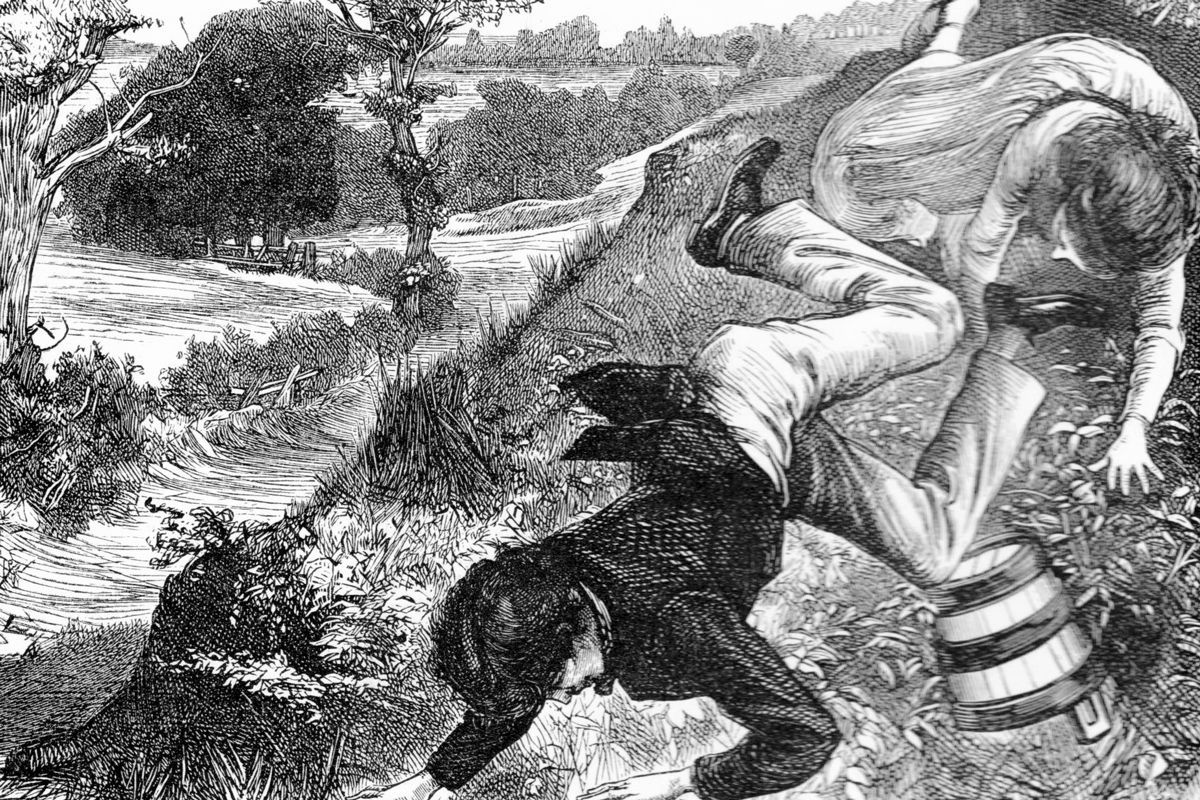
“Jack and Jill”
Jack and Jill went up the hill
To fetch a pail of water
Jack fell down and broke his crown
And Jill came tumbling after
One of the most enduring explanations for “Jack and Jill” comes from the village of Kilmersdon in Somerset, England, where locals have long claimed the rhyme was inspired by a real couple. According to the story, Jack and Jill climbed a nearby hill to fetch water when Jack was struck by a falling rock from a quarry and killed. In some versions, Jill later dies in childbirth, leaving behind a son raised by the village. Today, Kilmersdon still has a “Jack and Jill Hill” and a plaque commemorating the tale.
But other, stranger theories exist. Some writers have connected the rhyme to Norse mythology, arguing that Jack and Jill resemble Hjúki and Bil, figures who carried a pail of water and were associated with the moon. Others have linked the rhyme to the French Revolution — despite the awkward fact that the rhyme was already in print decades before Louis XVI and Marie Antoinette lost their heads.
Another explanation is much less romantic. In the 17th century, English rulers adjusted the size of liquid measures known as “jacks” and “gills” as part of alcohol tax policy. According to this theory, when the jack measure was reduced, the gill followed suit and “came tumbling after.” It’s probably the most prosaic interpretation of the rhyme — but also one of the more historically plausible.

“Mary, Mary, Quite Contrary”
Mary, Mary, quite contrary
How does your garden grow?
With silver bells and cockle shells
And pretty maids all in a row.
“Mary, Mary, Quite Contrary” has inspired some of the grimmest nursery-rhyme theories of all. One popular interpretation claims the rhyme refers to Queen Mary I — better known as “Bloody Mary” — whose reign was marked by the execution of hundreds of Protestants. In this reading, the garden is England itself, while the silver bells and cockle shells are supposedly instruments of torture.
Others have connected the rhyme (less gruesomely) to Mary, Queen of Scots, arguing that the “pretty maids all in a row” are her famous ladies-in-waiting, the “Four Marys.” Some versions even claim the cockle shells were decorations on a dress gifted to her by the French Dauphin.
Folklorists, however, remain unconvinced by all of these explanations. As Iona and Peter Opie noted, the various interpretations mostly amount to “happy guessers” trying to force hidden meanings onto a rhyme that wasn’t even recorded until the 18th century. Like many nursery rhymes, “Mary, Mary” may ultimately tell us less about Tudor queens and more about our enduring desire to find secret histories hiding inside simple verses.