


Women couldn’t wear pants on the Senate floor until 1993.

  • Carol Moseley Braun
Carol Moseley Braun
Gary Ell / Alamy Stock Photo
Author Nicole Villeneuve

August 15, 2023

Love it?

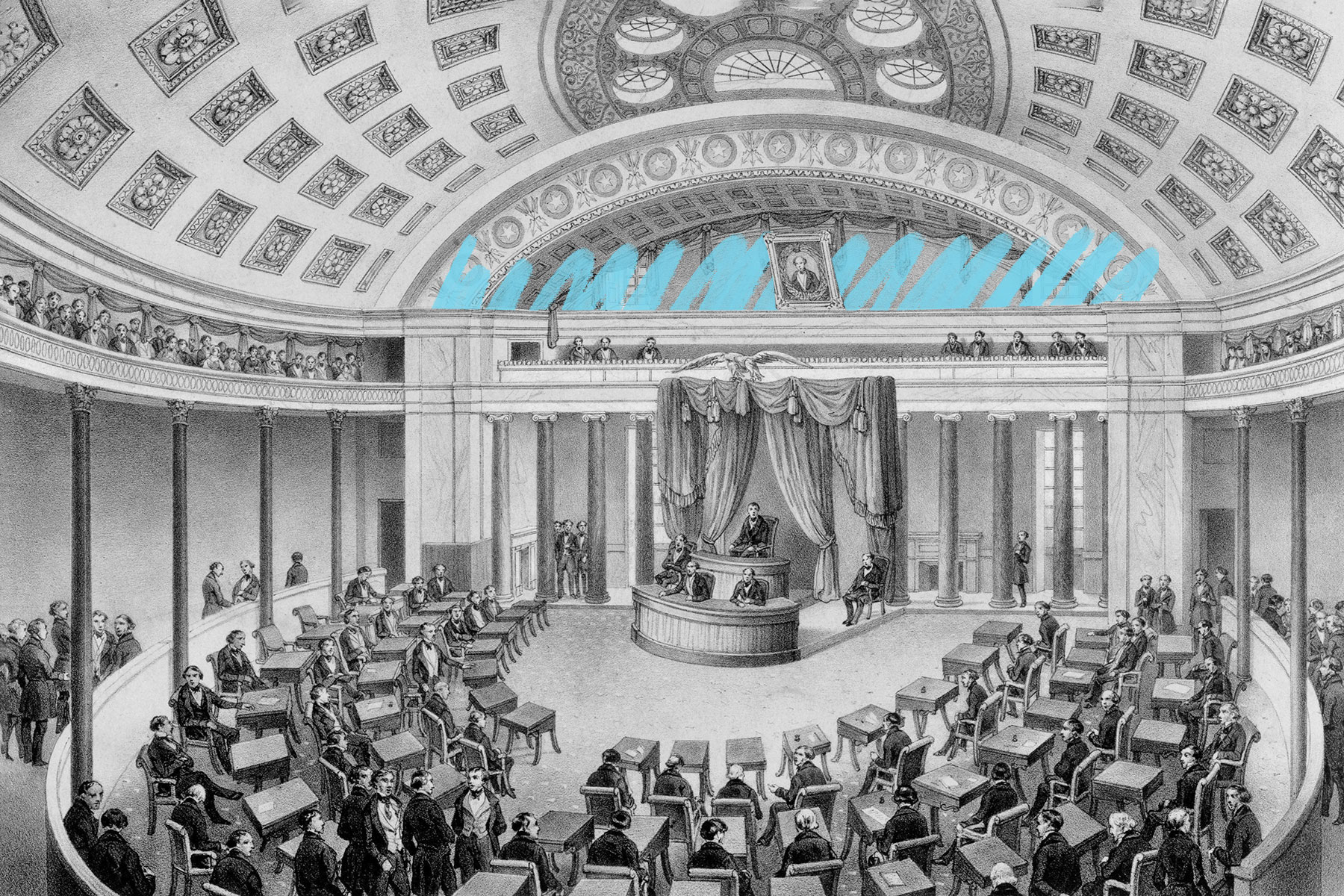
Carol Moseley Braun holds the distinction of being the first African American woman elected to the U.S. Senate, and in 1993, she also helped bring about another victory for equality: a rare rule change in the Senate that updated the dress code from its outdated, gendered restrictions to better align with the times.

Before becoming a senator, Moseley Braun was used to wearing pantsuits during her tenure in the Illinois legislature, where rules were more relaxed. One morning in early 1993, not long after she was sworn in as a Democratic senator, she chose an Armani pantsuit to wear to work. “I walked onto the floor of the Senate, and the gasps were audible,” she later said. The dress code — which required women to wear dresses or skirts with a jacket — was enforced primarily by peer pressure, as well as the whims of the Senate doorkeepers who allowed people into the chamber. 

Female aides initially tried to challenge the dress code in 1972, but their request was reportedly ignored. By 1993, thanks to an increasing number of women senators, the tide began to shift. After Moseley Braun’s unintentionally bold move, Senator Barbara Mikulski did the same. (Although no official Senate record confirms which senator first wore pants on the floor, most available information suggests it was Moseley Braun.) Female staffers, journalists, and other senators soon began advocating for an official allowance to wear pants. Shortly after, Senate Sergeant at Arms Martha Pope issued an amendment to the dress code, allowing “coordinated pantsuits” as part of the acceptable attire for women — a major win in what’s been called the “pantsuit revolution.”

Thomas Edison didn’t invent the lightbulb.

  • Swan’s carbon pencil lamp
Swan's carbon pencil lamp
Smith Archive / Alamy Stock Photo
Author Darren Orf

August 15, 2023

Love it?

Thomas Edison is the brilliant mind behind many inventions: the automatic telegraph, the phonograph, and the kinetograph, to name a few. The world-changing invention he’s most often associated with, however, is the incandescent lightbulb. There’s just one problem: Edison didn’t actually invent it. He was the first to produce a practical and commercially viable incandescent lightbulb, but the science behind the lightbulb had been around for more than a century before Edison took a crack at it in 1879. 

Back in March 1761, English scientist Ebenezer Kinnersley wrote in a letter to Benjamin Franklin that he successfully got a wire so “red hot” that it gave off light. This is known as “incandescence” and is the science inside every incandescent lightbulb. Kinnersley’s discovery was far removed from the lightbulbs we use today, but laid the foundation for the technology to develop in the coming decades. In 1841, English scientist Frederick de Moleyns scored the first patent for an incandescent lamp, though the lamp’s platinum filaments were too expensive and unreliable to be practically usable. Then came Joseph Swan, yet another English scientist, who created the first lightbulb with a carbon filament in 1878. Although still highly inefficient, these bulbs were at least better than the soot-spewing gas that lit up cities at the time, and they kicked off the switch to electric lighting. 

Although Edison didn’t invent the lightbulb, it can certainly be argued that he perfected it — something he did often with inventions throughout his career. In 1879, Edison realized that higher electrical resistance was needed for lightbulbs to last longer; he tested more than 6,000 materials and finally settled on carbonized bamboo. Within the year, Edison’s bulbs could last between 600 and 1,200 hours, showing the world that electric lighting was economically possible.

Abraham Lincoln’s only hobby was “cats,” according to his wife.

  • Lincoln and his family
Lincoln and his family
Glasshouse Images/ Alamy Stock Photo
Author Darren Orf

August 3, 2023

Love it?

The White House has a long history of family pets, some more exotic than others. The first furry friends in the executive mansion belonged to its first presidential residents — John and Abigail Adams — who had two dogs named Juno and Satan. Teddy Roosevelt owned an entire menagerie during his term, including guinea pigs, snakes, birds, several horses, and many other animals. But few Presidents had quite as much affection for their pets as Abraham Lincoln did for his cats, Tabby and Dixie. 

Both Tabby and Dixie were gifted to the President by William Seward, his secretary of state, and the two kittens lived at the White House (likely along with other strays invited by the commander in chief). Many anecdotes from government officials, family, and friends speak to Lincoln’s unyielding affection for his feline friends. Caleb Carman, a friend of the President’s, once said that Lincoln could “talk to [cats] for half an hour at a time.” Lincoln himself, known for his sharp wit, once quipped that “Dixie is smarter than my whole Cabinet!” And supposedly, the President was even distracted at the 1865 Siege of Petersburg during the Civil War due to the nearby meowing of kittens. But the anecdote that most cements Lincoln’s ailurophilia into history comes from his wife, Mary Todd. When asked if her husband had any hobbies, she had one simple reply: “Cats.

Rowdy sports fans nearly overthrew a Roman emperor.

  • Ancient chariot race
Ancient chariot race
Credit: Keith Lance/ iStock
Author Sarah Anne Lloyd

June 17, 2024

Love it?

Ancient Romans were fanatical about chariot races, and were devoted to one of four teams: the Reds, Whites, Greens, or Blues. After the fall of the Western Roman Empire in 476 CE, the four teams consolidated into two, the Greens and Blues. The rivalry was more potent than ever, and often led to violence. In Constantinople (modern-day Istanbul), the capital of the Eastern Roman Empire, competitions took place at the local hippodrome, an arena with a capacity of more than 60,000. In 532 CE, the bitter sports rivals, enraged by some recent tax increases, found a common enemy in Emperor Justinian I. After some particularly nasty fighting broke out at the hippodrome, Justinian, a longtime Blues fan, put his foot down, relinquished his fandom, and sent for the military. He sentenced seven leaders in the fighting to death, but two of them, one fan from each team, survived when the hanging scaffolding broke.

At the next big chariot race, the Greens were resentful of Justinian’s longtime preference for the Blues, the Blues were angry that Justinian was no longer a fan, and both demanded that the two riot leaders be spared. Both teams started chanting “nika,” meaning “win,” but they were cheering less for the charioteers and more for a violent revolt against the emperor. The crowd poured out into the streets, and the ensuing riot went on for five days. On the last day, the rioters returned to the hippodrome and attempted to install a new leader. Justinian was ready to retreat, but his wife, Theodora, convinced him to hold his ground. Troops stormed the hippodrome and massacred the crowd, while some soldiers guarded the exits to make sure nobody could escape. The death toll was around 30,000, or around 10% of the city’s population. Justinian reigned for another 33 years, until 565 CE.

Pretzels were invented by Catholic monks.

  • Snack board with pretzels
Snack board with pretzels
Paul Biñas/ Unsplash
Author Adam Levine

August 3, 2023

Love it?

Though it is a ubiquitous, even mundane snack today, the humble pretzel actually has a spiritual origin: It was invented by Catholic monks at the beginning of the Middle Ages and, according to legend, was imbued with religious symbolism. Most historians trace the origin of the pretzel to around 610 CE in a monastery in either Italy or France, and some scholars believe that the iconic twisted shape was meant to resemble children with their arms crossed in prayer. In fact, according to some sources, the modern name “pretzel” is derived from the old German word “brezel,” which comes from the Latin “bracchiātus,” which roughly translates to “little folded arms.”

The pretzel’s connections to the Catholic Church persisted throughout the Middle Ages. Images of pretzels began appearing in religious manuscripts of the time, and the food was frequently used in Easter games and hung on Christmas trees in the 16th century. While most people no longer associate pretzels with the divine (unless they’re really, really good), these salty snacks have never fully left their religious origins behind: They’re still commonly eaten by Catholics during Lent. Since they were baked without milk, pretzels were also a perfect food for the fasting tradition, when most Christians abstain from consuming dairy products.

Agriculture is why so many people need braces.

  • Orthodontic teeth model
Orthodontic teeth model
sujit kantakat/ Shutterstock
Author Darren Orf

August 2, 2023

Love it?

Braces have become so commonplace in the U.S. that wearing them is almost a rite of passage; data suggests that about 50% of children in the U.S. will need orthodontic treatment at some point, mostly due to misaligned teeth. But that wasn’t always the case. The advent of agriculture changed the human diet, which led to a smaller jaw that no longer has enough space to provide a comfy home for all 32 teeth. Before humans took to the plow around 10,000 BCE, our hunter-gatherer predecessors chowed down on tougher foods, such as uncooked vegetables and hard-shelled nuts, and needed bigger, stronger jaws to munch through them. When farming introduced softer foods into our diet, such as beans and cereals, the need for those beefy jaws declined. Our jaws got smaller over the generations, but human teeth shrank at a much slower rate, resulting in the dental traffic jam experienced by millions of Americans every year. 

In 2015, to test whether the rise of agriculture led to our species’ crooked teeth, scientists from University College Dublin analyzed the lower jaws of 292 skeletons ranging from 28,000 to 6,000 years old. The results were clear: Hunter-gatherers sported larger jaws, especially lower jaws, than their farming descendants only a few thousand years in the future. And our mouths weren’t the only body part impacted by Homo sapiens’ more sedentary existence. Additional studies show that humans developed lighter and less dense bones around joints due to a changed diet that reduced calcium intake and a less-active lifestyle brought on by the switch from foraging to farming.

The Egyptian pyramids were originally polished white.

  • Ancient Pyramids of Giza
Ancient Pyramids of Giza
Les Anderson/ Unsplash
Author Adam Levine

August 3, 2023

Love it?

Today, the famous pyramids of Giza are known as sand-colored monuments that seem to blend into the surrounding desert, but they were originally built to stand out in spectacular fashion. When the pyramids were first erected about 4,500 years ago to mark the tombs of Egyptian pharaohs, they were covered with a polished white limestone that would have sparkled in the sun and made the already-imposing structures even more dazzling. 

According to ancient papyrus scrolls written by people who actually participated in the construction of the pyramids, workers transported boats filled with limestone up the Nile River to the building site in Giza. The limestone casing stones were thoroughly polished in order to increase their luster, and each one weighed upwards of 15 tons. The fact that these massive polished stones were used to encase the entirety of each pyramid, fitted together perfectly to create a nearly seamless white exterior, is a testament to the engineering genius of the ancient Egyptians. Over the centuries, most of the limestone exterior of the pyramids has been destroyed, worn away, or stripped for use in other construction projects, but faint remnants of weathered white limestone can be seen toward the top of Giza’s Pyramid of Khafre — the last remaining architectural evidence of what pyramids looked like in the days of the pharaohs.

Daniel Boone didn’t actually wear a raccoon-skin cap.

  • Pioneer Daniel Boone
Pioneer Daniel Boone
Credit: Christine_Kohler/ iStock
Author Michael Nordine

June 11, 2024

Love it?

If you know one thing about Daniel Boone, it’s probably that he wore a raccoon-skin fur cap. But alas, it turns out you might know zero things about the legendary frontiersman, as Boone never wore such a head covering at all. “My father, Daniel Boone, always despised the raccoon fur caps and did not wear one himself,”  his son Nathan Boone said in an 1851 interview with historian Lyman Draper. The elder Boone instead preferred a wide-brimmed, Quaker-style hat made of felt or beaver fur, which would have offered better protection from the elements and shielded his eyes from the sun during his many long hunting trips.

We may have an actor named Noah Ludlow (1795–1886) to thank for the myth of Boone’s raccoon-skin cap. He was hired to make frames for prints of a portrait of Boone first painted by artist Chester Harding in 1820. Later, he played a character in a performance called “The Hunters of Kentucky” and drew inspiration from Boone to create his look, which included the cap we now associate with the storied frontiersman. The performances were a hit, which was good for Ludlow, but not so much for historical accuracy.

The first candid photograph of a person was taken in 1838.

  • Boulevard du Temple, 1838
Boulevard du Temple, 1838
Credit: Science History Images/ Alamy Stock Photo
Author Kerry Hinton

June 11, 2024

Love it?

Before the 19th century, photography did not exist, so people who wanted a lasting image of their home, their family, or themselves had to have one painted, sculpted, or drawn. In the early 1800s, inventors in France and England were at the center of the effort to create photographic representations of objects and people. In France, Joseph Nicéphore Niépce stunned the world in 1827 when he released what is believed to be the first photograph ever taken, titled “View from the Window at Le Gras.” Niépce rendered the image using a camera obscura combined with a light-sensitive metal plate, a process he called heliography. Despite its success, the heliograph required several days of exposure to capture the scene, eliminating the opportunity to photograph any people who may have been on the street.

In 1829, Niépce met artist and printmaker Louis-Jacques-Mandé Daguerre. Each man was familiar with the other’s work. Niépce admired Daguerre’s rotating diorama that had captivated Parisian audiences in 1822. Daguerre, like Niépce, saw the potential of improving upon the camera obscura to create clear and permanent images. They entered into a business partnership that resulted in the creation of the daguerreotype, an innovative photographic process that required only four to five minutes of exposure. 

The quicker shutter speed allowed Daguerre’s camera to capture an image never seen before: a photo of a human being. In 1838, he debuted a daguerreotype of a street scene on the Boulevard du Temple in Paris. In the lower left corner of the photo we can see a man having his shoes shined; remaining stationary allowed him to be included in the photo, something that would have been impossible using the multiple-day exposure that heliographs required. This anonymous stranger on Boulevard du Temple was not simply the subject of the world’s first candid photograph — he’s also believed to be the first human being ever photographed.

Martin Van Buren was the first President born in the United States.

  • Martin Van Buren portrait
Martin Van Buren portrait
mashuk/ DigitalVision Vectors via Getty Images
Author Adam Levine

August 2, 2023

Love it?

None of the United States Presidents in the first 61 years of the nation’s existence were actually born in the country they led. The reason for this is simple enough: The first seven U.S. Presidents — George Washington, John Adams, Thomas Jefferson, James Madison, James Monroe, John Quincy Adams, and Andrew Jackson — were all born before 1776, and therefore before the United States was an independent nation. The first President who could actually claim to have been born a U.S. citizen was the country’s eighth President, Martin Van Buren. Van Buren was born in 1782 in Kinderhook, New York, which also makes him the first native of the Empire State to be elected to the presidency. 

Before becoming President in 1837, Van Buren served as Vice President under Andrew Jackson (who himself was born in 1767 in a territory disputed between the British colonies of North and South Carolina). Jackson’s endorsement helped elevate Van Buren to the nation’s highest office. However, his presidency was marked by a severe economic downturn, which sunk his bid for a second term. He was defeated in his campaign for reelection by William Henry Harrison, who was born in Virginia in 1773, making him the last U.S. President to come into the world a subject of the British Empire.