



Teddy Roosevelt tried to change American spelling.
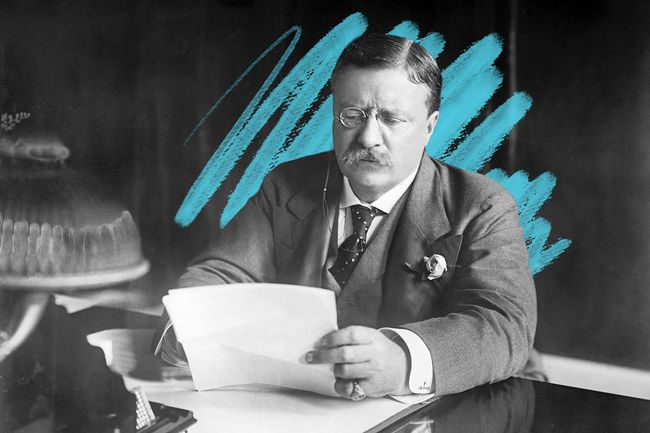
In 1906, President Theodore Roosevelt found himself at the center of an unexpectedly fierce national debate. The issue wasn’t war, trust-busting, or foreign policy — it was spelling.
That year, Roosevelt endorsed a movement to simplify hundreds of English words, hoping to make the language easier to learn and more efficient to print. Instead, he touched off a backlash that far exceeded the modest scope of his proposal.
The effort began with the Simplified Spelling Board, a group funded by steel magnate Andrew Carnegie. The board argued that English spelling was unnecessarily complicated and filled with silent letters, outdated spellings, Britishisms, and inconsistencies that made the language harder to learn. Its members included prominent writers, educators, and scholars (such as Mark Twain and the philosopher William James), and they proposed simpler versions of 300 words. Under their system, “although” became “altho,” “through” became “thru,” and “fixed” became “fixt.”
Roosevelt was convinced. Without consulting Congress, in August 1906 he ordered the Government Printing Office to use the board’s preferred spellings in documents issued by the executive branch. The reaction was immediate. Newspapers mocked the reforms, critics accused Roosevelt of overstepping his authority, and even British commentators joined the chorus of complaints. Some British writers jokingly asked whether the president was going to start spelling his last name “Ruzvelt.”
But the controversy quickly became as much about presidential power as it was about spelling. Congress objected to Roosevelt’s attempt to dictate language rules, and in December 1906 the House of Representatives voted to withhold funding for the printing of any government publications that didn’t follow conventional spellings. The next day, Roosevelt officially abandoned his effort, just four months after it began.
In the end, only a small number of government documents ever used the simplified spellings. But the episode became a memorable chapter in the long history of attempts to make English a little easier to read, write, and learn.


