




The Trojan horse is barely mentioned in the ‘Odyssey’.
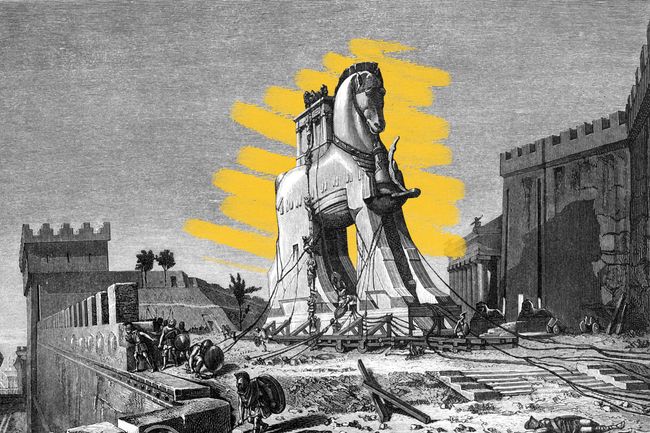
Along with the Cyclops and Odysseus’ confrontation with the many would-be suitors of his wife, the Trojan horse is one of the famous narratives people often associate with the Odyssey. There’s just one problem: It’s barely even mentioned in Homer’s epic poem, and never by name.
There are a few brief references to the tale in the Odyssey. In one, Homer writes, “Sing of the building of the horse of wood, which Epeius made with Athena’s help, the horse which once Odysseus led up into the citadel as a thing of guile, when he had filled it with the men who sacked Ilios.” Other passages mention Greeks “hidden in the horse” and the Trojans’ “fate to perish when their city should enclose the great horse of wood.”
Considering the Trojan horse isn’t in the Iliad either, a question naturally arises: When and where was the story actually told?
The answer has to do with the Epic Cycle, a series of a dozen or so ancient Greek epic poems that have been either lost entirely or preserved only in fragments. The Iliad and the Odyssey are the only two that survive in full, but two non-Homeric poems, Little Iliad and The Sack of Troy (The Sack of Ilium), mention the Trojan horse.
The epic that goes into the most depth about it isn’t Greek at all, but Latin: Virgil’s Aeneid, which recounts the story in full. It’s from the Aeneid that the famous line “timeō Danaōs et dōna ferentēs,” or “I fear the Greeks even when bearing gifts,” originates, as well as nearly everything else we know about the Trojan horse.


