

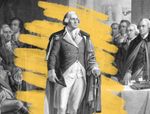


Ben Franklin proposed something like daylight saving time as a joke.

In most U.S. states, the clocks get set forward an hour on the second Sunday in March, making Monday morning arrive just a little too soon. While daylight saving time can seem like a cruel joke to groggy night owls, the concept is logical enough that even Benjamin Franklin suggested, albeit humorously, maximizing daylight by getting up earlier.
In 1784, when Franklin was living in Paris, he submitted a satirical letter to the Journal de Paris called “An Economical Project.” In it, he wrote that he was up late discussing ways to save money on lighting and went to bed around 3 a.m. or 4 a.m., before “[an] accidental sudden noise waked [sic] me about six in the morning, when I was surprised to find my room filled with light.”
Franklin, who was the author of Poor Richard’s Almanack, noted that he consulted his almanac and was “astonished” to find that the sun “was to rise still earlier every day till towards the end of June.”
In the letter, Franklin calculated that Parisian families could save millions of pounds by waking up with the sun and swapping candlelight for sunlight. He jokingly suggested levying a tax on closed shutters, setting limits on candle purchases, and ringing all church bells right as the sun rises — switching to cannons if the bells proved ineffective.
Franklin did not, even as a joke, suggest changing the time, but his letter was still somewhat prophetic. Ultimately, when countries started implementing daylight saving time, the main argument for doing so was fuel savings.


