


The Origins of 7 Famous Mythical Beasts
Some monsters have been haunting human stories for thousands of years. Others arrived surprisingly recently, helped along by newspaper headlines, blurry photographs, mistranslations, and the occasional hippopotamus-foot ashtray. In many cases, even cryptids that may seem to have an ancient lineage — such as Bigfoot and the Yeti — acquired their familiar names and appearances only in the past century or so.
From glowing-red-eyed winged beings to ship-crushing sea creatures, these famous beasts developed in very different ways. Some may have been inspired by real animals or fossils; others can be traced to a particular sighting, publicity stunt, or hoax. Here’s a look at the origins of seven of the most famous mythical monsters.
Bigfoot, aka Sasquatch
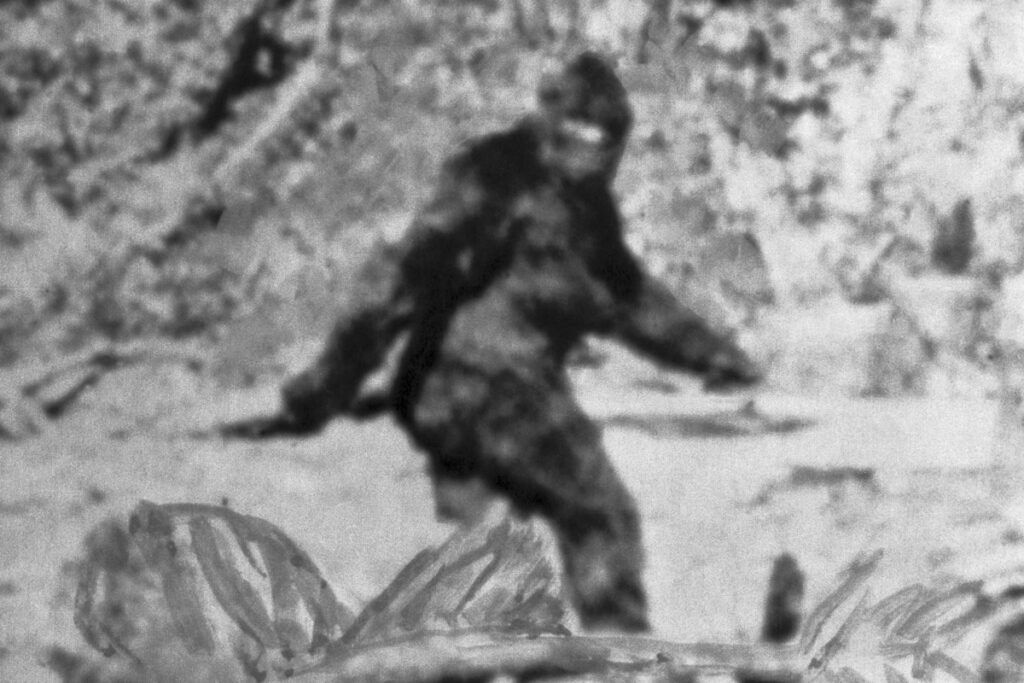
Stories of giant, hairy “wild men” living on the edges of civilization appear in cultures around the world, but the names Sasquatch and Bigfoot have much more specific histories. In the 1920s, teacher John W. Burns collected accounts of wild man figures while working on the Chehalis Indian Reservation in British Columbia’s Fraser Valley. He anglicized the term sæsq’ec, which comes from Halkomelem (a Coast Salish language), as “Sasquatch,” and introduced it to a wider audience in a 1929 article in Maclean’s magazine. In 1957, the nearby resort town of Harrison Hot Springs proposed staging a Sasquatch hunt as part of British Columbia’s centennial celebrations; officials rejected the proposal, but the resulting publicity revived the nearly forgotten creature and sent the story around the world.
The familiar term “Bigfoot” emerged in Northern California in the summer of 1958. Loggers near Bluff Creek reported that an intruder was disturbing their equipment and leaving enormous footprints. After worker Jerry Crew posed with a plaster cast for the Humboldt Times, the “Big Foot” story became a national sensation. The tracks were later attributed to carved wooden feet reportedly used by construction worker Ray Wallace, but the name stuck — and eventually merged with the older Sasquatch tradition.
More from our network






The Yeti, aka the Abominable Snowman
Himalayan cultures had long told stories about wild men, mountain beings, and bearlike creatures under various names. “Yeti” may derive from a Sherpa term, Yeh-teh, meaning “animal of rocky places,” or from a similar expression meaning “man-bear.” Some of the same regional words were also applied to the Himalayan brown bear, which can stand and walk on its hind legs.
The English term “Abominable Snowman” resulted from the 1921 British Everest Reconnaissance Expedition. After the party encountered mysterious humanlike tracks in the snow at more than 20,000 feet, some of the Sherpa guides became convinced they belonged to one of the wild, hairy men of legend. Journalist Henry Newman, who interviewed the expedition members in Calcutta, translated the Sherpa name for the creature as “Abominable Snowman.” (He later acknowledged that “filthy” would have been a better translation than “abominable.”)
Famous evidence followed, including Eric Shipton’s 1951 photograph of an enormous footprint, but alleged Yeti remains have proved less impressive: A preserved finger was human, a supposed scalp came from the hide of a serow (a goatlike Himalayan mammal), and many tracks can be explained by bears, wolves, or melting snow.

Mothman
Mothman’s story first developed over 13 months in Point Pleasant, West Virginia. On November 12, 1966, five gravediggers near Clendenin reported seeing a brown, humanlike creature soar overhead. Three days later, two young couples encountered something much more frightening near an abandoned power plant: a 6- or 7-foot figure with wings and enormous red eyes. They claimed it followed their car at speeds approaching 100 mph.
More sightings followed, and the creature received a name inspired by Killer Moth, a Batman villain. Reports largely subsided after December 15, 1967, when Point Pleasant’s Silver Bridge collapsed, killing 46 people. Paranormal writer John Keel later connected the sightings, the disaster, and local UFO reports in his 1975 book The Mothman Prophecies, transforming a brief local scare into an ominous modern legend.

The Loch Ness Monster, aka Nessie
The modern Loch Ness Monster, also called “Nessie,” dates primarily to 1933, though there were older traditions of kelpies, water horses, and other aquatic beings in Scotland. In April 1933, local hotel owners Aldie and John Mackay reported seeing a disturbance in the loch, a freshwater lake in the Scottish highlands. “Stop, the beast!” Aldie reportedly said as her husband drove past some kind of large, black, splashing creature. A local journalist turned the sighting into a dramatic account of an enormous monster, and reports multiplied.
The legend quickly attracted hoaxers. Enormous tracks reported by big-game hunter Marmaduke Wetherell (dispatched by the Daily Mail to investigate the scene) were found by Natural History Museum researchers to have been made with a preserved hippopotamus foot, of the type commonly used in ashtrays or umbrella holders. And the famous 1934 “Surgeon’s Photograph,” which appeared to show Nessie’s long neck rising from the water, was eventually exposed as a model built around a toy submarine. Some skeptical researchers have even argued that the familiar long-necked Nessie was influenced by the movie King Kong, released in Britain just before the 1933 sightings began.

The Kraken and Sea Serpents
Nessie is far from the only strange creature said to be lurking in the watery depths. In Norse mythology, Jörmungandr, “the world serpent,” lies in the ocean encircling Midgard, the realm of humans. Other traditions produced Leviathan, the Japanese sea deity Ryūjin, and numerous dragons and serpents associated with tides, storms, and the dangers of ocean travel.
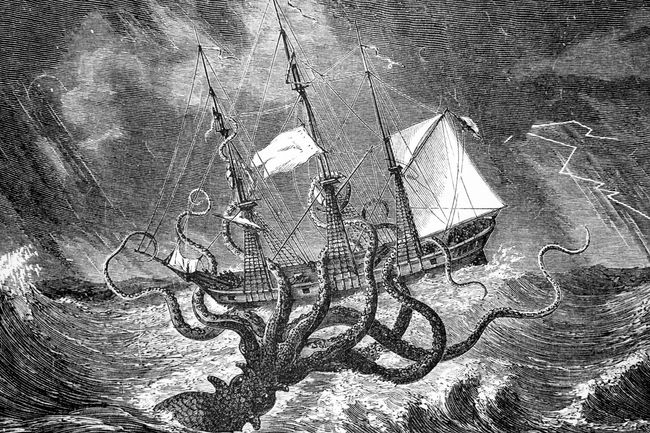
The Kraken developed in Scandinavian folklore as a creature capable of engulfing ships and crews. Unlike many legendary beasts, it has a particularly convincing real-life counterpart: the giant squid, an elusive deep-sea animal that can reach up to 40 feet long. Oarfish, whales, seals, octopuses, and porpoises may likewise explain the sea serpent sightings of legend.

Dragons
Giant serpents and reptilian monsters appeared independently in ancient Mesopotamia, Egypt, Greece, China, and numerous other societies. Even the English word reflects the creature’s snakelike beginnings: It comes from the Greek drakōn, originally meaning “large serpent.”
The dragons of different regions did not always behave alike. European dragons were often fire-breathing symbols of greed, destruction, and evil, especially after the rise of Christianity, while Chinese dragons were generally benevolent forces associated with rain, rivers, wisdom, and imperial authority. Scholars have proposed numerous inspirations for dragon stories, including crocodiles, monitor lizards, whales, dinosaur fossils, and humanity’s deeply rooted fear of large predators.

Unicorns
One of the earliest written accounts of a unicorn-like creature came from the Greek physician Ctesias, who traveled in Persia in the fourth century BCE. He described a wild creature with a white body, red head, blue eyes, and a multicolored horn sprouting from the middle of its head. Later writers, including Roman naturalist Pliny the Elder, repeated and embellished similar reports, possibly combining descriptions of rhinoceroses, oryxes, and other unfamiliar animals.
Medieval Europeans generally regarded unicorns as real. Biblical translations rendered the Hebrew word re’em, probably referring to a wild ox, as “unicorn,” while religious bestiaries transformed the animal into a symbol of purity and Christ. Supposed unicorn horns were believed to detect or neutralize poison and sold for enormous sums. Many were actually narwhal tusks — long, spiraled teeth that looked exactly like the relic a unicorn believer hoped to find.


