



The Most Popular Toys Throughout the 20th Century
The 20th century produced an array of iconic toys that captured the public’s imagination and, in some cases, continue to delight young people worldwide. The Slinky, originating in the 1940s, and the Rubik’s Cube, first sold in the United States in the early 1980s, have remained more or less the same since their invention, invoking a nostalgic simplicity. Other toys, such as LEGO and Barbie, have offered up countless iterations, weathering changing trends to endure in popularity and appeal. The legacy of these toys is in more than just their entertainment value — it’s in the way they reflected or even set cultural trends, interests, and technological advancements. Here are some of the most popular toys throughout the 20th century, many of which are still around today.

The Slinky
In the early 1940s, United States industry was largely focused on producing goods for the war effort, and it was during this time that the Slinky was accidentally invented. Richard James, a mechanical engineer, stumbled on the idea in 1943 while working with tension springs for naval equipment at a Philadelphia shipyard. After accidentally knocking some of his prototypes off a shelf, James couldn’t help but notice the way one of them “walked” down a stack of books on his desk. He worked on this strange spring — which his wife named “Slinky” after seeing the word in the dictionary — over the next two years. By the end of 1945, James got an initial run of 400 Slinkys into a local department store. It wasn’t until he staged a live demonstration, however, that the product’s popularity picked up, and the toy sold out. Within the first 10 years, he sold 100 million. The Slinky has endured for decades, not only as a popular toy on its own, but also through licensing and its iconic jingle — the longest-running jingle in television advertising history.
Sponsored Content




More from our network






LEGO
LEGO is known for its colorful modular plastic bricks, but when the company started in Denmark in 1932, it made wooden toys such as cars and yo-yos. Plastic toys didn’t come along until the late 1940s, when founder Ole Kirk Christiansen developed the forerunner of the buildable bricks we know today, known at the time as Automatic Binding Bricks. In 1958, the modern LEGO brick was patented, with an updated interlocking design that became its signature.
Through a deal with Samsonite, LEGO made its way to Canada and the U.S. in the early 1960s, but the iconic toy didn’t truly find its footing in North America until the early 1970s. The New York Times claimed the toy had been “ineptly marketed” since its stateside arrival, and the then-head of LEGO’s U.S. operations called the deal with Samsonite “a disaster.” In 1973, however, the company took over its own U.S. production and sales and, per the Times, sales “soared.” LEGO grew to be much more than a toy in the ensuing decades — it became an entertainment empire. Throughout it all, the company has stood by its name, which also happens to be its guiding principle: LEGO is an abbreviation of the Danish words “leg godt,” meaning “play well.”

Barbie
When Mattel released the first Barbie doll on March 9, 1959, it was the first time that most children had seen a three-dimensional, adult-bodied doll — the norm at the time were baby dolls designed to be taken care of. Ruth Handler, the co-founder of Mattel and creator of Barbie, had a different idea. After watching her daughter Barbara, the toy’s namesake, play with paper dolls, Handler envisioned a doll that was a little bit older and could inspire more aspirational play: Young girls could see their future selves in the doll, instead of a child to nurture. Barbie’s initial launch at the New York Toy Fair faced some skepticism from other toy industry executives, but Handler’s instincts were right: Around 300,000 Barbies sold within the first year. As beloved as Barbie was, though, she also courted controversy. Early on, detractors were uncomfortable with the doll’s figure. Barbie was at times criticized for being too conventional; other times, too progressive. But the doll’s popularity endured as the company diversified her looks, skin tones, body types, and, of course, jobs: Throughout her lifetime, Barbie has explored more than 250 different careers. The cultural phenomenon continues to this day: Around 1 billion Barbie dolls have been sold, and in 2023, the first live-action movie based on Barbie became the year’s biggest release.

G.I. Joe
Following Mattel’s major Barbie breakout, rival toy company Hasbro sought a similar success story. Barbie thrived by marketing primarily to young girls, and Hasbro aimed to fill a gap in the market with a toy made for boys. In the early 1960s, toy maker Stan Weston approached Hasbro with an idea for a military toy, but was turned down. One Hasbro executive, Don Levine, saw the toy’s potential, however, and workshopped the idea until the company approved. It wouldn’t be called a doll, though — Hasbro created the term “action figure” to market the new product, and even forbade anyone in the company from referring to it as a doll. Released in 1964, the original G.I. Joe line consisted of four 12-inch figures, one for each of the U.S. military branches: the Army, Navy, Air Force, and Marines. The action figure took off, and within two years, G.I. Joe accounted for almost 66% of Hasbro’s overall profits. The franchise eventually created less military-centric characters, expanded to comic books and animated series, and embraced sci-fi, espionage, and team-based narratives that have carried the toy as a symbol of adventure and heroism across generations.

Rubik's Cube
At first glance, a Rubik’s Cube appears simple, but the mathematically complex puzzle is anything but, and solving it is a problem that has captivated the public ever since the toy’s invention. Created by Hungarian architect and professor Ernő Rubik in 1974, the first "Magic Cube," as he called it, resulted from months of work assembling blocks of wood with rubber bands, glue, and paper. After painting the faces of the squares, Rubik started twisting the blocks around, and it took him weeks to get it back to its original state. One month later, he finally did. He patented the toy Rubik’s “Buvos Kocka,” or “Magic Cube,” and it first appeared in Hungarian toy shops in 1977. Within two years, 300,000 Hungarians had bought the puzzling cube. By 1980, an American toy company was on board, and international sales of the renamed Rubik’s Cube took off — 100 million were sold in three years. As quickly as the craze started, however, it seemed to fade. The New York Times reported in 1982 that it had “become passe,” replaced by “E.T. paraphernalia…[and] electronic video games.” But the toy has nonetheless endured, and to date, an estimated 350 million colorful cubes have been sold, making it one of the bestselling puzzles in history.

Cabbage Patch Kids
Known for their one-of-a-kind features, unique names, and adoption certificates, Cabbage Patch Kids caused a full-on frenzy in the 1980s, leading to long lines at stores — and even riots. Although the dolls are known as the invention of Xavier Roberts, whose signature is on every doll, the origin story reportedly starts with a folk artist named Martha Nelson Thomas. In the late 1970s, Thomas was selling her handmade “doll babies” at craft fairs in Louisville, Kentucky. Roberts reportedly resold the doll babies at his own store for a while, but eventually remade and renamed them Cabbage Patch Kids. (Thomas eventually took Roberts to court over the copyright, but the pair settled in 1985.) In 1982, Roberts licensed his dolls to the Coleco toy company, and the following year, thanks to a robust advertising campaign, demand was much greater than supply , sparking angry mobs of disappointed parents that holiday season. Around 3 million Cabbage Patch Kids had been “adopted” by the end of 1983, and over the next two years, sales topped half a billion dollars. The doll’s popularity faded quickly after that, but Cabbage Patch Kids remain toy store fixtures to this day.

Tamagotchi
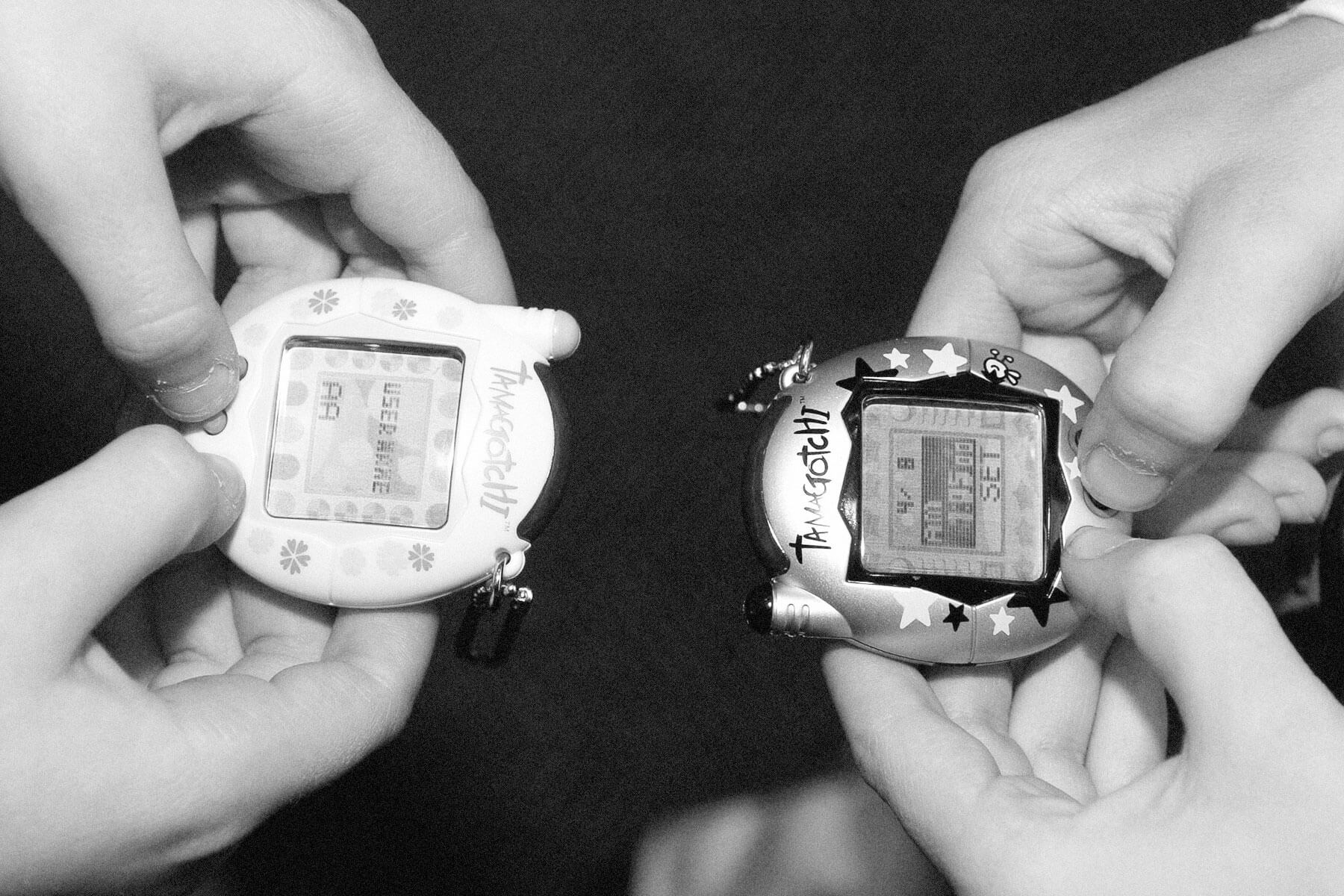
In the early 1990s, video game consoles were household staples, and by the end of the decade, tech toys such as Tickle Me Elmo and Furbies caused consumer crazes. But one pocket-sized toy that combined the best of both worlds was a ’90s must-have: the virtual pet. The handheld pixelated companions required regular feeding and playing, imbuing users with responsibility and emotional attachment, and engaging them in a type of continual play that was relatively new at the time.
The most popular virtual pet was the Tamagotchi, created by Japanese toy company Bandai. It was released in the United States on May 1, 1997, six months after it was launched (and subsequently sold 5 million units) in Japan. After the first day of the toy’s U.S. release, some stores were already sold out. Within the year, there were several competing virtual pets: GigaPets and Digimon offered different pet options and more gameplay. The constant connectivity of the virtual pets led to school bans, and as the internet gained traction in the late ’90s and early 2000s, online versions such as Neopets all but replaced the Tamagotchi. Virtual pets had an undeniable influence on future trends in gaming and handheld electronic devices, and while the toy has gone through several iterations and relaunches over the years, the original Tamagotchi largely remains a nostalgic relic of the ’90s.