

Why Do So Many Old Photos Include Empty Chairs?
W.S. Gilbert, the English dramatist and one half of the Victorian-era theatrical partnership Gilbert and Sullivan, once said, “It isn’t so much what’s on the table that matters, as what’s on the chairs.” Wise words indeed, though in the case of early photography, it wasn’t so much what was on the chairs as what was not.
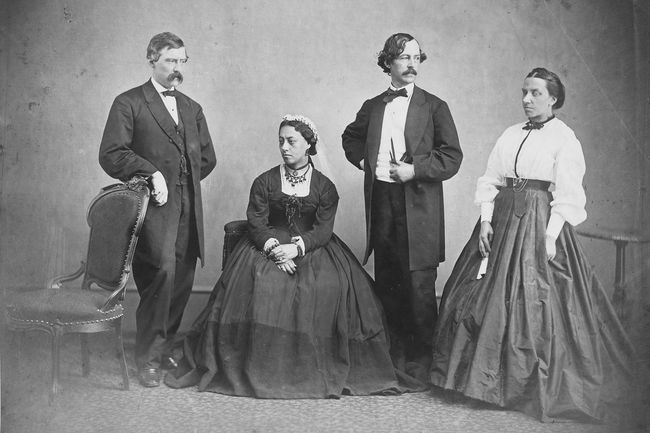
Scroll through any archive of 19th-century portraits and you’ll eventually notice a trend: an oddly formal, perfectly staged chair with nobody sitting in it. Here’s a look at the strange preponderance of empty chairs in early photography, and what these vacant pieces of furniture were meant to say.
Sacred Seats
The empty seat has a long history in art. In the ancient world, it served as a symbol of invisible or absent authority, such as a god. And beginning with the rule of Alexander the Great, the empty throne was used in Greek culture to represent absent monarchs. Another example can be found in the concept of hetoimasia, a Greek term meaning “preparation,” that arose in early Christianity.
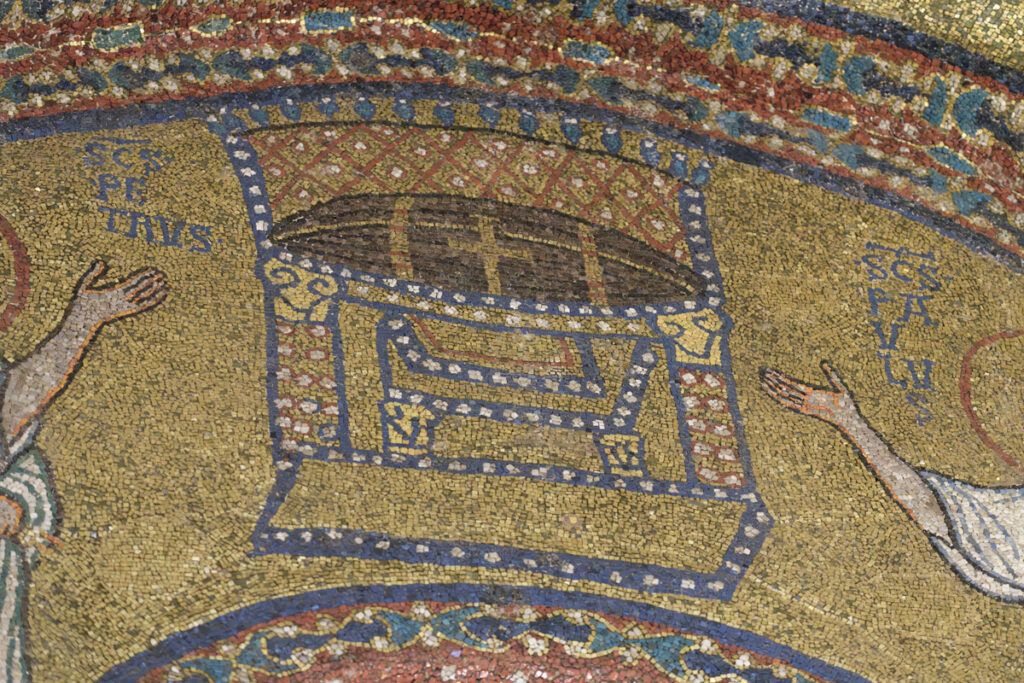
Hetoimasia was an iconographic motif of an empty, richly ornamented throne, typically occurring in late antique and Byzantine art (it’s still used in Orthodox iconography today). The vacant throne was often depicted surrounded by church and lay leaders awaiting the Last Judgment. A famous example of hetoimasia can be seen in the mosaic in the dome of the Arian Baptistry in Ravenna, Italy, built in the late fifth century CE, which depicts the empty throne of Christ flanked by the apostles.
While the empty throne was an established motif in early religious art, it didn’t gain any great symbolic traction in the secular world. It’s surprisingly hard to find well-documented examples of empty thrones or chairs used symbolically in a secular or everyday manner in paintings before the mid-1800s. The empty chair of the ancients stayed largely in its lane for centuries — until, that is, the invention of photography and one particular war.
More from our network






Wartime Grief
While ancient art had employed empty seats to symbolize the absence or unseen power of gods, messiahs, and kings, a more specific and much more personal version of the symbol found a new audience during the American Civil War. While the Mexican-American War was the first major conflict to be captured on camera, the American Civil War was the first to be extensively, systematically, and graphically documented by photography — and the public developed a newfound appetite and fascination for photos.
At the same time, families across the country faced a very literal empty seat at the dinner table as husbands, sons, and brothers marched off to battle — many never to return. This wave of grief found a voice in popular culture in 1861, the first year of the conflict. That year, a Massachusetts newspaper published the poem “The Vacant Chair,” written after the death of an 18-year-old Union lieutenant at the Battle of Ball’s Bluff in Virginia. The poem, by Henry Stevenson Washburn, was quickly set to music and became one of the era’s most widely sung mourning ballads. The chorus goes:
We shall meet, but we shall miss him.
There will be one vacant chair.
We shall linger to caress him
While we breathe our ev’ning prayer.
The image of the empty chair took on a powerful new significance in the U.S. For families who had lost someone, commissioning a portrait of his empty chair became a way to honor him and include him in the family’s visual history despite his absence. The vacant chair became a potent symbol of a family’s grief. And while similar images may have existed before the Civil War, it was during this conflict — in which an estimated 620,000 men, or roughly 2% of the U.S. population, lost their lives — that the empty chair became a powerful symbol of loss and grief.

A Shorthand for Absence
The symbol didn’t fade once the Civil War ended. By then, the image had become a recognizable convention in its own right, understood by viewers almost instantly as a symbol of loss rather than a strange accident of composition. A formally lit, carefully composed photograph of a single empty chair, often surrounded by mourning family members, required no caption — audiences understood immediately that someone significant was missing from the frame, whether a soldier, a parent, a friend, or a public figure.
The motif wasn’t limited to photography. After the death of author Charles Dickens in 1870, an engraving of his empty study chair circulated widely as a way of mourning him in print. And in 1888, Vincent Van Gogh borrowed from the same visual tradition in one of his most iconic images — a simple chair standing on a bare floor of terra-cotta tiles, the seat vacant save for the artist’s pipe and tobacco.
What began as an ancient symbol of absence found new meaning in a nation ravaged by war, ultimately becoming one of photography’s most impactful and enduring motifs — proof that sometimes the most powerful way to depict a person is to carefully photograph the space they used to occupy.


