

Count Dracula was inspired by Vlad the Impaler of Transylvania.

  • Vlad the Impaler
Vlad the Impaler
Pictorial Press Ltd/ Alamy Stock Photo
Author Michael Nordine

October 11, 2023

Love it?

Neither Dracula nor vampires are, strictly speaking, real — at least so far as we know — but that doesn’t mean they don’t have their basis in reality. While writing his endlessly influential novel Dracula, author Bram Stoker was inspired by Central European folklore in general and Vlad III in particular, whom history often remembers by a more colorful name: Vlad the Impaler. The son of Vlad Dracul, he’s believed to have been born in Transylvania, eventually became voivode (ruler) of Wallachia (a region of Romania south of Transylvania), and more than earned his nickname by impaling his enemies. Vlad Dracul took his name when he joined the Order of the Dragon, a secret cabal of Christian knights; “dracul” is Romanian for “dragon.” As fate would have it, “Dracula” means “son of Dracul.”

Stoker called Transylvania “one of the wildest and least known portions of Europe” in the book’s first chapter, an evocative description based on his research into the area and 19th-century travel literature (though the author never actually visited Romania’s spookiest region). Before falling in battle in 1476, Vlad III earned a reputation for brutality. Impalement was his favorite means of torturing and dispatching his enemies, but he was also known to decapitate, disembowel, and skin them; some claim he even dipped his bread in his victims’ blood while using their impaled bodies as morbid dinner guests. Whether such gory details are true may never be known, but it’s easy to see how he inspired one of the world’s most fearsome fictional characters.

The first environmental law was passed in 1306.

  • Coal-burning bottle works
Coal-burning bottle works
Credit: Les Archives Digitales/ Alamy Stock Photo
Author Sarah Anne Lloyd

November 7, 2024

Love it?

Unhealthy air can feel like a modern problem — or at least a postindustrial one — but humans have been breathing dirty air for a long time, and protesting it just as long. In ancient Rome, courts considered civil claims against people and businesses that released too much smoke in the air, and Byzantine Emperor Justinian declared clean air to be a human right. Then in 1306, King Edward I of England passed what’s often considered the first environmental law, when he made a proclamation banning coal burning.

Until the mid-13th century, British people burned wood to stay warm. But as cities such as London expanded and populations boomed, wood became scarce — demand for firewood and timber increased, and forestland was cleared for agricultural uses. So those who couldn’t afford the rising price of firewood turned to something readily available: sea-coal, now simply known as coal. (At the time, “coal” referred to charcoal.) It’s unclear exactly why it was called sea-coal, but it may have had something to do with how Brits could gather it from beaches along the North Sea.

Not only did sea-coal produce thick smoke and an awful smell, but it also was woefully inefficient, so furnaces needed more coal to produce the same amount of heat as wood, leading to even more smoke. In Britain’s notoriously foggy weather, all that smoke created smog that could hang in the air for days at a time. The pollution was so bad in London that in 1285, commissions were appointed to figure out a way to be rid of it. Still, the air got even worse, and in 1306, Edward I banned the burning of sea-coal. Although the king threatened steep fines and smashed furnaces as a punishment, the ban didn’t have a lasting effect on the use of coal in Britain.

Betsy Ross probably didn’t make the first American flag.

  • Betsy Ross with U.S. flag
Betsy Ross with U.S. flag
Keith Lance/ DigitalVision Vectors via Getty Images
Author Adam Levine

October 11, 2023

Love it?

In 1777, Congress passed a resolution dictating that the official flag of the newly founded United States would consist of 13 white stars against a blue background, and 13 alternating red and white stripes. According to popular myth, the first American flag was subsequently created by Philadelphia resident Elizabeth “Betsy” Ross. There’s just one problem with this common narrative: There’s no evidence that it’s actually true. 

The claim that Betsy Ross made the first American flag didn’t surface until 1870 — nearly a century after the nation’s founding — in a speech Ross’ grandson William Canby delivered to the Historical Society of Pennsylvania. Canby said that his grandmother would often recount a story of the time she received a visit from George Washington, who presented her with a proposed design of 13 stripes and 13 six-pointed stars, and asked if she could create a flag based on the sketch. According to Canby, Ross agreed, and even came up with the idea to give the stars five points instead of six, and to arrange them in a circle. 

Canby’s story was compelling, and the speech was widely circulated in popular newspapers. Before long, it became accepted as fact that Ross created the first American flag. However, although Canby produced affidavits from Ross’ daughter and granddaughter corroborating the tale, he never offered any concrete evidence — including, crucially, the flag itself. (In fact, there’s no evidence of any American flag that can be traced back to Ross.) Over the years, historians have called Canby’s account into question, and while it’s been established that Ross did sew flags for the Pennsylvania Navy, some historians suggest the original Stars and Stripes was actually created by Francis Hopkinson, a New Jersey delegate to the Continental Congress. They cite a bill that Hopkinson sent to the Congress in 1780, asking for payment for designing “the flag of the United States of America.” But this theory also remains unconfirmed, as the Congress refused to pay Hopkinson for his services, claiming he “was not the only one consulted.” To date, the true origin of the American flag remains a mystery.

The first traffic light was illuminated with gas lamps.

  • Old traffic light
Old traffic light
Jene Smu/ Shutterstock
Author Sarah Anne Lloyd

October 12, 2023

Love it?

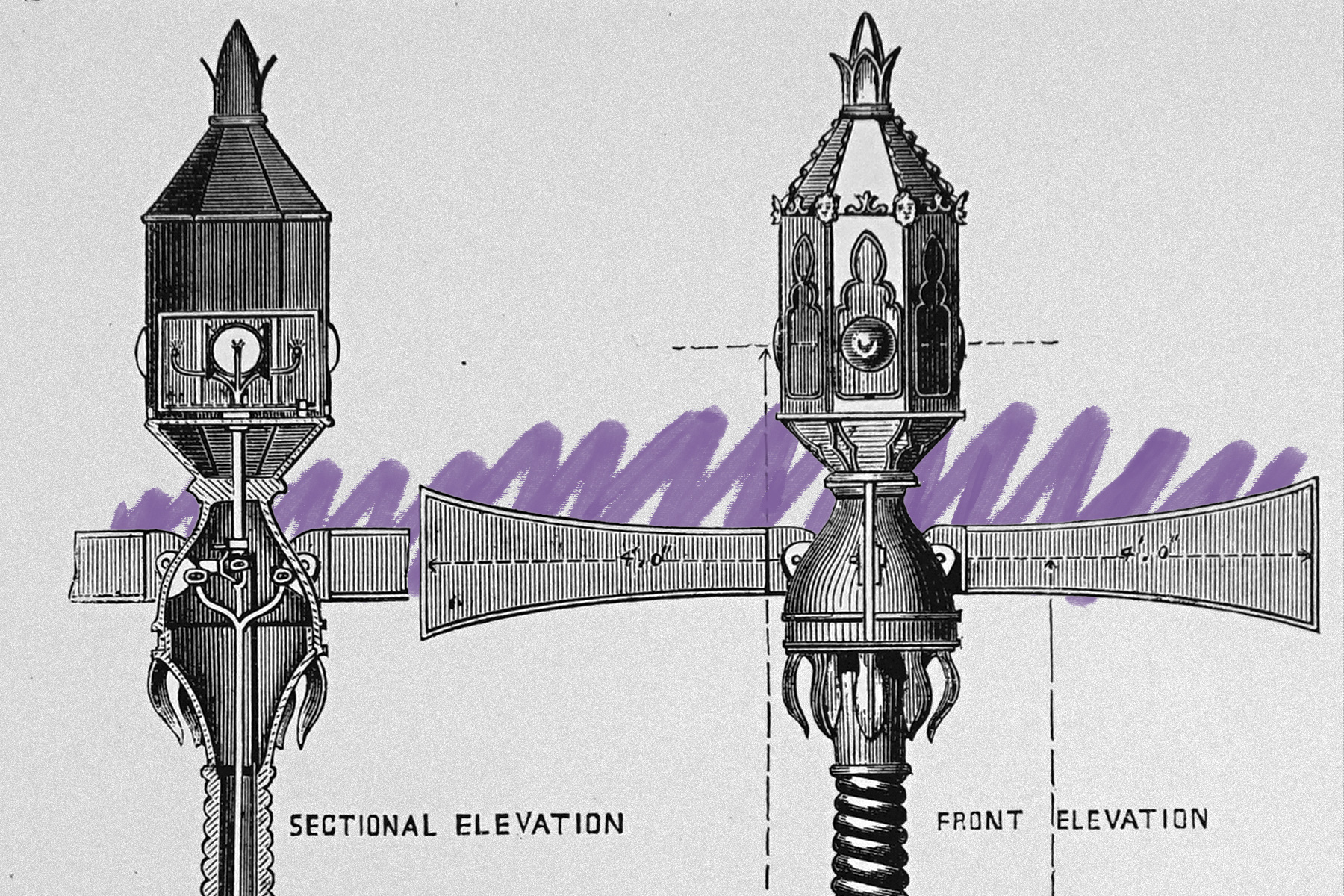
Traffic accidents were a problem long before motor vehicles dominated the road — pedestrians, horses, and carts all competed for the right of way, sometimes with fatal results. In fact, the first traffic signal in Britain predated cars: Railroad engineer John Peake Knight helped design signaling systems for trains, including semaphore signals, which employed a movable arm to indicate whether a train operator should stop. Knight proposed that these signals could work on city streets, too, with gas lamps for nighttime visibility.

After the plan received government approval, the first gas traffic light was installed in London on December 9, 1868, just outside the Houses of Parliament. This being Victorian England, it was ornately decorated, with a hollow cast-iron column adorned with gilding and acanthus leaves. Above the signal arms, an octagonal box with a pineapple finial contained red and green gas lamps. Automated lights were still several decades away, so the signal had to be manually operated by a police officer 24 hours a day. The light was successful at first, and drivers, for the most part, actually paid attention to it. But the very next month, a leaky pipe filled the hollow tower with gas and caused an explosion that severely injured the officer operating it. London didn’t get traffic lights again until electric lights were installed in 1929.

Vikings didn’t actually wear horned helmets.

  • Viking ship, 1888
Viking ship, 1888
Credit: ZU_09/ iStock
Author Sarah Anne Lloyd

October 31, 2024

Love it?

When you think about Vikings, you may picture horned helmets — and vice versa. The horns are a staple of Viking imagery in comics, sports mascots, and Halloween costumes, but there’s actually no evidence that they were widely used.

Horned helmets first entered the Viking mythos in 1876, when artist Carl Emil Doepler included them in his iconic costume designs for German composer Richard Wagner’s Der Ring des Nibelungen, also known as the Ring Cycle, an epic tale of Norse mythology told over the course of four different operas. (Even if you’re not familiar with the work, you’ve probably heard “Ride of the Valkyries,” which opens up the last act of the second opera, Die Walküre, or The Valkyries.) Wagner’s opera was so wildly influential on popular culture that the helmets became associated with Vikings in the popular consciousness. 

Then, in 1942, two workers were harvesting peat from a bog near Veksø, Denmark, when they uncovered a pair of horned helmets, which were originally attributed to Vikings, supposedly adding a little scientific backup to the popular lore. Alas, 80 years later, new analysis showed that the helmets dated back to around 900 BCE, some 1,700 years before the first Vikings. Without those artifacts, there isn’t any strong archaeological evidence that indicates Vikings ever wore horned helmets.

Evidence of the Big Bang was discovered by accident.

  • Big Bang galaxy explosion
Big Bang galaxy explosion
Quality Stock Arts/ Shutterstock
Author Adam Levine

October 11, 2023

Love it?

On May 20, 1964, astronomers Arno Penzias and Robert Wilson were conducting experiments at Bell Labs in New Jersey when they found something odd. While using the Holmdel Horn Antenna to study radio signals emitted by objects in deep space, they noticed that the antenna was picking up an unusual, persistent buzzing noise. At first, they thought the noise was caused by some sort of interference or equipment failure, so they methodically investigated every possible explanation, including the idea that pigeons were roosting in the antenna. Eventually, the astronomers realized the noise was not an equipment error, but an electromagnetic signal dating back billions of years, called cosmic microwave background radiation. Also referred to as CMB, it is the oldest known light in the universe, and one of the strongest pieces of evidence for the Big Bang theory.

The Big Bang theory posits that the universe began as an infinitely hot, infinitely dense singular point in space, which then began to inflate and expand at an incredibly fast rate. Before this expansion, the cosmos would have been too hot and dense for light to travel through, but when the universe was about 380,000 years old, it finally cooled enough for the subatomic particles to bind together into stable atoms (a process known as “recombination”), allowing light to travel through space for the first time. The cosmic microwave background that Penzias and Wilson stumbled on is a remnant of that first light, and its discovery is strong evidence that the recombination event predicted by the Big Bang theory actually occurred. What’s more, the CMB’s temperature is uniform throughout the cosmos, supporting the theory that the universe originated at a single, super-dense point in space which then inflated rapidly in all directions. For their serendipitous discovery of the CMB, Penzias and Wilson received the 1978 Nobel Prize in physics.

The Third Punic War didn’t officially end until 1985 — 2,000 years after it started.

  • Carthage after the Third Punic War
Carthage after the Third Punic War
Credit: mikroman6/ Moment via Getty Images
Author Timothy Ott

October 31, 2024

Love it?

From 264 to 241 BCE and again from 218 to 201 BCE, the city-states of Rome and Carthage engaged in a pair of epic wars for control of the western Mediterranean region. Although Rome was victorious in both cases and emerged as the dominant power, Carthage’s continued prosperity remained problematic to hawkish members of the Roman Senate. As a result, the Third Punic War was launched in 149 BCE to settle this zero-sum conflict between the two rivals, leading to the siege and razing of Carthage by 146 BCE. Considering that the city was utterly destroyed, and its survivors were sold into slavery, it’s easy to see how the terms of a peace treaty failed to materialize between the conquerors and the conquered.

Two millennia later, that oversight represented a loose thread for representatives of Rome, the capital of the Republic of Italy, and Carthage, a suburb of the Tunisian capital of Tunis. So on February 5, 1985, two leaders, the mayor of Rome and the honorary mayor of Carthage (which was largely absorbed into Tunis except some ruins preserved as an archaeological site), met at the historic city to sign the type of peace agreement that had been neglected by their ancient predecessors. The treaty, which pledged the “exchange of knowledge and the establishment of common information, cultural and artistic programs,” was ostensibly part of a larger endeavor to strengthen ties between Italy and Tunisia, and was undoubtedly engineered to generate favorable publicity for the participants. Regardless of the motivation, this innocuous signing carried major historical ramifications, as it brought a formal conclusion to a war that had been frozen in time since the last of the fighting on the north African coast 2,131 years earlier.

New York City’s first motorized taxis were electric vehicles.

  • Electrobat electric car
Electrobat electric car
Old Books Images/ Alamy Stock Photo
Author Sarah Anne Lloyd

October 12, 2023

Love it?

At the turn of the 20th century, gas engines hadn’t become the standard yet; electric, gas, and steam-powered vehicles each held around one-third of the U.S. automobile market. Electric vehicles stood out from the pack because they didn’t produce unpleasant pollution (sound familiar?) and because they were much quieter than their gas or steam counterparts. The big disadvantage was that they didn’t have great range, something that drivers still worry about today. 

One of the very first electric cars in America was the Electrobat, a heavy, utilitarian carriage powered by an adapted ship’s motor and built specifically for rough city roads. It had to safely lug around a 1,600-pound lead-acid battery, but it was the ideal vehicle to make short trips throughout the city. It became the basis for the first cab company in New York City, the Electric Carriage and Wagon Company, founded in 1896. The founders also came up with a clever way of working around the battery problem: a battery-swapping station made from an old skating rink on Broadway. 

The Electric Carriage and Wagon Company reported 1,000 trips in April 1897, its first month of service, and the electric cab system was a success in New York. But public opinion — and the service itself — soured once it tried to expand to other markets. The new facilities were poorly managed, with undertrained drivers and badly maintained batteries. The taxi company, later called the Electric Vehicle Company, shut down in 1907, and electric cabs didn’t return to the Big Apple until 2022.

Agatha Christie wrote romance novels under the name Mary Westmacott.

  • Agatha Christie, 1891
Agatha Christie, 1891
Credit: INTERFOTO/ Alamy Stock Photo
Author Sarah Anne Lloyd

October 24, 2024

Love it?

Mystery stories require a meticulous structure, and emotions typically don’t drive the plot. This worked out well for Agatha Christie, who liked her public persona to be somewhat guarded, especially after her infamous 1926 disappearance caused a media ruckus. But Christie found a way to express herself more deeply while still maintaining her privacy: She wrote several semi-autobiographical romance novels under a pen name, Mary Westmacott. The alias allowed Christie to be emotionally vulnerable — and the books received rave reviews.

“The Westmacott [novels] always said things that Agatha couldn’t express any other way,” biographer Laura Thompson wrote in Agatha Christie: A Mysterious Life. These books gave Christie an outlet to explore her fraught relationship with her first husband Archie Christie, reflect honestly (and sometimes harshly) on motherhood, and unearth past trauma. In the Westmacott novel that most closely parallels her own life, Unfinished Portrait (1934), a woman reeling from losses similar to those experienced by Christie meets a handsome painter on an exotic island who listens to her painful life story while creating her portrait. 

The Westmacott books were a valuable, anonymous outlet to Christie from 1930 until 1949, when her identity was revealed in the “Atticus” gossip column of the Sunday Times. She published two more books under the pseudonym after that, but insisted that her real name stay out of the promotion.

Leonardo da Vinci did most of his writing backward.

  • Da Vinci sculpture
Da Vinci sculpture
Victor Ovies Arenas/ Moment via Getty Images
Author Sarah Anne Lloyd

October 9, 2023

Love it?

Famed Renaissance polymath Leonardo da Vinci left behind thousands of pages of notes and diagrams from his many pursuits in math, anatomy, botany, science, engineering, and art — he created more than 200 illustrations with notes on flight alone. Leonardo had groundbreaking ideas on everything from human anatomy to bridge design, and even the writing itself is impressive: Most of it is written from right to left, in a mirror image of ordinary European script. He only wrote left to right when someone else needed to read it. He also used his own form of shorthand.

Leonardo never directly explained why he wrote this way, but there are a few prevailing theories. It may have been simply practical: The artist was most likely left-handed, and writing left to right could get messy using a pen and ink. He also may have been trying to keep his ideas secret from potential copycats, or even trying to hide his work from the Roman Catholic Church. While Leonardo’s artwork is rich with religious symbolism, he was also a skeptic, and some of his ideas would have been at odds with the teachings of the church. After Leonardo’s death, his loose-leaf notes went to his student Francesco Melzi, an Italian painter. They were bound into several volumes, mirror writing and all, and soon began circulating among European elites as collector’s items. They are still kept in museums and private collections today.