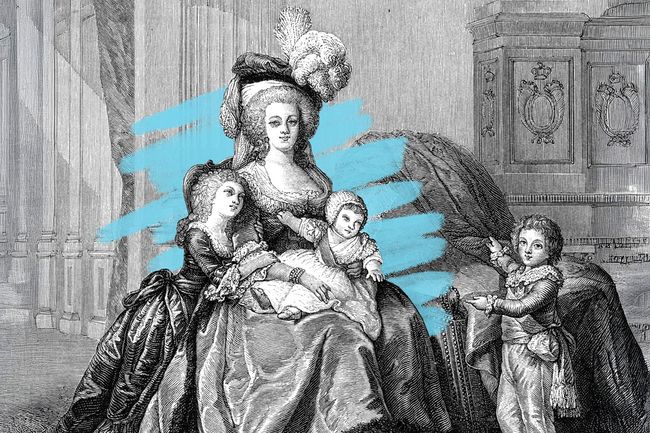
Marie Antoinette never said “Let them eat cake” about the people of France, but she might have said it about her adopted children — of which she had several. The Austrian-born queen of France had four biological children with King Louis XVI, only one of whom survived childhood, and adopted several others.
The couple adopted Armand Gagné (born François-Michel Gagné) in 1776, when the boy was 5, after the queen’s carriage nearly ran him over and she learned he was an orphan. Jean Amilcar was born in 1781 in French Senegal, enslaved as a child, and given to Marie Antoinette as a gift; she freed, baptized, and adopted him.
Ernestine Lambriquet’s parents were servants at Versailles, which led to her being a playmate of the king and queen’s daughter Marie-Thérèse; after the girl’s mother died in 1788, she was also adopted by the monarchs. So, too, were Jeanne Louise Victoire (better known as Zoë) and her two older sisters, whose father was an usher for the king and who were orphaned and then adopted in 1790. Only Armand, Ernestine, and Zoë actually lived with Marie Antoinette and Louis XVI, however — the rest were more akin to foster children whom the royal family supported financially.
Marie Antoinette may have been out of touch with her people, but let it not be said that she was impolite. After being tried and found guilty of three charges (including high treason) by the Revolutionary Tribunal on October 16, 1793, she was sentenced to death by guillotine. After accidentally stepping on the foot of her executioner, Charles-Henri Sanson, while climbing the scaffold, she spoke her last words: “Pardonnez-moi, monsieur. Je ne l'ai pas fait exprès,” or “Pardon me, sir, I meant not to do it.” She was initially buried in an unmarked grave in Madeleine cemetery, but the remains of her and Louis XVI were exhumed and reburied at the Basilica of Saint-Denis in 1815, during the Bourbon Restoration.
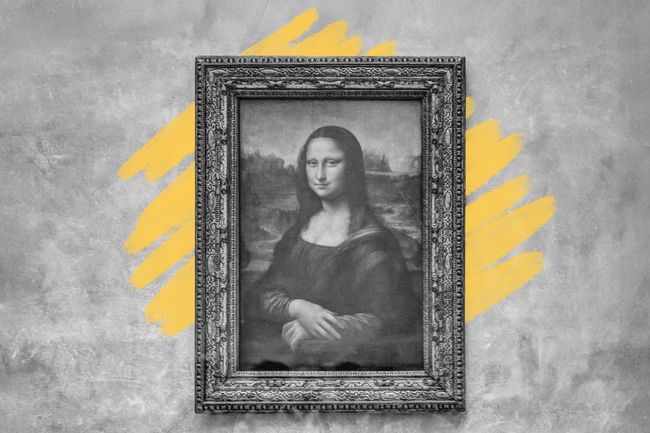
There’s a reason you’ve heard of a “Mona Lisa” smile but not “Mona Lisa” eyebrows: She doesn’t have any. The world’s most famous painting was created by Leonardo da Vinci at the beginning of the 16th century. That was, to put it mildly, a long time ago — long enough for the eyebrows that Leonardo originally painted to have faded, according to at least one expert. French engineer Pascal Cotte made a 250-megapixel scan of the portrait in 2007 and spent an estimated 3,000 hours analyzing his data after being allowed to use the Louvre’s laboratory, concluding that the painting originally included both brows and lashes.
People (especially women) have been plucking and shaving their eyebrows for thousands of years based on fashion trends, but that doesn’t appear to be the reason that the subject of the “Mona Lisa” — widely thought to be Lisa del Giocondo — is sans eyebrows in her portrait. Her husband is believed to have commissioned the painting, which Leonardo ultimately kept; some historians have speculated that he was simply never paid for his work, while others believe he became personally attached to it. In any case, Cotte also concluded that the woman’s face initially appeared wider, and her smile more expressive, in the drafting stages, with her famously sedate, evocative look coming later.
The “Mona Lisa” wasn’t world-famous until it was stolen.
Though it’s always been well regarded, the painting’s level of fame was closer to its subject’s expression for the first 400 years of its existence. That changed forever when the portrait was stolen from the Louvre in 1911, a sensational crime that led to Pablo Picasso being suspected of carrying out the heist. He didn’t; it was actually a former Louvre employee named Vincenzo Perugia, who wanted to return the “Mona Lisa” to Italy. But the painting’s profile rose astronomically in the more than two years it was missing. By 1919, the El Paso Heraldreferred to the heist as “the most colossal theft of modern times,” and the painting had become the most colossal artwork of its time.
Advertisement
Advertisement
Men used to wear corsets.
Credit: Marcus Harrison - adverts/ Alamy Stock Photo
AuthorSarah Anne Lloyd
October 10, 2024
Love it?24
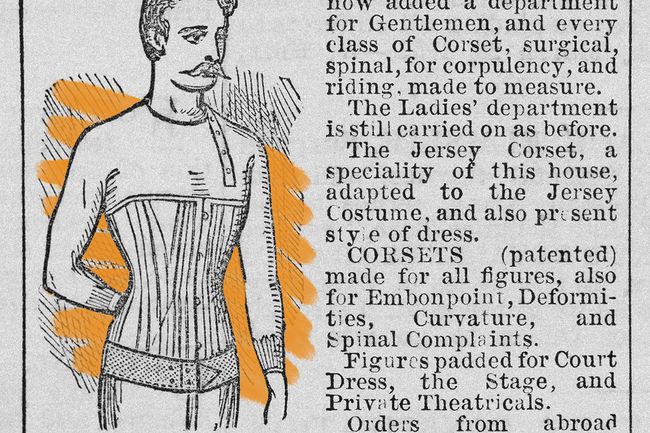
The classic lace-up, waist-cinching corset is endlessly versatile and an absolute mainstay of any Renaissance fair outfit. The historical garment is generally thought of as women’s wear — but it wasn’t always that way. During England’s Regency era at the turn of the 19th century — a setting you may be familiar with from Jane Austen novels or, more recently, the Netflix series Bridgerton — men’s fashion moved away from powdered wigs and elaborate, stiff fabrics. Dandyism came into style in Europe, and the most fashionable gentlemen went for a sleek, streamlined look as ornamentation took a backseat to precise tailoring. Collared linen shirts, fitted trousers, and waistcoats were all the rage.
Just like how some shapewear can make a dress drape just so, the cut of a bespoke jacket and breeches could be complemented by the right corset. To get the exact shape they were after, well-coiffed men would not only wear corsets, but also add padding around their chest and shoulders. The famously plump George IV was known to wear a corset, too — one almost made him faint at his 1821 coronation.
Exaggerated silhouettes remained in fashion until the 1830s, but corsets weren’t necessary for the increasingly understated mainstream menswear of the 1840s. While dandy culture never fully went out of style — famed dandies such as Charles Baudelaire and Oscar Wilde rose to prominence after 1840 — the Regency-era masculine corset did.
Even if you’re not familiar with the name, you’ve probably seen a union suit before: It’s that one-piece long underwear with a butt flap. It’s typically associated with rugged working men of the late 19th and early 20th centuries, but it actually has its roots in the mid-1800s women’s suffrage movement. Women eager to ditch restrictive undergarments such as corsets, hoop skirts, and bustles tried switching to a flannel ensemble sometimes called a “chemiloon.” The legs reached down to the ankle, eliminating the need for garters and stockings. Some models even had buttons for attaching layers of light skirts that could replace heavy petticoats.Although they were in use much earlier, the first of these garments was patented in 1868 as the “emancipation union under flannel,” as it “emancipated” women from restrictive clothing. Later versions were advertised as thriftier and more hygienic alternatives to traditional women’s fashion. The garments proved controversial at the time for women, but they were also very comfortable and easy on the wallet — so when a men’s version emerged, it was extremely popular.
Advertisement
Advertisement
One of the most popular breakfast cereals was invented by accident.
Credit: Hanasaki/ iStock
AuthorTimothy Ott
October 3, 2024
Love it?46
Well before the name Kellogg became synonymous with milk-infused breakfast fare and animated tigers, it was associated with health. While serving as director of the Battle Creek Sanitarium in Michigan, physician John Harvey Kellogg earned widespread fame in the late 19th and early 20th centuries for his efforts to cure a range of illnesses. To treat digestive problems, Kellogg developed a concoction called Granula in the 1870s that was made from wheat flour, oatmeal, and cornmeal, baked at high temperatures, and crumbled into tiny pieces. Though it was a hit with patients, the food was a little too similar to what is now considered the first breakfast cereal, the identically named Granula created by nutritionist James Caleb Jackson in 1863, fueling a lawsuit that forced Kellogg to change his product’s name to Granola.
Around 1894, Kellogg and his associates, which included his wife, dietitian Ella Eaton Kellogg, and younger brother Will Kellogg, tried developing a new flaked cereal made from wheat dough. While the exact origin is unclear, several sources point to one batch of dough being left out longer than planned. This slightly moldy but fermented batch produced large, delightfully crispy flakes when baked, and the team debuted their creation, dubbed Granose, to a strong reception in the summer of 1895. Of course, the health-minded Dr. Kellogg refused to allow any sugar in this cereal; it was only after former patient C.W. Post hit it big with the 1897 launch of Grape-Nuts, a flavored spinoff of the Granola he saw produced in the sanitarium’s kitchen, that Will devised the sweeter, corn-based version of Granose that became ubiquitous on American kitchen tables as Corn Flakes.
The Kellogg brothers sued each other over the brand name.
From the 1880s until 1906, Will Kellogg quietly managed the Battle Creek Sanitarium’s operations under the critical eye of his domineering older brother. After the younger sibling finally achieved success with his Kellogg’s Toasted Corn Flake Company, he was none too thrilled when his elder relation began selling his own cereals under the label Kellogg’s Food Company of Battle Creek. Will subsequently filed a lawsuit for copyright infringement in August 1910, prompting a countersuit from his brother. Although they initially settled out of court in 1911, Will reignited the legal furor a few years later when he began marketing bran cereals in direct competition with those created by his brother. However, a Michigan judge determined the Kellogg trademark belonged to Will’s company, a decision upheld by the Michigan Supreme Court in 1920, ensuring the family’s cereal glory would thenceforth be the sole domain of the younger brother.
Advertisement
Advertisement
The tradition of using three names dates back to ancient Rome.
Credit: Robert Ray/ iStock
AuthorSarah Anne Lloyd
August 15, 2024
Love it?47
Just like most Americans have a first, middle, and last name, many ancient Romans also used three names, especially upper-class men. (Women typically had two names, and enslaved people were called by just one.) But these ancient monikers weren’t a direct parallel to how we use middle names today. Roman full names started with a praenomen, or personal name, which often came from numbers or months, possibly noting the time or order of birth (such as “Quintus” or “Sextus”). The middle name, nomen gentilicium, came from a person’s gens, a broad family clan based on a patriarchal line. Names then ended with a cognomen, which could reflect a smaller family group or reference a specific attribute, such as a big head, pug nose, or left-handedness. These nicknames were passed down to children, and throughout a person’s life, they could have more than one cognomen.
Some Roman men, particularly aristocrats, had more than three names — often because they were adopted or accepted an inheritance, linking them to additional family members. One senator in the second century CE had a whopping 38 names, six of which came from his father. By the fifth century CE, multiple names had mostly fallen out of use, and after that Roman citizens typically went by just one name. Middle names came back into vogue in Renaissance Italy, when families would give their children Catholic saint names in hopes the saints would protect them. This paved the way for middle names as we know them today, although the practice didn’t catch on in Britain or the United States until the 19th century.
The common moniker “Pablo Picasso” is actually only a small fraction of the famous painter’s full name. When he was born in 1881 in Andalusia, Spain, his family gave him around 15 names (sources vary), taken both from saints and members of his own family. The exact order is unclear, but his full name was along the lines of Pablo Diego José Francisco de Paula Juan Nepomuceno Crispín Crispiniano María de los Remedios de la Santísima Trinidad Ruiz Picasso. His first name, Pablo, came from an uncle who had died a few years before he was born. It actually took a while for Picasso to settle on which names to use in his signature. He signed his earliest paintings P. Ruiz, then P. Ruiz Picasso, then P.R. Picasso, before settling on Picasso.
Advertisement
Advertisement
It took the Oxford English Dictionary editors five years just to reach the word ‘ant.’
Credit: jozef mikietyn/ Alamy Stock Photo
AuthorSarah Anne Lloyd
October 31, 2024
Love it?24
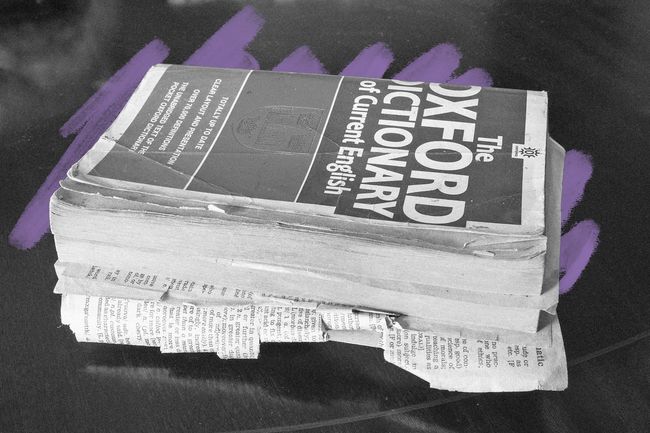
The Oxford English Dictionary, also known as simply the OED, is a massive reference book containing not just words — including obsolete ones — and their definitions, but also detailed information on the words’ history and usage. The project was born in 1857, when the Philological Society of London, a group dedicated to the history of literature and words, established a committee to collect words that didn’t appear in existing dictionaries at the time. Their goal was to document the English language going back to Anglo-Saxon times, which ended around 1000 CE — so quite a lot of territory to cover.
Work started in earnest in 1879, after Oxford University Press signed on to finance and publish the dictionary, at the time called the New English Dictionary (NED). The staff buckled down and got to work reading and researching; editor James Murray estimated the dictionary would take about 10 years to compile. In 1884, after working on the dictionary for five years, the first fascicle (meaning a part of a book) came out. It only covered the words “a” through “ant.”
The project was clearly more ambitious than the Philological Society had originally imagined. Murray started working on the dictionary full time, and over the next several years he was joined by another editor and two co-editors. The last fascicle was published on April 19, 1928, nearly 50 years after work began. The original plan was for the dictionary to contain 6,400 pages over four volumes; ultimately, the first edition of the NED contained 12 volumes with 15,487 pages, covering a whopping 414,825 words. Today, the OED continues to document the growing English language, and includes more than 600,000 entries, with new words and meanings added regularly.
J.R.R. Tolkien worked on the Oxford English Dictionary.
You can, in some small part, thank Lord of the Rings author J.R.R. Tolkien for the Oxford English Dictionary — or maybe you can thank the OED for TheLord of the Rings, since etymology features so heavily in Tolkien’s epic trilogy. A 27-year-old Tolkien joined the OED project in 1919 and spent around 18 months on staff, focusing on words beginning with the letter “W” (including “wasp” and “walnut”). The author went on to coin words that appeared in later editions of the dictionary, including “hobbit,”“eucatastrophe,” and “dwarves” as a plural form of “dwarf.”
Advertisement
Advertisement
Men have been shaving since the Stone Age.
Credit: Penta Springs Limited/ Alamy Stock Photo
AuthorMichael Nordine
September 25, 2024
Love it?57
Long before the age of electric and five-blade razors, men still felt compelled to shave. The practice is so old, in fact, that it dates back to the Stone Age, roughly 100,000 years ago. The planet was quite cold at the time; somewhat counterintuitively, this made facial hair a liability rather than a way of keeping warm. A long, damp beard doesn’t exactly feel good in the rain or snow, and in extreme enough conditions it could trap enough moisture to freeze against the skin and cause frostbite.
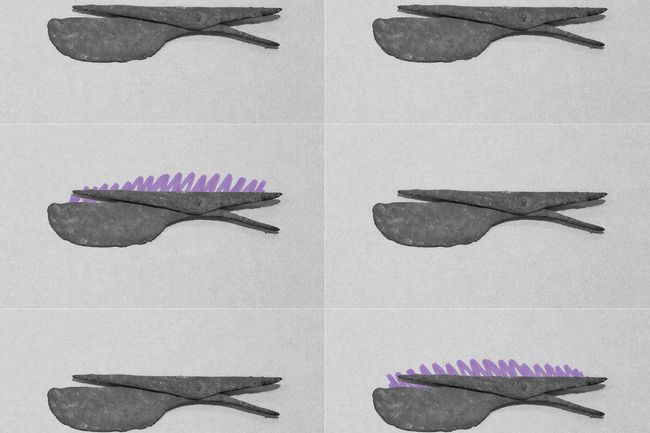
This necessitated the first instances of shaving, though our ancestors’ methods were unsurprisingly primitive. Lacking more advanced tools, the first people brave enough to maintain their facial hair did so with seashells that essentially functioned as tweezers — they simply pulled their hair out. They later moved on to using obsidian shards, which sounds less painful and more effective. Copper razors appeared in ancient Egypt between 2686 BCE and 2181 BCE, with some featuring decorative flourishes such as goose heads and hippo-shaped handles, suggesting this more primitive method of shaving lasted longer than most of us would like to imagine.
The Stone Age was the longest period in human history.
It isn’t even close, either, as the Stone Age began an estimated 2.6 million years ago and ended about 5,000 years ago. The period has been described as the first 99% of human history. Homo sapiens weren’t the only hominids around during this era, as the now-extinct Neanderthals and Denisovans were still alive at the time as well. Divided into three periods — Paleolithic, Mesolithic, and Neolithic — the Stone Age came to an end when humans first started working with metal and began making tools and weapons out of bronze. It was followed by the Bronze Age and then the Iron Age.
Advertisement
Advertisement
People used to send their children through the U.S. mail.
Credit: Bygone Collection/ Alamy Stock Photo
AuthorSarah Anne Lloyd
September 11, 2024
Love it?107
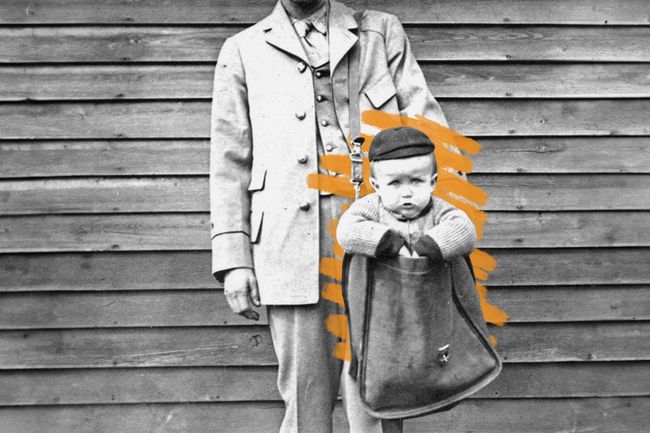
On January 1, 1913, the United States Post Office began offering parcel service. While private freight companies had already existed for quite some time, the program allowed many more people, including folks in rural communities, to get goods shipped to their front doors. Immediately, Americans started shipping pretty much anything they could think of. One of the first packages sent using the service was a brindle bulldog. College kids started mailing their laundry home. More than one Flushing, Queens, resident received an opossum. But the most brazen early parcel customers trusted the Post Office with was the most precious cargo of all: human children.
The first recorded baby delivered via parcel post was James Beagle, an 8-month-old resident of Glen Este, Ohio. His journey wasn’t long: A carrier picked up the “well wrapped” infant from his parents on January 25 and, per the address on an attached card, delivered him to his grandmother just a few miles away. The postage cost 15 cents, and his parents insured him for $50.
This practice was never officially authorized, and in February 1914, the second assistant postmaster general announced that babies could not be transported by mail. But this didn’t stop postal employees, particularly rural ones, from occasionally breaking the rules. Just a month later, a 14-pound baby was shipped 12 miles from her grandmother in Clear Spring, Maryland, to her mother in Indian Springs. On February 19, 1914, 5-year-old May Pierstorff was mailed about 75 miles from her home in Grangeville, Idaho, to her grandparents’ place, which cost 53 cents in postage and was, apparently, cheaper than a train ticket. (In that case, she was chaperoned by a cousin who worked for the mail service.) In 1915, 6-year-old Edna Neff was mailed a whopping 720 miles from Pensacola, Florida, to her father’s home in Christiansburg, Virginia.
That same year, on August 31, 1915, 3-year-old Maude Smith — with a shipping label sewn to her dress, appropriate postage affixed, and snacks in hand — was placed by her mail carrier on a train from Caney to Jackson, Kentucky, to visit her sick mother. When she arrived at her destination, she had a note from a postal clerk to a local postmaster pinned to her dress: “I doubt the legality of the sending, but it was put on the train and I must deliver and report.” The U.S. Post Office actually investigated that case, and although it’s unclear what the outcome was, Smith was one of the last children ever to be mailed.
Someone shipped a building’s worth of bricks through the U.S. mail.
The first few years of the Post Office’s parcel service were a little wild, and it wasn’t just traveling children testing its limits. Builders realized the service’s shipping rates were often cheaper than those of the freight companies they’d been using to bring materials to job sites. The most famous case of bricks-by-mail happened in 1917, when merchant W.H. Coltharp experienced a serious case of sticker shock when trying to ship the 80,000 bricks needed for the facade of a bank building in Vernal, Utah.
The bricks were coming from Salt Lake City, and as there was no road between the two cities, shipping them by wagon freight cost four times as much as the bricks were worth. Vernal was only a couple of postage zones away from Salt Lake City, however, so shipping by train via parcel post cost half as much. Coltharp had his 40 tons of bricks split up into crates and mailed about a ton, or 40 crates, of bricks at a time. Suddenly, rail workers used to just throwing mail bags off a train and moving along had to stop and unload 2,000 pounds of bricks — and it started leading to major delays throughout the region. Eventually, word reached the postmaster general, who quickly drafted a rule limiting the parcels a person could mail in one day to 200 pounds.
Advertisement
Advertisement
Yellow pencils used to be sold as a luxury item.
History Facts
AuthorSarah Anne Lloyd
September 19, 2024
Love it?189
Today, yellow pencils are just normal, generic pencils, but when they were popularized in the late 19th century, they were considered the height of luxury. Before then, lacquered pencils were often a sign of low-quality wood that needed to be covered up, and they were usually finished in darker colors such as black or maroon. A decent pencil, meanwhile, would be either plain or varnished wood. But that all changed with the introduction of luxury pencils made with the finest, purest graphite, which came from a mine on the border of China and Siberia.
The German pencil manufacturer Faber (now Faber-Castell) was the first company to get its hands on graphite from the region, and it allowed for extremely fine-tuned pencil formulas, with 16 different degrees of hardness and softness. This was a big deal in the pencil world, and Faber boasted in its catalogs that “Siberian graphite” was “a household word amongst artists, engineers, designers and draftsmen generally.” Around the same time, pencil-maker Franz von Hardtmuth decided to develop an expensive luxury pencil to compete with Faber’s Siberian graphite. He created a pencil with 17 grades of hardness — one more than Faber’s — and started dressing it up to bring to market. The new pencil got 14 coats of yellow lacquer and tips sprayed in gold paint, and was named the Koh-I-Noor 1500, after the famed large diamond.
Yellow was an auspicious color: It was known as the Chinese color of health and good fortune, so it winked at the sought-after Asian graphite, although it’s unclear where Hardtmuth’s graphite actually came from. Combined with the pencil’s black tip, it also displayed the colors of the Austro-Hungarian flag. The Koh-I-Noor 1500 pencil hit the market in 1888, and, even with the higher price tag, it was a smash hit. Other pencil companies, particularly those eager to associate themselves with Asian graphite, also started painting their pencils yellow; by 1895, even Faber had a “Yellow Siberian” pencil. The American-made Dixon Ticonderoga No. 2 pencil — the yellow one ubiquitous in classrooms today — debuted in 1913.
Pencils have always had graphite-based cores. The earliest graphite pencils were likely made in the 16th century, and while graphite was a relatively new phenomenon, people were very familiar with lead — a soft, dark mineral that leaves marks behind. The word “graphite” wasn’t coined until the late 18th century, so the pencil material was often referred to as “lead,” “black lead,” or “plumbago” (which essentially means lead). In some areas of the British Isles, it was called “wadd,” but the etymology of that one is lost to the ages. It’s not that everyone literally thought the material was lead — but, unable to pinpoint exactly what graphite was, “lead” was a nice stand-in. While the term “plumbago” has since fallen out of vogue, “lead” stuck around.
Advertisement
Advertisement
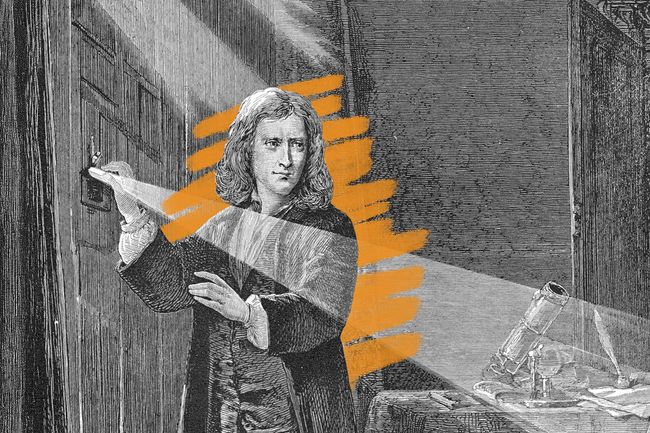
Isaac Newton stuck a needle in his own eye as part of an experiment.
If you’re brave enough, there is no more convenient scientific subject than your own body: You’re intimately familiar with it, you get near-instant feedback, and you always have it with you (though, to be clear, we are not suggesting you do this at home). Inventors who have used themselves as guinea pigs include polio vaccine inventor Jonas Salk, LSD creator Albert Hofmann, and one of history’s most famous scientists, Sir Isaac Newton. (And no, this is not about the apple that probably didn’t fall on his head.)
Newton had a keen interest in the study of light and vision, especially the way humans perceive color. He wondered if colors were created from inside the eye or by forces outside of it, and if it was the former, if directly manipulating one’s eye could create the sensation of color.
To find out, Newton tried an experiment with his own sight. He took a bodkin (a kind of large sewing needle), inserted it into his eye socket below his actual eye, and pressed it into the back of the eyeball. Then he started to record what he saw, writing, “There appeared severall [sic] white darke & coloured circles.”
It was a neat effect, but not a scientific breakthrough. Newton gained more insight and acclaim through far less invasive experiments with prisms; by demonstrating that a beam of white light could be refracted and then come back together, he found that colors are innate properties of light, not tricks of the eye.
Newton is remembered as a man of science, but he certainly dabbled in more esoteric pursuits, too. A trove of his papers sold at auction in 1936 revealed thousands of pagesdevoted to alchemy, the pseudoscientific study of the transmutation of matter that flourished in the Middle Ages. Newton’s notes included work on finding the philosopher’s stone, a magical substance said to perform miracles such as turning lead into gold and creating an elixir of life. Even at the time, alchemy was considered radical, and Newton’s alchemy manuscripts were deemed not fit to be printed upon his death.
Advertisement
Advertisement
Another History Pick for You
Today in History
Get a daily dose of history’s most fascinating headlines — straight from Britannica’s editors.