



The original winner of the 1904 Olympic marathon rode in a car for most of the race.

  • 1904 Olympic runners
1904 Olympic runners
History and Art Collection Alamy Stock Photo
Author Bennett Kleinman

January 23, 2024

Love it?

The marathon at the 1904 St. Louis Games is one of the most unusual events in Olympic history, in no small part because it was initially won by an athlete who rode in a car for most of the race. That man was American Fred Lorz, who led the field of 32 runners right out of the gate. At the 9-mile mark, however, Lorz began suffering from terrible cramping, as the combination of sweltering heat and dirt being kicked up from the unpaved route made it difficult to breathe. It was then that Lorz opted to hitch a ride with a passing vehicle, which he rode in for 11 miles before hopping out to complete the race on foot in just under three hours.

Just as President Theodore Roosevelt’s daughter Alice was set to award Lorz his medal, a spectator accused him of cheating. Lorz admitted to riding in a car, claimed it was just a joke, and stated that he didn’t actually plan to accept the trophy. With Lorz disqualified, American Thomas Hicks emerged as the new winner, though he too ran an unconventional race. At various points throughout the marathon, Hicks was helped by his trainers, who fed the athlete a combination of poisonous strychnine, egg whites, and brandy in hopes of stimulating his body. The result was that Hicks began to hallucinate around the 20-mile mark, and he was eventually carried over the finish line by trainers with a time of 3:28:53 — still taking home the gold.

An early proposal for daylight saving time changed the clock eight times a year.

  • DST time change
DST time change
Credit: RobertPetrovic/ iStock
Author Sarah Anne Lloyd

February 27, 2024

Love it?

Every year, people in many parts of the world set their clocks forward an hour each spring at the beginning of daylight saving time (DST), and then back an hour in the fall. One of the first people to seriously advocate adjusting the clock seasonally was a British builder named William Willett, who had noticed that few people were out in the early morning light during the summer, and his golf games often ended early when the sky became dark. But his idea worked a little differently than the “spring forward” and “fall back” time changes many observe today.

In his 1907 self-published pamphlet “The Waste of Daylight,” Willett wrote, “The sun shines upon the land for several hours each day while we are asleep, and is rapidly nearing the horizon, having already passed its western limit, when we reach home after the work of the day is over.” To maximize time spent during the daylight hours, he suggested changing the clocks at 2 a.m. on Sundays during the spring and fall — something we still do today. But, unlike today, the transition was to happen 20 minutes at a time over the course of four weeks, twice a year, for a total of eight time changes each year. And rather than an even hour, the time difference would be 80 minutes. Willett’s proposal was considered in the British House of Commons in 1908, but it was met with derision and soundly rejected. 

During World War I a decade later, many countries were looking for new ways to save money. Inspired by Willett’s original proposal, which had included estimated savings in electricity costs, Germany and Britain implemented “Summer Time” in 1916, changing the clocks just one hour twice a year. The United States followed suit, first observing daylight saving time on March 31, 1918.

Homo sapiens has been on Earth for only 0.0067% of its existence.

  • Human skull in museum
Human skull in museum
Credit: Vladislav Gajic/ Shutterstock
Author Michael Nordine

April 30, 2024

Love it?

Though humans have been the planet’s dominant species for some 50,000 years, our reign is a blink of an eye in the grand scheme of things. Homo sapiens (Latin for “wise man”) has been on Earth for only 0.0067% of its existence, an infinitesimally small amount of time that emphasizes both how insignificant and how impressive a species we are. Homo sapiens first emerged in Africa approximately 300,000 years ago, at which point several other types of humans were still extant, including Neanderthals, Denisovans, Homo floresiensis, Homo naledi, Homo luzonensis, and Homo erectus. Though our ancestors are known to have coexisted with Neanderthals and Denisovans, it’s possible they never encountered the other early humans.

There are a number of theories seeking to explain why we survived and our predecessors didn’t, including superior brainpower and dumb luck, plus a newer theory suggesting that our interpersonal skills and dependence on one another helped us succeed where others failed. (Perhaps the secret really was the friends we made along the way.) We haven’t been here the longest — that would be Homo erectus, whose 1.5 million years on the planet is a record among humans that we sapiens won’t surpass for some 1.2 million years — but we have left the most sizable footprint. Whether that ends up being a good thing may be for the next species to decide.

Jack-o’-lanterns come from an Irish legend.

  • Boy painting Jack o Lantern, c 1910s
Boy painting Jack o Lantern, c 1910s
Credit: Prestor Pictures LLC/ Alamy Stock Photo
Author Kevin McCaffrey

October 25, 2023

Love it?

The jack-o’-lantern has its roots in Irish lore — specifically, the legend of a man called “Stingy Jack,” who tried to trick the devil and suffered the consequences. There are many versions of the tale, but the gist is that Jack invited the devil for a drink but balked when it came time to pay, and asked the devil to transform into a coin he could use for payment. The devil went along with this, but Stingy Jack kept the coin for himself, putting it next to a silver cross in his pocket to keep the devil from reverting to his original form. Jack’s next move was to free the devil if he agreed not to bother Jack for a year and not to take his soul when he died. A year later, Jack once again tricked the devil, this time getting him to agree to leave Jack alone for 10 years.

After Jack died, God wouldn’t allow the trickster into heaven, and the devil, honoring his deal, wouldn’t take Jack into hell, either. The devil sent Jack away with only a burning coal from the fiery underworld to light his way. A ghostly Jack placed the coal in a carved-out turnip lantern, sentenced to roam the Earth for eternity. The Irish referred to the specter as “Jack of the Lantern,” and eventually, “Jack o’ lantern.” People even began carving out lanterns to mimic the story. The first jack-o’-lanterns were made by carving out turnips, beets, and potatoes and illuminating them with a candle. These date back at least to 1640, when author Sam Howell referenced “a turnip cut like Death’s head with a candle in’t.” Pumpkins aren’t native to Ireland, so the tradition as we know it didn’t come about until Irish immigrants brought the legend to the United States, where pumpkins had been introduced to Europeans by Indigenous people in the Americas.

First Lady Mamie Eisenhower popularized the pink bathroom trend.

  • First Lady Mamie Eisenhower, 1954
First Lady Mamie Eisenhower, 1954
Credit: Bettmann Archive via Getty Images
Author Michael Nordine

October 20, 2025

Love it?

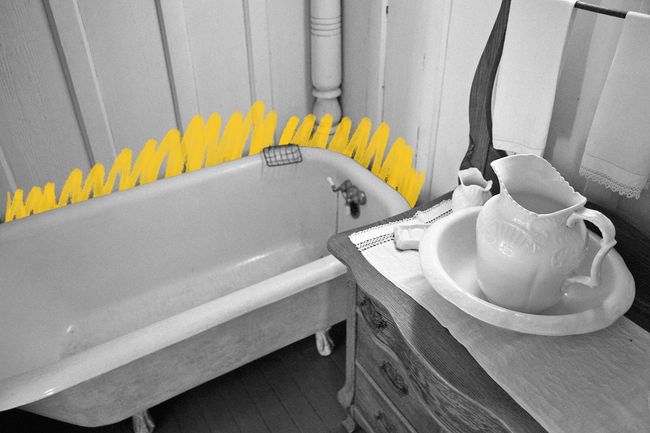
At least 57 women have held the title of first lady of the United States, but not many have had colors named after them. One was Eleanor Roosevelt, whose inaugural gown was of a hyacinth hue that came to be known as Eleanor Blue, and another was Mamie Eisenhower, who was so tickled by a certain color that her favorite shade was nicknamed Mamie Pink. It wasn’t just her dresses that were pink, however, as she adorned so much of the White House residence in the color that reporters called it “the Pink Palace.” That included the bathroom, beginning a trend that there’s still evidence of in midcentury homes today.

Bathrooms had been styled a sanitary white for decades, and the move toward a brighter, happier color has been identified as a visual marker of the postwar optimism that defined the 1950s. It wasn’t just a few Mamie-heads who got in on the action: It’s been estimated that as many as one in four American homes built between 1946 and 1966 had some form of pink bathroom. The trend fell out of favor as the Cold War and space race resulted in a shift toward a colder, more futuristic aesthetic, but many midcentury houses still sport bathrooms full of Mamie Pink.

Leonardo da Vinci may have painted two versions of the ‘Mona Lisa.’

  • Leonardo da Vinci painting the “Mona Lisa”
Leonardo da Vinci painting the "Mona Lisa"
Credit: Fine Art/ Corbis Historical via Getty Images
Author Timothy Ott

October 20, 2025

Love it?

Smiling at viewers from behind a glass enclosure at Paris’ Louvre Museum, the “Mona Lisa” is perhaps the most famous painting in the world. But is it possible that this one-of-a-kind Renaissance masterpiece from Leonardo da Vinci is actually two of a kind? That’s the stance of the Mona Lisa Foundation, which holds that another version of the 16th-century painting, often known as the “Isleworth Mona Lisa,” portrays a younger depiction of the sitter from approximately a decade earlier.

Deriving its name from an owner of the painting based in Isleworth, England, the “Isleworth Mona Lisa” largely remained out of the public eye until being unveiled in Geneva, Italy, amid a 2012 publicity push from the Mona Lisa Foundation. Beyond the resemblance between the older and younger subject, the foundation points to the results of examinations that indicate both artworks were from the hand of the same artist. Historical evidence also suggests the existence of more than one “Mona Lisa,” as the painting was recorded among the possessions of Leonardo’s servant in 1525 despite having been sold to French King Francis I seven years earlier.

While the double-version theory has its supporters in the art world, others are hesitant to make a definitive connection. For one thing, the “Isleworth Mona Lisa” was rendered on canvas, while Leonardo mainly painted on wood. There are also numerous copies of the “Mona Lisa” to be found, including one that was apparently painted alongside the original by one or more of Leonardo’s apprentices. And then there’s the matter of the objectivity of the Mona Lisa Foundation, which was formed by the international consortium that owns the “Isleworth Mona Lisa” to prove the painting’s authenticity. With the artist silent on the topic of this iconic artwork through his surviving journals, it’s likely that the question of whether he did indeed produce two versions will remain as much of a mystery as the subject’s enigmatic smile.

When rugs were too expensive, colonial Americans made sand art on their floors.

  • Maid sweeping the floor
Maid sweeping the floor
Credit: Lakeview Images/ Alamy Stock Photo
Author Sarah Anne Lloyd

October 20, 2025

Love it?

If you were a well-to-do family in colonial-era America, you may have draped your floor in richly painted oilcloth, a tightly woven fabric with a waterproof coating, to reduce draftiness and make walking around more comfortable. If you were very affluent and had a taste for the finer things, you might have imported carpets across the Atlantic. Most people, however, settled for simpler floor coverings, such as straw matting or sand — if they opted for any at all. 

Sand, ideally fine white sand, came with a bonus feature: You could turn it into decor if you were feeling creative. Some households created fun designs in the sand, including scrolls, feathers, herringbones, and wreaths, as a temporary decoration. And while tracking sand inside a house is usually frowned upon today, sand was actually an extremely practical floor covering in the 18th century. Before paved roads and regular bathing, a lot of mud and grime would build up on floors very quickly. Much like sawdust on a tavern floor, the sand would absorb dirt, oil, and moisture, allowing the mess to be swept away more easily — and it was a more pleasant walking surface than the hard, cold floor. Sanded floors weren’t exclusive to poor families, either. Some households scattered their sand daily with a special sieve, and writer John F. Watson observed chambermaids with “a genius for drawing” making sand designs with a broom. Still, sanded floors eventually waned in popularity during the 19th century, in favor of woven rugs and painted hardwood floors.

‘Moby-Dick’ was inspired by a real whale named Mocha Dick.

  • Moby-Dick the white whale
Moby-Dick the white whale
Credit: Kadumago/ Alamy Stock Photo
Author Michael Nordine

May 21, 2024

Love it?

“Call me Ishmael” is the legendary first line of Moby-Dick, but the protagonist’s name is hardly the most famous in Herman Melville’s 1851 novel. Indeed, he’s probably a distant third to both Captain Ahab and the eponymous whale himself, who was based on a real albino sperm whale named Mocha Dick. Named for the Chilean island near which his decades-long reign of terror took place, Mocha is said to have destroyed more than 20 whaling ships in addition to escaping 80 or so before finally being felled in 1838. His story was told by explorer and newspaper editor J.N. Reynolds, whose article “Mocha Dick: Or the White Whale of the Pacific” was published by The Knickerbocker the following year.

Described by Reynolds as “an old bull whale, of prodigious size and strength,” whose albinism made him “white as wool,” Mocha was made even more fearsome by the fact that his head was covered in barnacles. He was actually quite docile until he was attacked, and measured 70 feet long at the time of his unjust and untimely passing. As for why Melville changed the name from Mocha to Moby when he wrote his novel, no one knows. The author never revealed his reasoning, and no one has been able to figure it out.

Refrigerators used to be toxic.

  • Woman using refrigerator, 1930s
Woman using refrigerator, 1930s
Credit: ClassicStock/ Alamy Stock Photo
Author Sarah Anne Lloyd

October 17, 2025

Love it?

Iceless refrigerators have come a long way since the 1920s, when they first became affordable for home kitchens. Since then, there have been many technological advances in refrigeration — including making sure your kitchen fridge doesn’t kill you in your sleep.

The basic cooling mechanism of GE’s 1927 Monitor Top model, widely considered the first affordable home refrigerator, was the same as that of most refrigerators today: Liquid gas refrigerant absorbs heat from the interior, turning it into a gas. The gas then travels through a compressor, which pressurizes the gas so it can turn into a liquid and run through the system again. 

Unfortunately for consumers, the Monitor Top fridge used either sulfur dioxide or methyl formate for this process — both of which are toxic. The refrigerants were theoretically contained safely within the system, but if the compressor malfunctioned or the pipes eroded, it could cause a leak that released toxic gases into a home. Both sulfur dioxide and methyl formate have distinct odors, but that doesn’t help you much if you’re fast asleep. 

Even before the Monitor Top, refrigerators in industrial settings and wealthy households frequently turned deadly; ammonia, which is both toxic and flammable, was a very popular refrigerant, too. Manufacturers eventually addressed the problem with the development of chlorofluorocarbons, better known as CFCs or Freons, in the 1930s. CFCs didn’t pose the same immediate risks as previous refrigerants, and they were the standard coolant in home refrigerators until scientists realized they depleted the Earth’s ozone layer and replaced them with more environmentally friendly chemicals.

William Shakespeare invented the name Jessica.

  • Engraving of Jessica in “The Merchant of Venice”
Engraving of Jessica in "The Merchant of Venice"
Credit: Kirn Vintage Stock/ Alamy Stock Photo
Author Michael Nordine

October 16, 2025

Love it?

William Shakespeare wrote dozens of plays — at least 36, by most counts — and coined nearly as many phrases that are still in use. We wouldn’t call things we don’t understand “Greek to me” were it not for Julius Caesar, wouldn’t refer to jealousy as a “green-eyed monster” without Othello, and wouldn’t find ourselves in a “brave new world” without The Tempest, among other examples. Nor would we have the name Jessica, which the Bard invented around 1597 while writing The Merchant of Venice

Thought by some to have been derived from Iscah, the name of Abraham’s niece in the Bible, the name Jessica first appeared as the daughter of Shakespeare’s villainous moneylender Shylock. She’s no fan of him, however, and she absconds with a chest of her father’s gold while eloping with Lorenzo against Shylock’s wishes. This betrayal motivates Shylock’s vengeful insistence on exacting a pound of flesh from a Venetian merchant in lieu of the money he owes him. 

Jessica was among the most popular names for baby girls throughout the 1970s and ’80s in the U.S., though its popularity in America has waned in the decades since. In England and Wales, however, Jessica was the most popular name for baby girls as recently as 2005.