




The Short-Lived Republic of West Florida
In the early 19th century, as the United States pushed steadily south and west, the nation’s map was far less settled than it is today. Borders shifted, treaties were creatively interpreted, and distant empires claimed lands they could barely govern.
On the American frontier, settlers often lived in a gray zone — technically under a nation’s flag, but more or less governing themselves. Out of that uncertainty emerged one of the strangest chapters in U.S. history: a republic that survived for just two and a half months.
The Republic of West Florida’s brief existence began in the fall of 1810, when Anglo-American and British settlers in Spanish territory staged a revolt and declared independence from Spain — only to see their fledgling nation absorbed, almost immediately, by the United States. Here’s a look at the strange story of West Florida.
It Wasn’t the Florida We Know
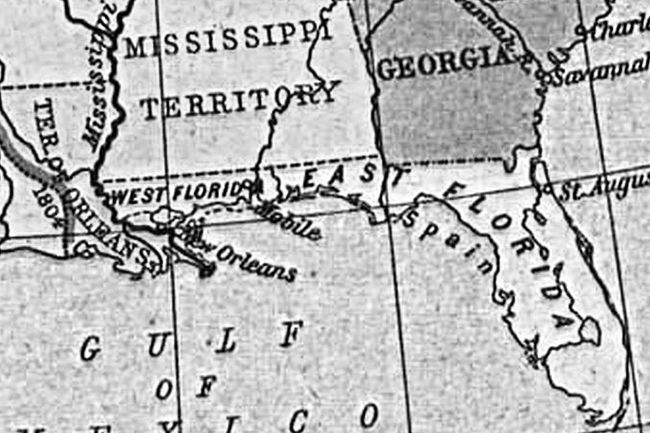
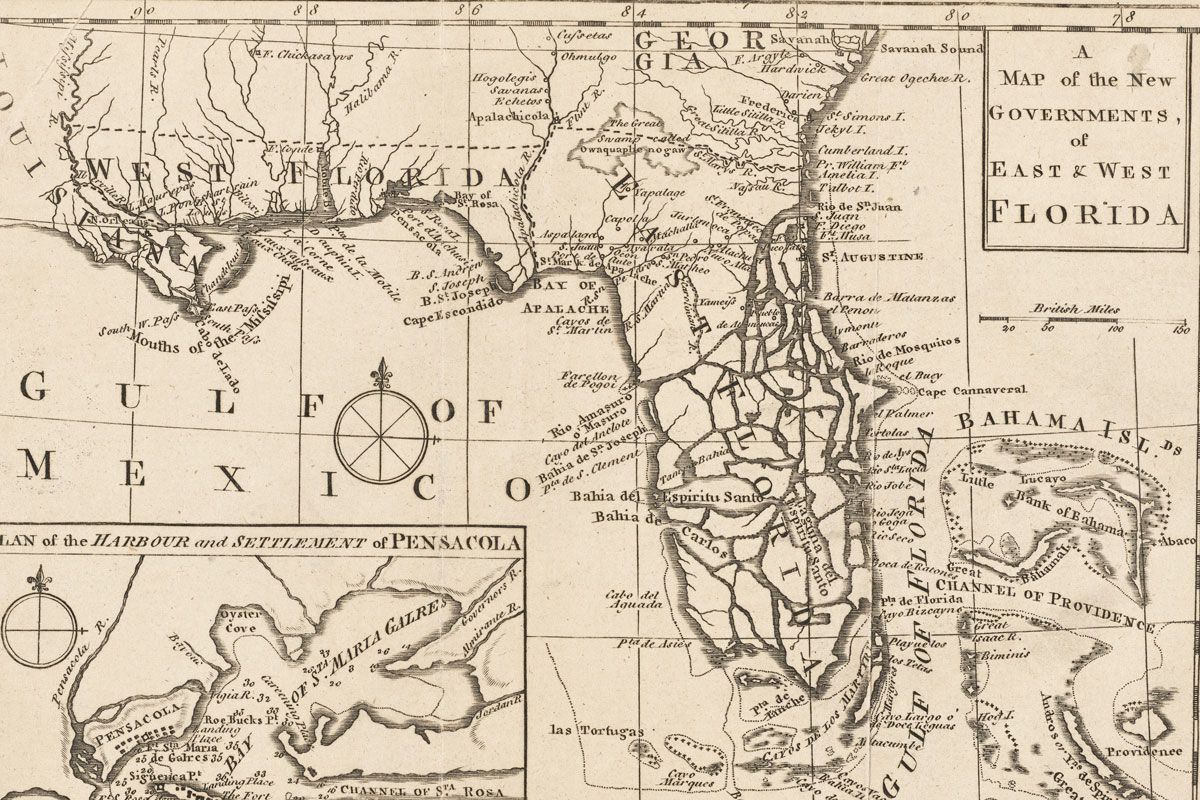
To understand West Florida, you have to set aside modern geography. This was not the western half of today’s Sunshine State. In fact, none of the short-lived republic’s territory lies in modern Florida. West Florida was a narrow strip of Gulf Coast land stretching from the Mississippi River east to the Perdido River — territory that now falls mostly within Louisiana, Mississippi, and Alabama.
The name Florida dates back to Spanish exploration in the 1500s, when Juan Ponce de Leon named the peninsula La Florida — referring to Pascua Florida, the Spanish Easter season during which he first sighted the land. By the 18th century, the Perdido River served as the boundary between West Florida and East Florida, with the latter encompassing most of the peninsula that later became the modern state of Florida.
The region’s political identity shifted repeatedly during the 18th century. Originally claimed by Spain, it passed to British control in 1763 after the French and Indian War. Britain divided its holdings into East Florida and West Florida, establishing administrative borders that outlived British rule. When Spain regained the territory after the American Revolution, it kept those British-era boundaries and governed East and West Florida as separate colonies.
By 1810, both East and West Florida remained Spanish colonies, but in West Florida the empire’s grip was weak. Spain was strained by wars in Europe and independence movements across Latin America. Out on the Gulf Coast, Spanish officials were underfunded and undermanned — and settlers in the region, whose cultural and economic ties leaned toward the United States rather than distant Spain, were ready for change. East Florida, which was centered on St. Augustine and more dependent on Spanish military support, remained comparatively loyal to Spain.
More from our network






A Spanish Province in Name Only
The population of West Florida was diverse. English-speaking settlers — many from the American South — dominated politically and economically. They lived alongside Spanish and French officials, enslaved people, free people of color, and Indigenous communities. Trade flowed north toward American ports rather than south toward Spanish ones, and cultural ties to the United States grew stronger each year.
Spanish governance frustrated many settlers. Land policies were slow and inconsistent, legal systems unfamiliar, and trade regulations restrictive. Spain also lacked the ability to protect the region from lawlessness or external threats.
Complicating matters further was the Louisiana Purchase of 1803. The United States assumed that the western portion of West Florida had been included in the deal, but Spain rejected this interpretation outright. American officials argued that Louisiana’s eastern boundary reached the Perdido River, while Spain insisted it stopped at the Mississippi River. The resulting stalemate left West Florida in political limbo, governed by Spain but increasingly claimed by the United States.

The Rebellion at Baton Rouge
By 1810, patience had run out. A group of local settlers, many of them prominent landowners, decided to take matters into their own hands. On September 23, they launched a brief uprising, capturing Fort San Carlos in Baton Rouge from Spanish forces. The takeover was swift and largely bloodless, reflecting how little resistance Spanish authorities could muster.
The Republic of West Florida declared independence a few days later. Although the uprising took place in Baton Rouge, the new republic established its capital in the nearby town of St. Francisville, reflecting the rural character of its leadership and support base. The Republic of West Florida was complete with a constitution, elected leaders, and a blue flag bearing a single white star. The new government insisted it was orderly, lawful, and deserving of international recognition.

74 Days of Nationhood
For 74 days — from September 23 to December 6, 1810 — West Florida operated as a self-declared sovereign state. Its leaders spoke earnestly of self-government and local rights, borrowing language from the American Revolution. But the reality was more precarious.
The republic had few resources and no powerful allies to defend itself. On October 27, 1810, President James Madison issued a proclamation that West Florida already belonged to the United States as part of the Louisiana Purchase and ordered U.S. forces to take possession. The announcement asserted American authority at once, but troops did not enter the republic’s capital at St. Francisville until early December. For several uneasy weeks, West Florida existed in a political limbo.
Governor Fulwar Skipwith, speaking for the fledgling government of West Florida, formally protested the U.S. takeover. Armed resistance was briefly discussed, but without outside support it was certain to fail. In the end, the leaders chose not to fight. On December 6, 1810, American troops entered St. Francisville, and by December 10 the republic had disappeared into U.S. control.

A Footnote in History
Unlike other independence movements within the United States, West Florida left little lasting mark on the national memory. The land was eventually divided among several states, leaving no single region to preserve a distinct identity. In Louisiana, however, the former West Florida territory became known as the Florida Parishes, a regional label that still echoes the short-lived republic today.
Spain treated the episode as a minor inconvenience rather than a major diplomatic crisis. For the United States, annexation was promoted as a straightforward correction of territorial boundaries based on the contested interpretation of the Louisiana Purchase. While the United States had annexed and divided much of West Florida into Louisiana, Mississippi, and Alabama soon after 1810, Spain did not formally cede East and West Florida until the Adams-Onís Treaty. It was signed on February 22, 1819, and took effect in 1821, ending Spain’s legal claims to the territory and transferring the Floridas to U.S. control.


