




What Did Food Look Like Before Food Coloring?
Before grocery store shelves became a veritable rainbow of products, many foods looked very different. For most of human history, food got its color from natural plant pigments, what animals ate, and how foods were processed. That began to change in the 19th century with the rise of industrial food production as well as early synthetic dyes, many of which were derived from coal tar byproducts.
Once introduced, food colorants spread quickly. They changed not only how food looked, but also what consumers came to expect. By the early 20th century, food coloring was here to stay, and what we now think of as normal food hues are often anything but natural. Here’s a peek at what seven familiar foods used to look like before modern coloring punched them up.

Cheddar Cheese
A brick of bright orange cheddar cheese is a household staple for many, but real cheddar wasn’t originally orange at all. The color we now associate with the cheese began as a marketing trick in 17th-century England, when cheesemakers started adding plant-based dyes.
At the time, farmers were skimming fatty cream off the top of milk to sell separately, leaving behind lower-fat milk that produced paler cheese. The golden hue of traditional cheddar came from the beta-carotene in the grass the cows ate; because that was carried in the milk’s fat, the color disappeared when the fat was skimmed off. Adding color with saffron, marigold, annatto, and even carrot juice helped mask the difference.
The practice made its way to North America and in some cases became even more exaggerated. By the 19th century, some producers were even adding lead chromate to intensify cheddar’s orange color and make lower-quality cheese look more desirable. This was part of a broader era of food adulteration, when appearance mattered more than safety. Today, most orange cheddar still gets its color from annatto and not from aging or flavor — but, thankfully, not from lead either.
More from our network





Salmon
Wild salmon owe their vibrant pink-orange color to their diet, specifically carotenoids from krill and other small crustaceans they eat. Farmed salmon, meanwhile, are raised on manufactured feed in ocean net pens and thus don’t naturally consume these foods. Without intervention, their flesh would be a rather unappealing dull grayish color — not exactly the first thing you’d reach for when shopping for dinner.
Salmon’s appearance became important as farmed salmon moved from experimental aquaculture into grocery stores in the late 20th century. Customers, it turns out, were willing to pay more depending on the color of the cut, and so farmers began adding astaxanthin, a naturally occurring carotenoid pigment found in the food wild salmon eat, to their fish feed.
Much of this pigment supply was industrialized and scaled by companies such as DSM, a Swiss-Dutch chemical company. In the late 1980s, DSM (formerly Royal DSM) even introduced the SalmoFan, a color chart resembling a paint swatch, allowing farmers to select the exact shade of pink they wanted their salmon to be — a practice that continues today.

Oranges
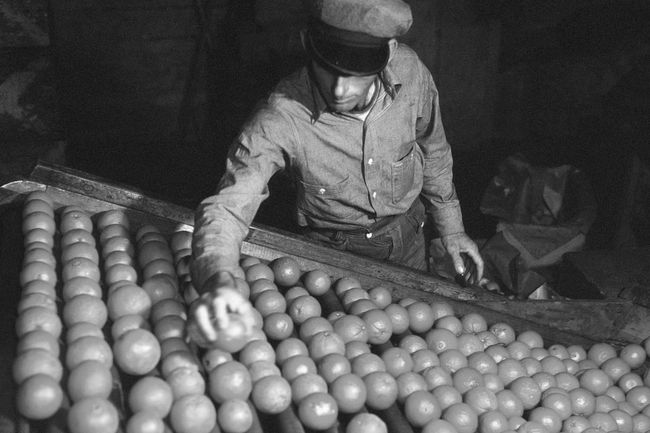
Contrary to what the name suggests, oranges are sometimes not orange at all. When they grow in tropical climates such as southern Florida, high temperatures prevent chlorophyll breakdown in the peel. This leaves the peel a patchy green, even if it’s perfectly ripe. As U.S. citrus production expanded in the early 20th century, oranges from California — where cooler nights naturally encouraged a brighter peel — helped shape consumer expectations by promoting perfectly orange-colored fruit through advertising and packaging.
Florida growers had to compete. In the 1930s, they began using dyes such as Citrus Red No. 2, applying it to the peel and giving the fruit a brighter color. The practice continues today, but as the U.S. government plans to phase out Citrus Red No. 2 dye, growers may need to rely on another method: exposing the oranges to ethylene gas in degreening rooms.

Maraschino Cherries
In the early 20th century, concerns over food adulteration led to the 1906 Pure Food and Drug Act, enforcing closer scrutiny of synthetic additives. This included early versions of food coloring such as toxic and synthetic coal-byproduct dyes. At the time, maraschino cherries had already been transformed from preserved Adriatic fruit into a heavily processed product. They were often preserved in sulfur or chemical brine solutions, then rehydrated in sugar syrup, artificially flavored with vanilla or almond, and finally dyed a vivid red using aniline dyes — one of the toxic coal-tar dyes.
So did consumers have to suffer with what The New York Times described as “sickly yellow” maraschino cherries after the Pure Food law? Not exactly. As certain coal-tar dyes fell out of favor, foods were able to get that bright, artificial color through an evolving roster of government-approved synthetic reds.

Butter
There’s not much better than a pat of golden-yellow butter on fresh bread, but the rich dairy product didn’t always look like what we expect today. That’s largely because butter’s natural hue comes from beta-carotene in the fresh grass that cows eat, which shows up in their milk. Butter made in spring and summer, when cows grazed on pasture, was naturally deeper yellow, while winter butter, made from hay-fed herds, often turned noticeably pale.
Seasonal variation lessened once cows left the pasture and entered the industrial dairy era in the second half of the 1800s. So, producers started standardizing color, most commonly with plant-based additives such as annatto, creating a more uniform yellow year-round.
By the late 19th century, the focus on color intensified during the so-called “butter wars” as margarine emerged as a cheap competitor. Margarine was often dyed to resemble butter, prompting legislation in parts of North America that restricted its coloring — or even forced it to be a different color entirely, such as pink. In response, butter producers leaned even more heavily into a consistent golden-yellow hue year-round as a marker of reliability and authenticity.

Meat
Before modern additives, processed meat products looked far duller than the vibrant reds and pinks we see today. Fresh meat can appear bright red at first, thanks to oxygen binding to myoglobin, a protein found in muscle. But as oxygen decreases, the pigment changes again and leaves meat a brownish-gray that gives the appearance of spoilage.
That’s partly why producers began using curing agents long before synthetic dyes entered the picture. Early curing relied on naturally occurring nitrates in salt (often called saltpeter), which was widely used for preserving meats. Over time, it was discovered that these compounds convert into nitrites, which interact with myoglobin to form a stable, heat-resistant pigment that keeps it the familiar pinkish-red color seen in bacon or sausages. (It also helped inhibit bacterial growth.) Synthetic dyes, of course, were eventually used, too, such as the once-common Red No. 2 or Red No. 3, creating the vivid reds seen in some regional hot dogs such as Maine’s famed red hot dogs.

Wine
Ancient winemakers sometimes used herbs or minerals to preserve and enhance the appearance of their wines. Modern winemakers can color their wine, too: Since the 1970s, a concentrated grape-juice-based additive known as Mega Purple has regularly been used in some mass-produced wines to deepen colors, improve taste, and standardize quality across batches. Lighter-skinned grape varieties, cooler growing seasons, early harvesting, or fermentation hiccups can make some reds paler, and Mega Purple can help round this out.
Mega Purple isn’t the only coloring tool in winemakers’ kits. Some food-grade additives used in the broader food industry, such as FD&C Yellow No. 5, cochineal extract, and carmine, sometimes show up in wine in order to meet consumer expectations.


