



There was a WWII factory hidden beneath a fake American neighborhood.
During World War II, pilots flying over Seattle might have spotted a quiet neighborhood near the Duwamish River with tree-lined streets winding past modest houses, tidy lawns, parked cars, and backyard fences. But no one lived there. The entire community was a stage set concealing one of the most important aircraft factories in the United States.
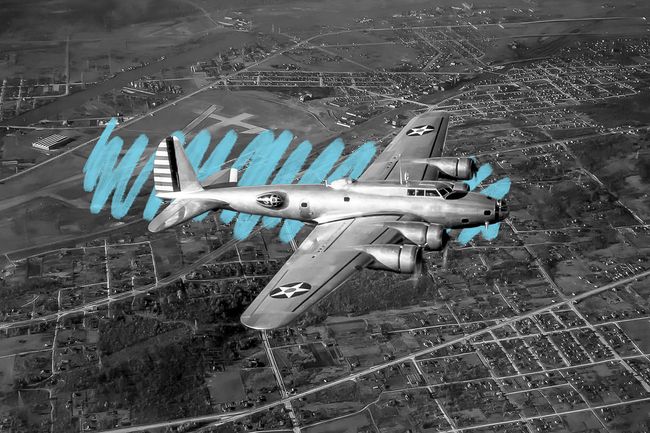
After Japan attacked Pearl Harbor in December 1941, fears of another aerial assault spread along the West Coast. Boeing’s Plant 2 was considered a particularly valuable target. Thousands of workers there were building B-17 Flying Fortresses — which became essential to the Allied bombing campaign in Europe — as well as the first B-29 Superfortresses, designed for the long-range Pacific campaigns.
To disguise the plant, the U.S. Army Corps of Engineers covered its roof with an elaborate camouflage village sometimes called “Boeing Wonderland.” The ground was fashioned from burlap, canvas, and chicken wire, while lawns and trees were made from chicken feathers and spun glass. The neighborhood even had at least two whimsically appropriate road names: Synthetic Street and Burlap Boulevard.
Hollywood art director John Stewart Detlie (known for classic 1930s musicals) helped apply movie set techniques to the project, which was finished in 1944. From high overhead, the factory appeared to blend into Seattle’s residential landscape, although the pastoral neighborhood may have looked slightly out of place amid the surrounding industrial buildings. Below the scenery, tens of thousands of men and women worked around the clock, turning out hundreds of bombers each month. During breaks, they could stroll the fake streets on the plant’s roof.
Enemy planes never reached Seattle, so the camouflage was never put to the test. It was removed after the war, but Plant 2 continued operating for decades, contributing to the development of the B-47, the B-52, and the early 737. The factory was eventually demolished beginning in 2010, and part of its former site was restored as wetland along the Duwamish River.


