


People have kept pets for tens of thousands of years, though we can’t say exactly when the practice began or what the very first pets were. We do know that dogs were the first domesticated animals, but our ancient ancestors could reasonably have kept other creatures as pets long before wolves turned into our faithful friends. Today, pets are everywhere. In the United States, 66% of households — that’s around 86.9 million homes — own a pet. By far the most popular pets are dogs and cats, found in 65.1 million and 46.5 million households, respectively. Next, although some distance behind, come freshwater fish, small animals such as hamsters, gerbils, and rabbits, and then birds.
Among the most popular categories of pets, we find animals that would generally be considered somewhat uncommon. It’s not all that often, for example, that we come across someone who owns a chinchilla, a ferret, a fancy guppy, a cockatiel, or a six-toed Norwegian lundehund. But even these unusual animals are no match for the strangest pets in history. Here are 10 of the most bizarre animal companions, kept by a range of famous figures, from Roman orators to Hollywood icons.
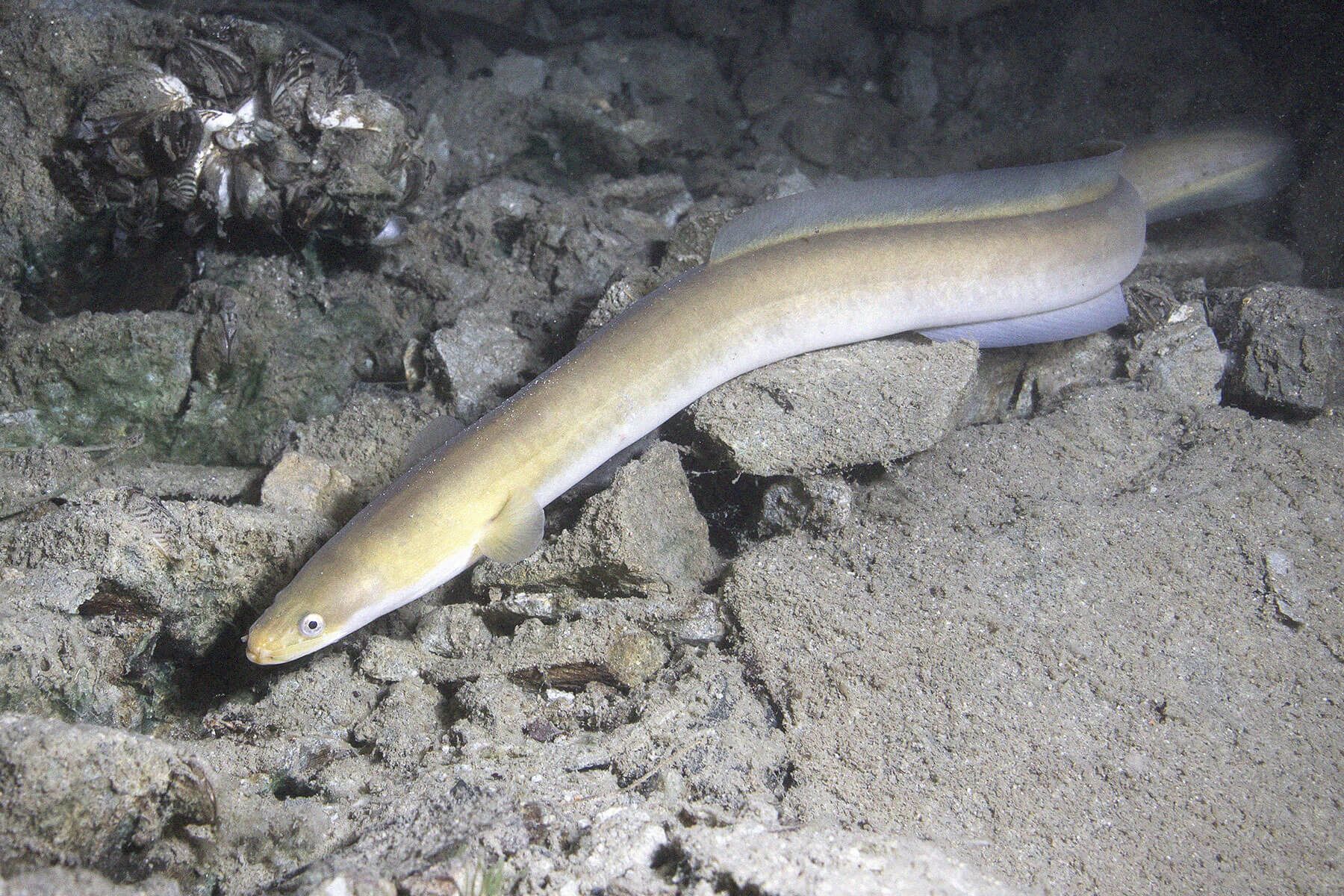
Lucius Licinius Crassus is considered one of the greatest orators of ancient Rome. And bizarrely, much to the bemusement of later Roman commentators, he had a beloved pet eel. It’s said that he trained the eel to respond to its name, and even adorned his slimy companion with earrings and small necklaces.
Danish astronomer Tycho Brahe, often considered the greatest observational astronomer of the pretelescopic era, lived a rather colorful life. He lost his nose in a duel over a mathematical formula. He was the keeper of a clairvoyant dwarf named Jepp. And he had a pet elk (some sources say it was a moose) that attended feasts and banquets with him. Unfortunately, at one such feast the elk drank too much beer, and took a fatal fall down the castle stairs.
The French Romantic poet Gérard de Nerval was a major influence on the later symbolist and surrealist movements. He could often be found walking his pet lobster, Thibault, on the end of a blue silk ribbon through the Palais-Royal in Paris. When asked about his strange pet, he replied, “I have affection for lobsters. They are tranquil, serious, and they know the secrets of the sea.”
Joséphine de Beauharnais was the first wife of Napoleon Bonaparte and served as empress of the French from 1804 until 1810. She kept a menagerie of exotic animals, but her favorite pet was an orangutan named Rose. Rose was a dignified ape who wore white cotton chemises, had a fondness for turnips, and apparently slept in the same bed as Joséphine and Napoleon.
Lord Byron, regarded as one of the greatest English poets and a key figure in the Romantic movement, was known to be eccentric. While a student at Trinity College, Cambridge, in the early 1800s, he was told he could not keep his pet dog as canines were banned from the college. So, he went out and found himself a tame bear, because there were no rules against keeping such an animal. He would walk the bear through the college grounds, and even tried to enroll it as a student — though the application was rejected.
When Theodore Roosevelt began his presidency in 1901, his family moved into the White House with a horde of pets in tow. These included a lizard named Bill, a blue macaw called Eli Yale, Baron Spreckle the hen, Maude the pig, a one-legged rooster, a barn owl, and various guinea pigs with names such as Admiral Dewey and Fighting Bob Evans. As if that wasn’t strange enough, the Roosevelts also had a pet badger called Josiah, a small black bear named Jonathan Edwards, and a hyena called Bill.
In November 1926, some supporters of President Calvin Coolidge sent him a live raccoon so that the first family could kill it and eat it for Thanksgiving dinner. But instead of sacrificing the creature, the Coolidge family decided to keep it as a pet. They named it Rebecca and built a little house for it, and Rebecca was allowed to roam the White House and accompanying gardens.
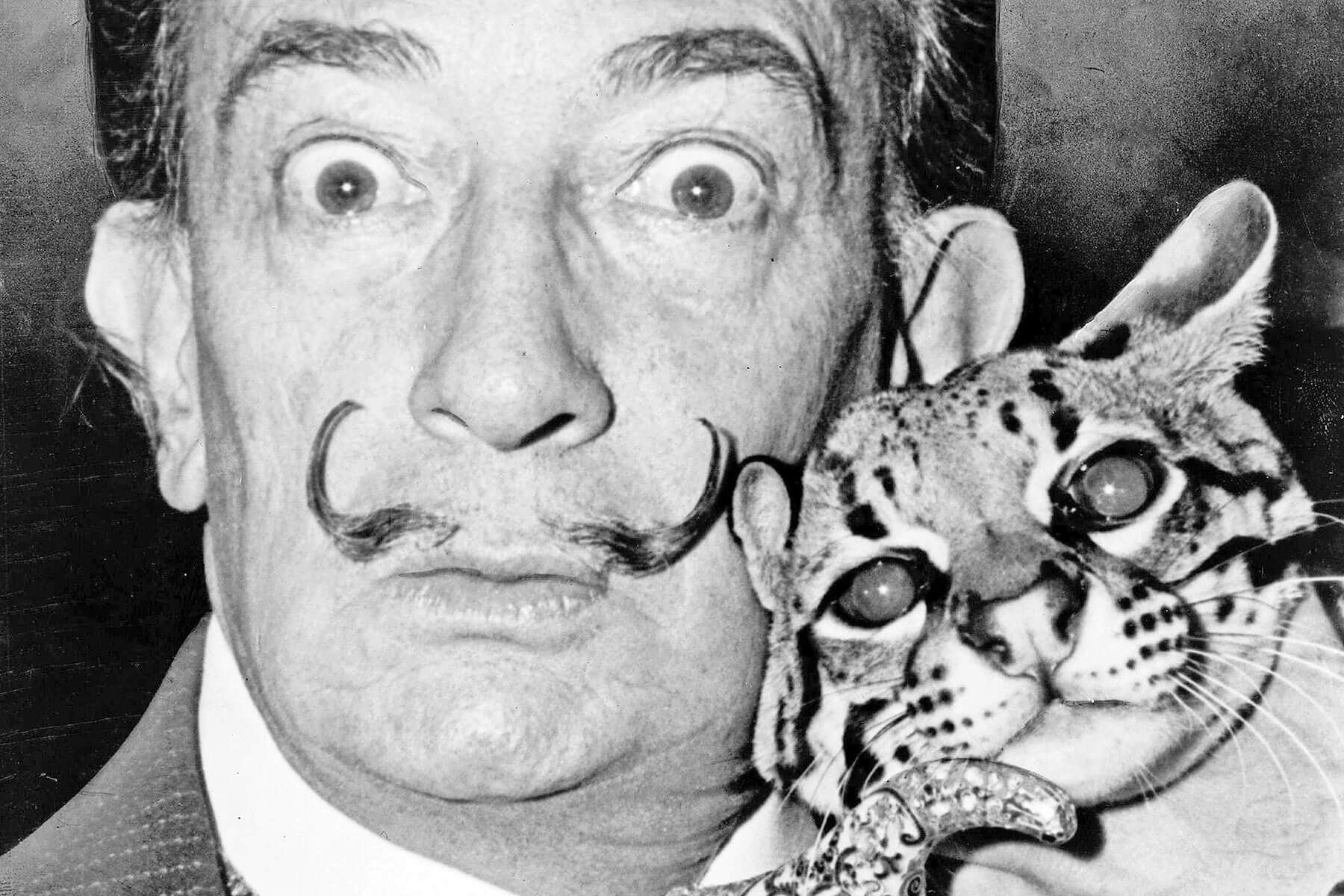
Salvador Dalí was the living embodiment of surrealism, so it was perhaps no surprise to see him walking the streets with his pet ocelot, Babou. Dalí claimed that the medium-sized spotted wild cat was a gift from the president of Colombia. During the 1960s, the painter took Babou almost everywhere he went, safely secured on a leash and studded collar.
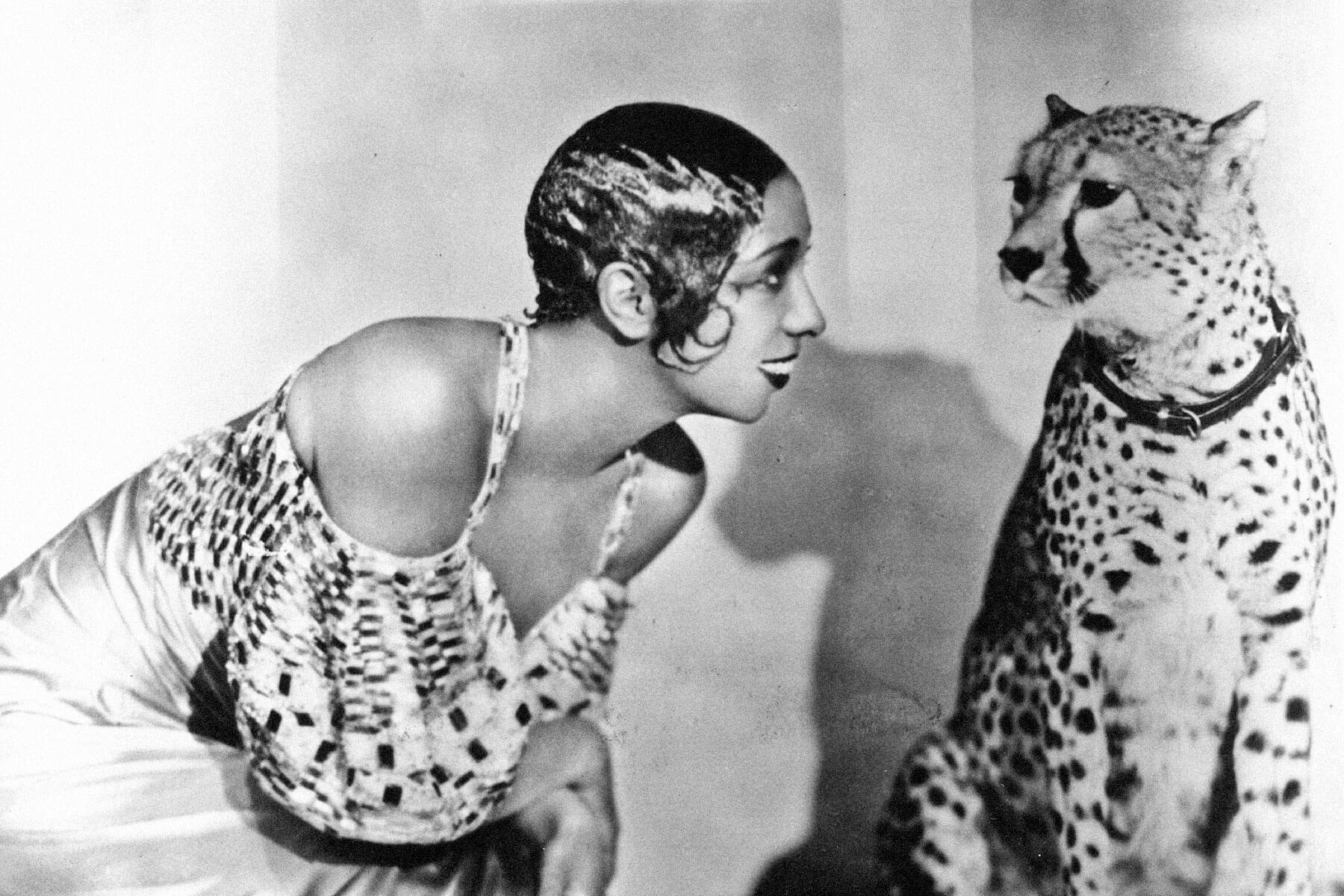
Josephine Baker was an American-born French dancer and singer who became a sensation in Paris in the 1920s. She was also the first Black woman to star in a major motion picture. On stage, she was often accompanied by her “co-star,” her pet cheetah Chiquita. Chiquita became a star in her own right, known for wearing a diamond collar and leaping into the conductor’s pit during performances.
While filming the 1959 adventure-romance Green Mansions, Audrey Hepburn had to work alongside a baby deer called Pippin (or “Ip,” as she called it). Hepburn was encouraged to care for the fawn for the sake of the movie, and the two soon formed a strong bond. She fed the deer from a baby bottle, shared a bed with it, and even took it shopping and to parties. After filming, Hepburn was devastated when she and Ip had to separate. Her husband later tracked down the deer and Hepburn took it in as her pet.
Credit: PHAS/ Universal Images Group via Getty Image
Author Tony Dunnell
June 19, 2024
Love it?142
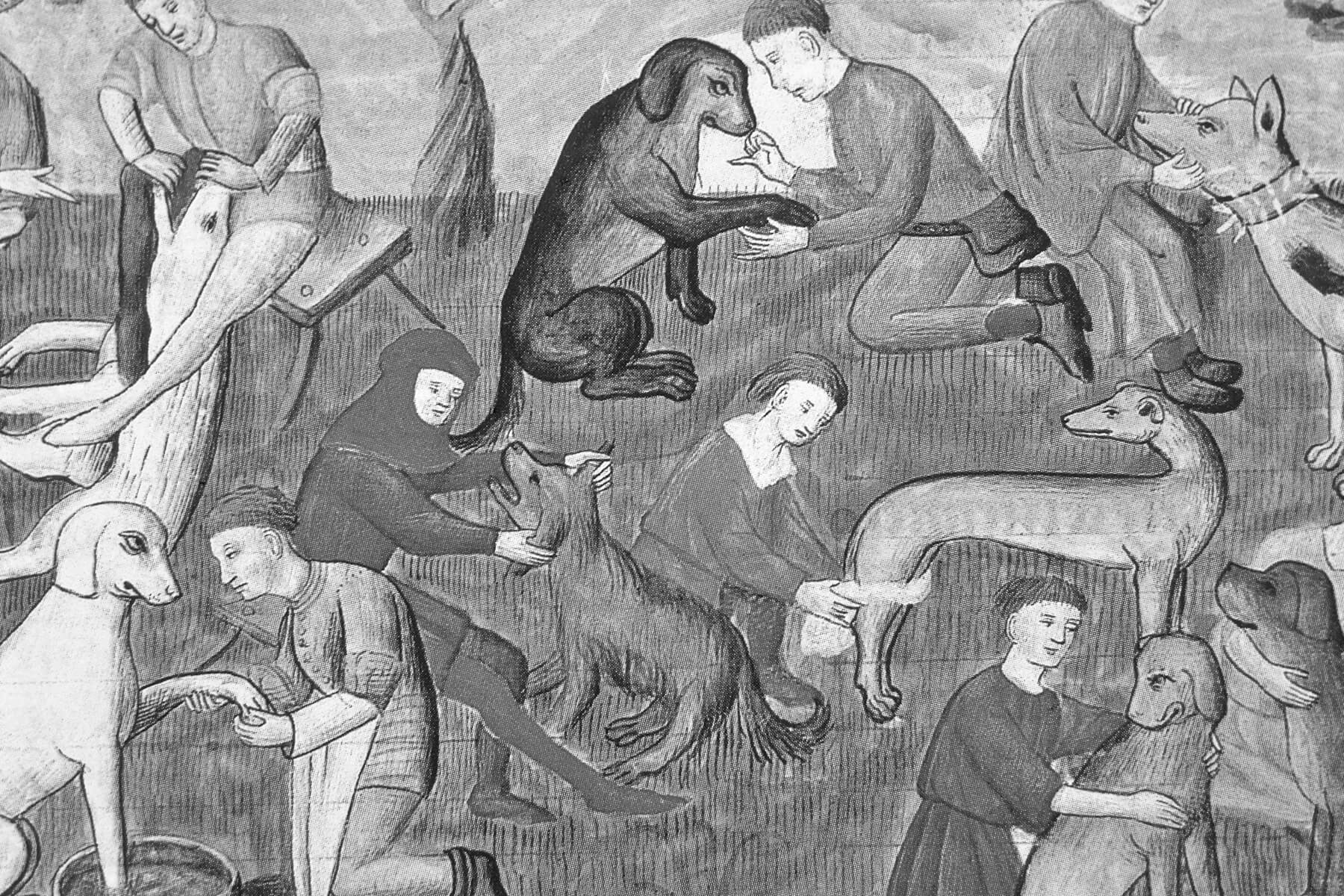
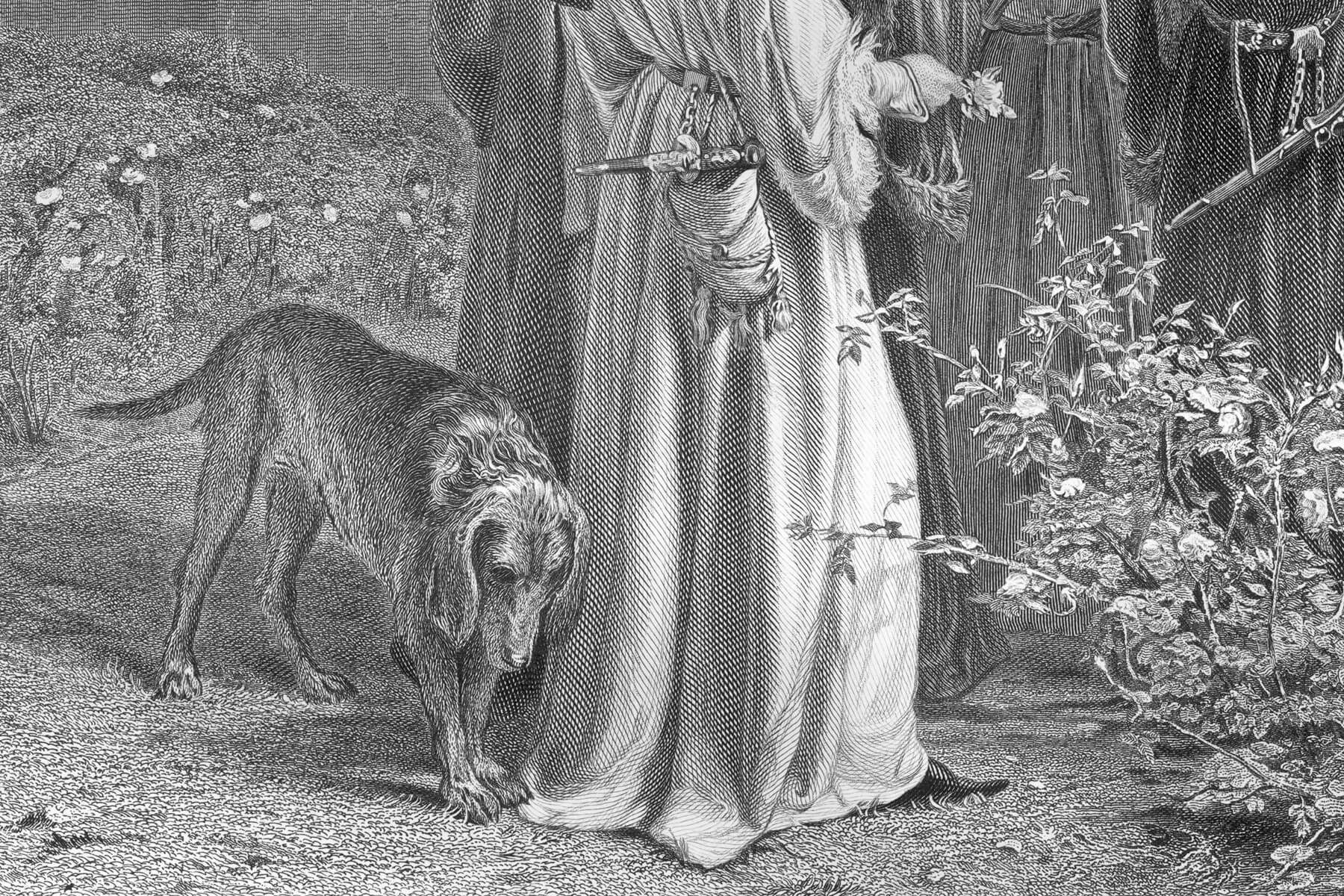
Alongside their eternal nemeses cats, dogs are the most popular pets in the world. They have been humans’ most faithful friends for at least 12,000 years, hunting with us, protecting us, and accompanying us in our everyday lives. In fact, dogs were the first domesticated animals, predating chickens, cows, goats, pigs, sheep, and even agriculture itself. By the medieval era, they were firmly embedded in homes across the world. They could be found walking alongside peasant poachers as they went out to hunt, or curled up at the feet of the greatest kings and queens of Europe.
These pets, of course, had names. And thanks to a 15th-century British manuscript titled “The Names of All Manner of Hounds,” we have a fascinating insight into what canines were called in the Middle Ages. The unique manuscript, recently examined in an academic paper by researcher David Scott-Macnab, contains a list of 1,065 names given to hunting dogs during the period. It’s a treasure trove of mutt monikers, some of which truly deserve to come back into fashion (others, perhaps, not quite so much). Here are some of the funniest names on the list.
Some of the best medieval dog names are those that reflect classic canine characteristics. As we all know, dogs possess a phenomenal sense of smell, as much as 100,000 times more sensitive than ours. Medieval dog owners were well aware of this canine trait, hence some wonderful olfactory-based names, including Goodynowze and Nosewise. Thanks to their superior noses, dogs are also good at finding things, so we also have the names Fynder and Fyndewell. Other sobriquets include Swifte for the agile canine, Wellyfedde and Plodder for the more languid dogs, and Letego for the dog who likes a game of tug-of-war.
Credit: Culture Club / Hulton Fine Art Collection via Getty Images
Advertisement
Advertisement
Brayneles
Some dogs, it’s true, aren’t the smartest of creatures. Medieval dog owners recognized this, and sometimes bestowed names on their pets that called into question their intellectual capacities. These unflattering appellations include Brayneles, Litillwitte, Symple, Careles, and Helpeles. They were all thoroughly good dogs, for sure, but perhaps not the brightest.
Credit: Print Collector/ Hulton Archive via Getty Images
Filthe
Our medieval ancestors didn’t stop at questioning the intelligence of their dogs. They also besmirched their canine companions with unflattering names that left little to the imagination. Filthe was one such name, alongside Lewde, Oribull, Synfull, Dredefull, Vagrawnte, Wrecche, and Badde. Hopefully these designations all came from a place of love, and the dogs didn’t resent their owners for saddling them with the less-than-lovely names.
Advertisement
Advertisement
Credit: Culture Club/ Hulton Archive via Getty Images
Joliboye
Medieval dog names weren’t all defamatory — many were very positive. For the ever-amiable hound there are names such as Joliboye, Mery, Happy, and Cherefull. For dogs that can brighten even the gloomiest of days, we have Careaway and Havegoodday. Then there’s Pretiboy for all the good-looking pups out there, or Blameles for the dog that can do no wrong. Arguably the most superlative name on the list is Beste-of-all.
Credit: PHAS/ Universal Images Group via Getty Images
Radissche
Dog owners in the Middle Ages were quite fond of naming their pets after foodstuffs. Fish-based names include Salmon and Halibutte, alongside other ingredients such as Mustarde, Garlik, Sage, and Rasyne. Consumables also appear among the most popular names for male and female dogs today. In 2023, the names Oreo, Ginger, Honey, Pepper, and Whiskey were all popular. Incidentally, only two names on the medieval-era list also frequently appear on modern lists of popular dog names: Belle and Ranger.
Advertisement
Advertisement
Credit: Heritage Images/ Hulton Fine Art Collection via Getty Images
Tullymully
Many of the monikers listed in “The Names of All Manner of Hounds” don’t make much sense — at least to the modern ear — but nonetheless have a delightful ring to them. Who wouldn’t want a dog called Tullymully or Rowte-owte? And then there’s Dasyberde, Honyball, and Tynker. Of course, not everyone is quite as imaginative. Undoubtedly the least creative name on the list is Nameles, which shows a true lack of dog-naming effort.
Animal fame has reached new heights in the internet era, but some especially notable pets still managed to achieve celebrity status before the likes of Grumpy Cat, Lil Bub, and Boo — one of the animals on this list even dates back to the first century CE.
Many high-profile companions reach stardom by virtue of their celebrity owners, such as Mr. Famous, Audrey Hepburn’s aptly named Yorkshire, who appeared alongside her in 1957’s Funny Face. But pets can also become famous on their own merits (or demerits), as in the case of the dog who pushed kids into a river so he could stage a rescue for treats, or the cat who survived a whopping three shipwrecks. Here are the stories of six animals who left their indelible pawprints — or hoofprints — on the world.
In the mid-20th century, the attempted domestication of ocelots — a breed of wild cat that isn’t recommended as a pet — wasn’t unheard of. One of the most famous pet ocelots of the era was Babou, the animal companion of surrealist artist Salvador Dalí. The feline followed him everywhere, even famously accompanying Dalí to one of his art exhibitions in a bejeweled collar.
Understandably, Babou was not always a welcome guest. When Dalí once brought him to an art gallery in Paris, the owner angrily told Dalí that Babou had “made a nuisance” on his 17th-century engravings. The artist reportedly responded, “A nuisance of Dalí’s … can only increase their value.”
On another occasion, Dalí tied Babou’s leash to a table at a Manhattan restaurant. When another diner expressed her alarm, Dalí assured her the animal was just a normal cat he’d “painted over in an op art design.” By 1970, Dalí had acquired a second ocelot named Bouba, although she didn’t achieve quite the same level of notoriety.
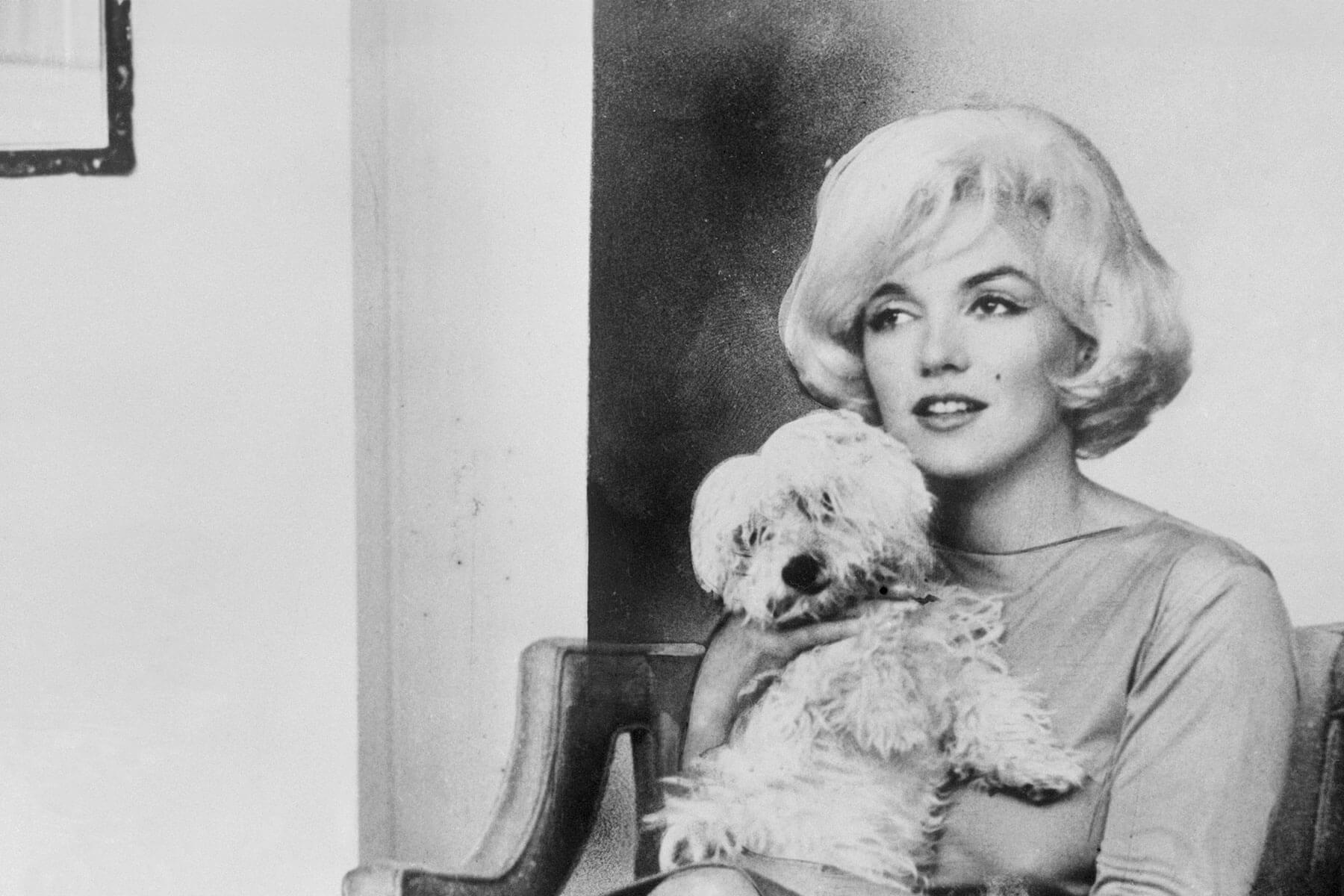
This fluffy little Maltese dog was famous for his association with two major celebrities, having been gifted to Marilyn Monroe in 1960 by Frank Sinatra to console her after her split from playwright Arthur Miller.
Cheekily named for Sinatra’s alleged ties to the mob and called “Maf” for short, the dog was Monroe’s close companion for roughly the last two years of her life. He was even permitted to sleep on a fur coat Miller had given her. Following Monroe’s death in 1962, Frank Sinatra’s secretary Gloria Lovell cared for Maf until his death in 1974. But his fame didn’t end there: Two Polaroids featuring Maf sold for more than $220,000 in 1999.
Advertisement
Advertisement
Credit: DEA / ICAS94/ De Agostini via Getty Images
Incitatus the Horse
The most famous pet of the ancient world was likely Incitatus, a horse owned by Caligula, the third emperor of Rome. According to one myth, Caligula loved his horse so much, he even appointed the animal to consul.
Although this likely never happened, it certainly contributed to the horse’s legendary status. Even if Incitatus (whose name means “swift” or “at full gallop”) never held a human position, he still enjoyed a pretty lavish life. According to historians, he resided in a marble stable with an ivory manger and wore a collar made of precious stones.
Elvis Presley had a chaotic menagerie of animals at Graceland, including several horses, donkeys he kept in an empty swimming pool, and a myna bird that would mimic the excuses it heard for why Presley couldn’t come to the phone.
His most storied pet, however, was Scatter, a chimpanzee who wore human clothes and caused oodles of mischief. Scatter had a penchant for alcohol and peeking under women’s skirts, destroyed the office of legendary movie producer Samuel Goldwyn, and frequently ran off to break into neighbors’ houses. Even so, years after the chimp’s death, Elvis said that he was “one of the best buddies [he] had around.”
The 1944 film National Velvet, which told the story of a young girl who believes in and trains a difficult horse, propelled then-12-year-old Elizabeth Taylor to stardom. Her equine co-star, the racehorse King Charles, was already famous in his own right before hitting the big screen: He was related to two of the most famous racehorses of all time, Man o’ War and Seabiscuit. Taylor, having bonded with the horse over the course of the production, repeatedly asked to keep him as her pet. The film’s producer, Louis B. Mayer, eventually granted the young actress’s request for her 13th birthday.
Unlike the other animals on this list, this one’s fame has little to do with his owner. According to legend, a cat named Oscar, later known as “Unsinkable Sam,” was one of just a few to survive the 1941 sinking of a German battleship called the Bismarck. Oscar was then picked up by the HMS Cossack, a British destroyer, and again survived when his new home was torpedoed exactly five months later. Following this second disaster, the lucky (or unlucky) cat spent less than one month on the British aircraft carrier Ark Royal before it suffered the same fate as the Cossack — yet Oscar miraculously managed to survive once again. Afterward, he retired to a home on land in Belfast, where he lived until his 1955 death. A portrait of “Unsinkable Sam” resides in London’s National Maritime Museum.
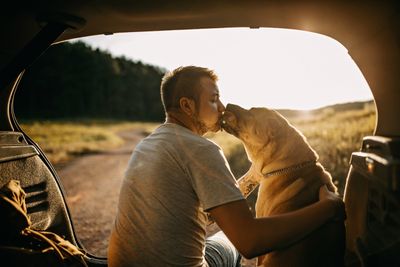
Humans have walked alongside domesticated dogs for at least 15,000 years, and possibly twice as long as that. The oldest known grave where humans and dogs were buried together dates back to the Paleolithic era, proving not only domestication, but also that there was an emotional bond between humans and canines.
It’s impossible to imagine how many human lives our faithful friends have saved in all those millennia — the countless times dogs have alerted us to danger and protected us from threats, dragged us from rivers or found us when we’ve fallen and can no longer walk. Our trusted canines have often served as an extension of our eyes and ears — as well as our hearts.
Dogs are more than capable of being heroes, and while most of their brave and selfless deeds have been lost to history, others have been recorded for posterity. Here are some of those heroic dogs, from the ancient world to the modern age.
In 456 BCE, a group of Persian soldiers tried to sneak into the Greek city of Corinth with the intention of holding the city until a much larger force could launch a full-scale attack. They knew that about 50 dogs were posted around the city to warn of enemy incursions, and so they quietly set about eliminating the canine guards. Only one survived, a dog named Soter. Soter managed to escape, but he didn’t run. He fulfilled his duty by alerting the Corinthian garrison of the sneak attack. The Corinthians repelled the Persians and sent out for immediate reinforcements. Soter was later honored with a pension and a silver collar that read, “To Soter, defender and savior of Corinth, placed under the protection of his friends.”
In 1306, Scottish independence leader Robert the Bruce was crowned king of Scotland. He set about reclaiming territory held by the English, which enraged King Edward I of England. The English managed to capture Robert’s wife, as well as one of Robert’s beloved and highly trained hunting dogs, Donnchadh (pronounced “DON-nu-chu”), who was a Talbot breed, an ancestor of the modern bloodhound. The English concocted a crafty plan: They would use the captured hound to track the Scottish king. They set the dog free and Donnchadh soon picked up the trail, unknowingly leading a group of English soldiers straight to Robert. However, the English hadn’t fully appreciated Donnchadh’s loyalty to his owner. When they reached Robert, the dog immediately turned on the English soldiers, defending Robert and giving both time to escape the ambush — and, in so doing, keep the fight for Scottish independence alive.
Advertisement
Advertisement
Photo credit: Print Collector/ Hulton Archive via Getty Images
Moustache
Moustache, sometimes called Mous, was a black French poodle who took part in the Napoleonic Wars. His deeds are shrouded in legend and not all of his exploits may be true, but this little pup certainly saw his share of action. It all started when Moustache decided to set off with a group of grenadiers, and soon became part of their regiment. He marched across the Alps with Napoleon Bonaparte’s army in the spring of 1800. He warned his comrades of an Austrian ambush, saving them from disaster. He took a bayonet in his left shoulder, but managed to crawl to safety to be patched up. And before he was even fully recovered, he took part in the Battle of Marengo. According to legend, he also marched into the Battle of Austerlitz, where he supposedly rescued the French flag from a fallen standard-bearer and returned it to the French camp, despite being wounded in the leg. Moustache was later reputedly killed by a cannonball at the Siege of Badajoz in 1812, at the age of 12. Soldiers buried the brave poodle with a simple but well-earned inscription on his grave: “Here lies the brave Moustache.”
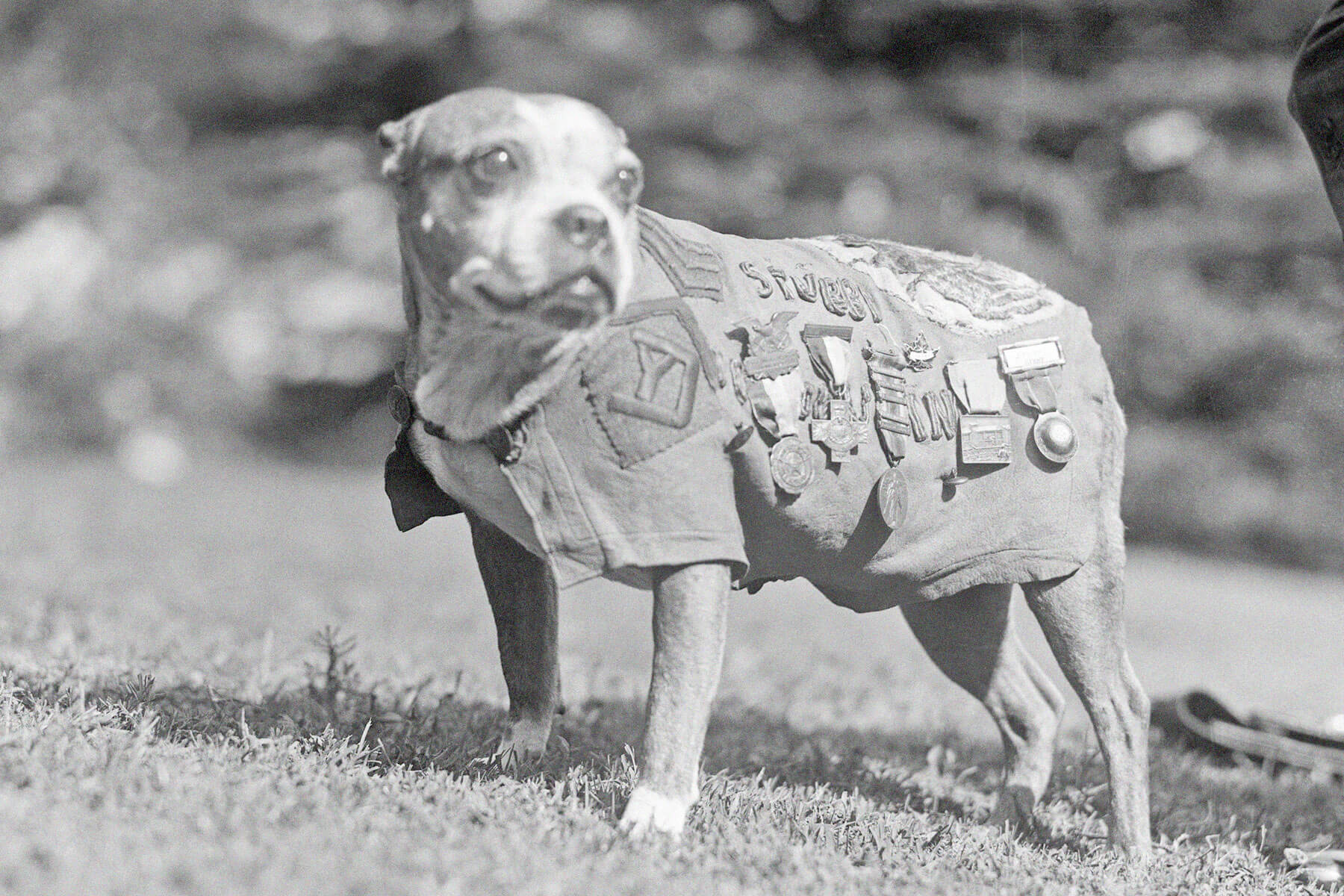
Sergeant Stubby was quite possibly the most decorated dog of World War I. In 1917, Private J. Robert Conroy of the 102nd Infantry, 26th Yankee Division, found a puppy wandering around the grounds of the Yale University campus where the division was training. He named the pup Stubby on account of his short tail, and the dog soon became the regiment’s unofficial mascot. He learned the various drills and even mastered a dog salute. When the division shipped out for France, Stubby went with them and soon found himself on the front lines of World War I. He served with the 102nd in the trenches for 18 months and participated in four offensives and 17 battles. Apart from being a vital morale-booster, Stubby learned how to warn his fellow soldiers of incoming gas attacks, helped locate injured soldiers, and even apprehended a German spy. He was injured in battle on more than one occasion, and — along with his numerous medals — gained promotion to the rank of sergeant, becoming the first dog to receive a rank in the U.S. armed forces.
In the winter of 1924 and 1925, a potentially deadly outbreak of diphtheria struck the remote town of Nome, Alaska, putting the lives of more than 10,000 people — particularly children — at risk. With air travel impossible due to a blizzard, the only way to get a lifesaving antitoxin serum to Nome was through sled dog teams. Incredibly, a relay of 20 teams managed to deliver the medication in just five and a half days, in what became known as the “Great Race of Mercy.” Initially, it was Balto, the lead dog of the final, 53-mile leg, who was given all the press attention. But while Balto was certainly a hero, an amazing Siberian husky named Togo, and his musher Leonhard Seppala, were the true saviors of the day. Togo, once a mischievous pup, traversed an incredible 264 miles, far more than any of the other sled dogs. Later, Seppala said, “I never had a better dog than Togo. His stamina, loyalty, and intelligence could not be improved upon. Togo was the best dog that ever traveled the Alaska trail.”
When, in 1944, Ed Downey, an American GI, heard whimpering coming from a foxhole in New Guinea, he carefully went to investigate. Inside, he found an abandoned Yorkshire terrier, who, although already a young adult, weighed only 4 pounds and stood just 7 inches tall. Downey soon sold the tiny dog to Corporal William “Bill” Wynne, who named her Smoky. For the next two years, Smoky went everywhere with Wynne, seeing out the remainder of World War II. Her many achievements included participation in 12 combat missions. She also survived Japanese kamikaze attacks, 150 air raids on New Guinea, and a typhoon in Okinawa, and on one occasion saved Wynne’s life when she warned him of an incoming attack while aboard a landing craft. She even helped with the construction of an Allied airfield in the Philippines when she pulled a telegraph wire through a 70-foot-long pipe, sparing 250 ground crewmen what would have been a dangerous, three-day digging task.
On December 4, 1966, the Tan Son Nhut Air Base in Vietnam was attacked by a barrage of mortar fire as more than 60 Viet Cong soldiers tried to breach the perimeter. In the early hours of the morning, U.S. Air Force airman Bob Throneburg was sent out on patrol with his K-9 Corps companion, Nemo A534. When Nemo, an 85-pound German shepherd, detected a small group of enemy soldiers, Throneburg released him to attack. In the ensuing fight, Throneburg was hit in the shoulder, while Nemo took a bullet under his right eye. Despite his injuries, Nemo refused to abandon the fight, giving Throneburg time to call for backup. As Throneburg began to lose consciousness, Nemo returned to his handler and crawled on top of him to protect him. Thankfully, friendly soldiers arrived and — after they eventually convinced Nemo to get off Throneburg — both man and dog were taken to a hospital, where they recovered after months of treatment. Throneburg earned the Purple Heart and Bronze Star Medal, while Nemo became the face of the K-9 Corps, forever remembered for his loyalty and bravery.
In 1993, a series of terrorist bombings rocked the city of Bombay (now Mumbai) in India. The blasts killed more than 250 people and injured hundreds more, but it could have been far worse if not for the heroic actions of a Labrador retriever called Zanjeer. Zanjeer was a detection dog with the Bombay Police. At the onset of the bombings, he saved countless lives by detecting a scooter covered with explosives, which he highlighted with his three-bark alert. In the days that followed, he found two more explosive devices planted on the street, as well as more than 7,339 pounds of explosives, 600 detonators, 249 hand grenades, and 6,406 rounds of live ammunition. In his incredible eight-year career, the pup was credited with discovering a further 11 military bombs, 57 terrorist bombs, 175 petrol bombs, and 600 more detonators. It’s amazing to think of how many lives Zanjeer must have saved — and more than fitting that he was honored with a full state funeral upon his death in 2000.
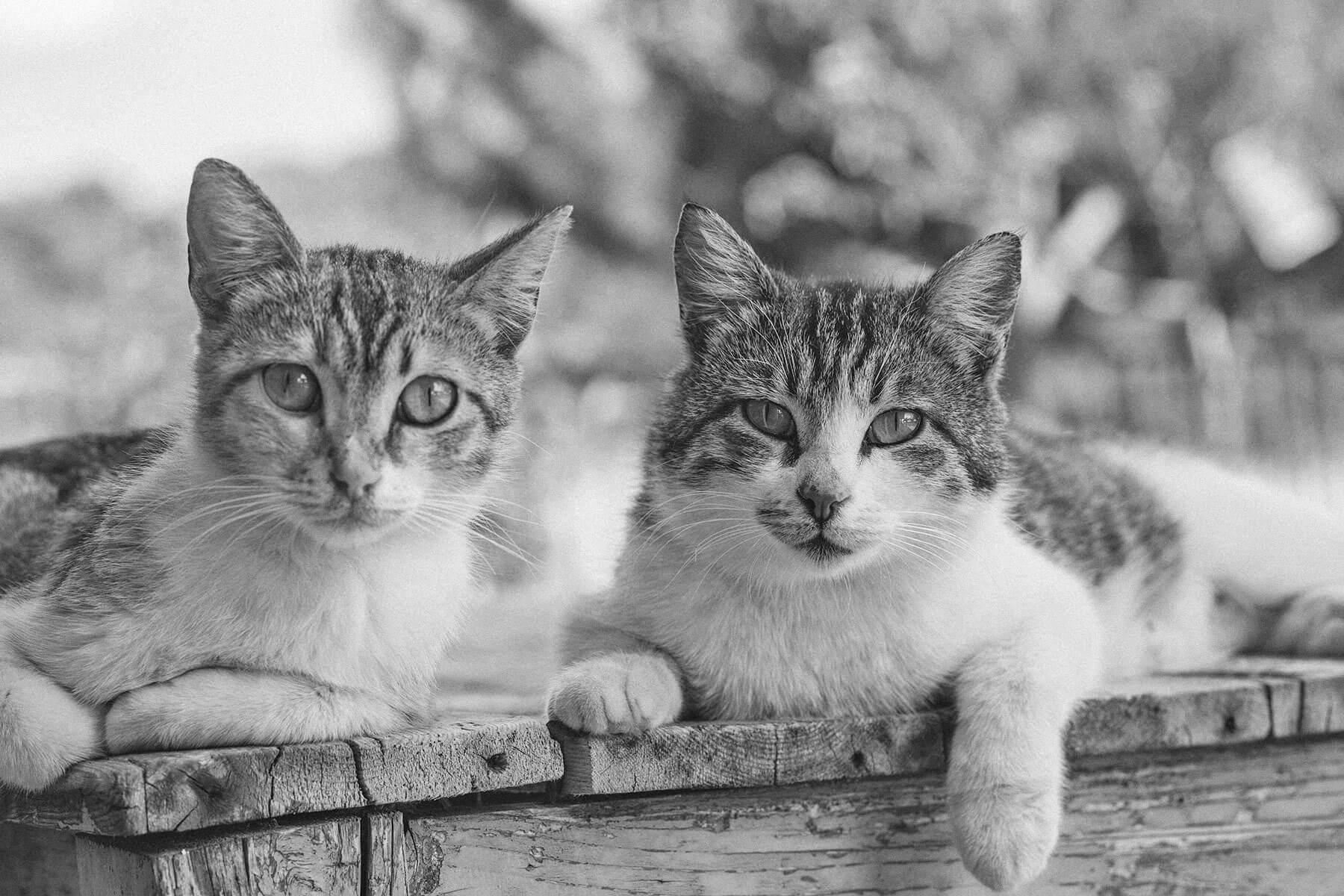
The first felines existed more than 10 million years ago, predating humans by millions of years. Perhaps the fact that cats were here first explains why they’re so comfortable acting like they own the place. It also won’t be a surprise to anyone who’s had a pet kitty to hear that the alliance between human and cat was probably the cat’s idea. Cats may have a reputation as aloof and self-sufficient divas, but these fluffy felines have been beloved pets in homes around the world for millennia. Here’s the story of how cats and humans first came together.
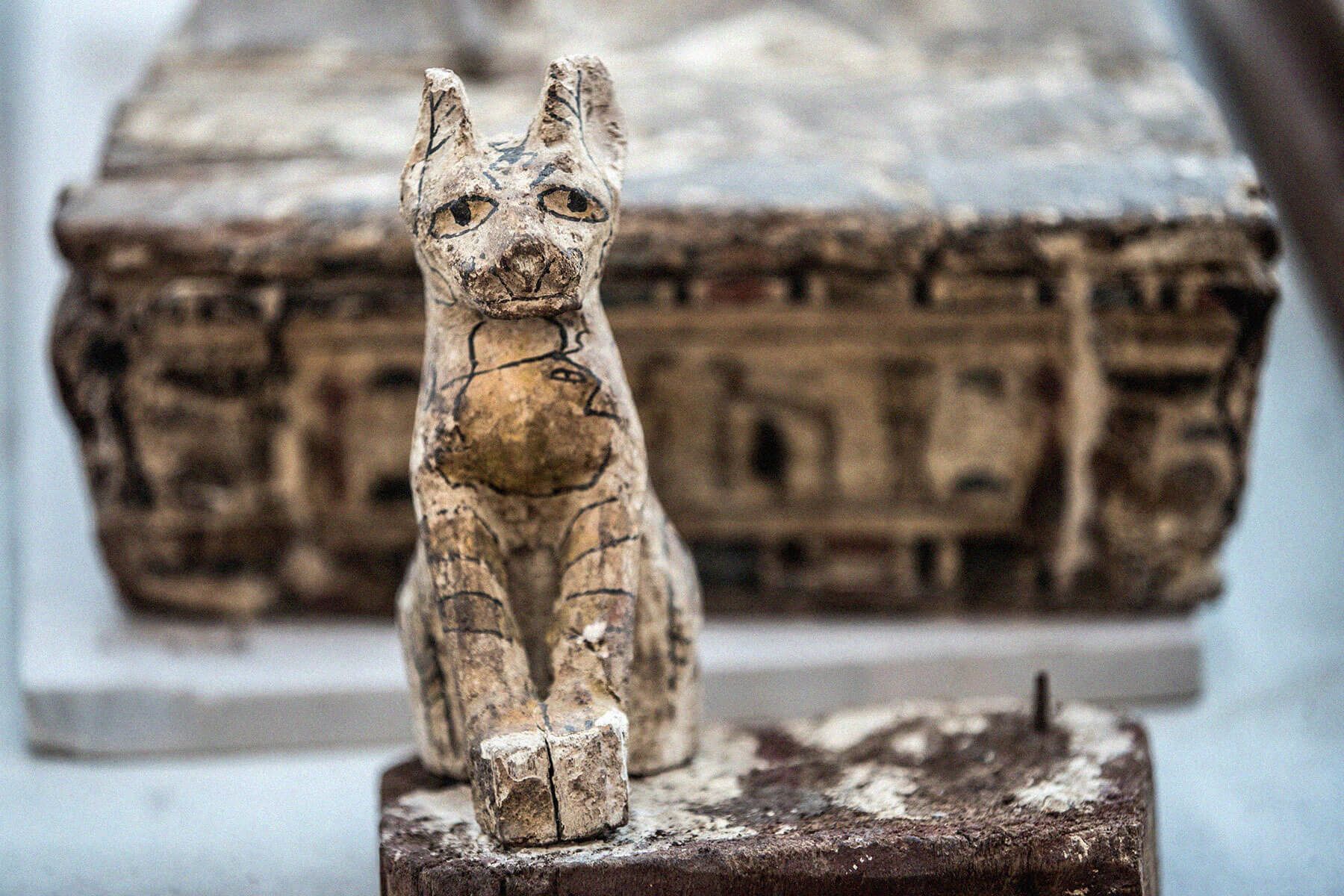
It’s been difficult for researchers to pin down the exact origin of the house cat, but it’s believed our furry friends evolved from wildcats roughly 12,000 years ago, around the time that humans moved to an agricultural lifestyle. In 2004, French archaeologists on the Mediterranean island of Cyprus found what is now the earliest evidence of a pet kitty: a human buried with a cat in a grave that was at least 9,500 years old. Researchers know this pair must have traveled together because wildcats were not native to any other Mediterranean island aside from Sicily. The cat was also buried facing the same way as the human, just 16 inches away, indicating a close relationship.
Before this discovery, the earliest house cats were thought to have been from either ancient Egypt or China. Archaeologists in China found evidence of cats sharing a home with farmers in the village of Quanhucun 5,300 years ago, and Egyptian art depicts cats and humans living together as far back as 4,000 years ago. Ancient Egyptians were famously fond of felines, and thought so highly of their cats that they associated them with godlike qualities. The Egyptian royal class would even dress cats in gold and let them eat from their plates.
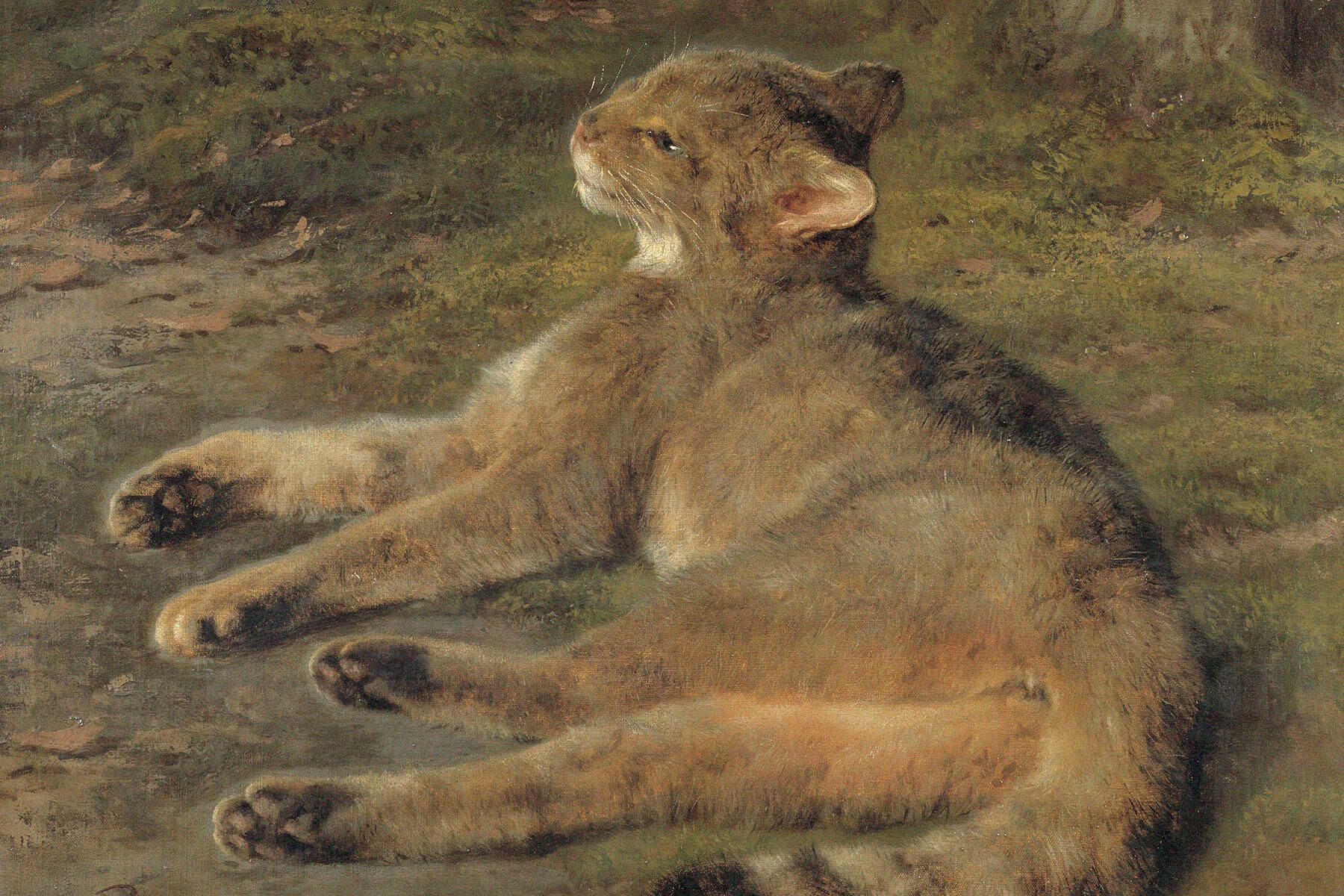
Photo credit: Heritage Images/ Hulton Fine Art Collection via Getty Images
House Cat DNA
Researchers suspect that all domestic cats descended from a subspecies of the Eurasian and African wildcat Felis silvestris, which roughly translates to “cat of the woods.” Four strains of the subspecies can be traced to wildcats in Europe, China, Central Asia, and Southern Africa, and the fifth subspecies, Silvestris lybica, the Middle Eastern wildcat, is what gave us the house-dwelling cats we know and love today.
Over time, house cats evolved from these wildcats in several notable ways. Today’s kitties tend to be smaller, due to a change in diet and activity level, and their coats have become more colorful as they have less of an evolutionary need to blend in with their surroundings. Domestication also rapidly increased the number of different breeds: As of 200 years ago, only five breeds of domestic cat were recognized. Today, the Cat Fanciers’ Association recognizes 45 separate breeds, while the International Cat Association recognizes 73. While dogs are bred in a wide variety of sizes, shapes, and temperaments, house cats are much more genetically similar across the board, the main differences coming in coat patterns and color. This is because dogs were bred for a number of different jobs, such as herding, hunting, and sled-pulling, while cats have mainly specialized in one domestic task.
When humans began moving away from hunting to a farming lifestyle, they had to deal with new problems that came with storing excess crops — namely, rodents. Cats saw an abundance of prey, and decided to call these settlements home. Humans, meanwhile, figured that having cats around was preferable to having an infestation of pests. What’s more, the furry exterminators, who have an almost full-protein diet, had no interest in eating the grain.
This same principle exists today in businesses that have a symbiotic relationship with felines, such as in New York City, where food market owners gladly pay the $200-$350 fine from the health department to keep cats around and the mice away. This mutually beneficial dynamic was necessary to make the pairing between humans and cats work, because otherwise the feline’s nature as a solo predator makes it a tough match for domestication. Dogs, who were domesticated thousands of years before cats, are natural pack animals who see humans as the alpha. Cats, as any cat owner will tell you, do not. This is why scientists believe it was likely the cats, not the humans, who made the move to initiate a partnership — and only because there was something in it for them.
Cats came to the United States with the earliest colonists from Great Britain; it’s believed the American shorthair cat descended from these European kitties. As of 2020, about 37 million U.S. households (26%) had a cat, and 1.3 million of those had five cats or more, for a total of roughly 60 million pet cats nationwide. Some 43% of those cats were bought from pet stores, while another 40% were picked up from shelters or rescues. A lot has changed from the early barn cats that found us thousands of years ago, but the most popular name for male pet cats in the U.S. is also one of the first on record: Tom.
Advertisement
Advertisement
Another History Pick for You
Today in History
Get a daily dose of history’s most fascinating headlines — straight from Britannica’s editors.