



An Egyptian mummy received military honors.
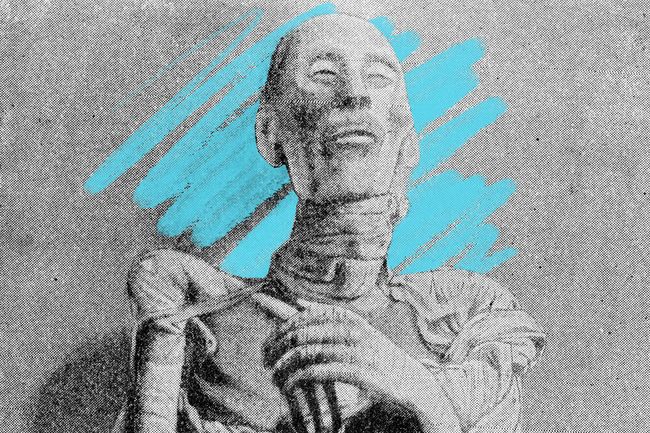
Egypt’s Ramses II was one of the most storied leaders of the ancient world. During a reign that lasted from 1279 to 1213 BCE, he earned renown as a military strategist, a canny politician, and an ambitious builder who constructed major temples as well as a new capital he named after himself. (He wasn’t exactly shy about self-promotion.) So perhaps it’s not a huge surprise that when his mummy landed in France in September 1976, it was welcomed with military honors.
Ramses II’s mummy traveled on French military aircraft from Cairo to Paris, surrounded by plastic balls for cushioning and packed into a sealed crate. (The popular story that he traveled with a passport is, however, false.) When the mummy arrived at Le Bourget Airport near Paris, an air force contingent and the Republican Guard (an honor guard that frequently accompanies foreign heads of state) greeted the arrival, saluting the mummy with their rifles. The ceremonies were broadcast live on French national television.
After 3,200 years, Ramses II’s remains weren’t exactly fresh as a daisy. Exposure to fresh air and the resulting influx of pests and fungi had especially damaged the mummy after it was discovered in 1881 near Luxor, Egypt. At the Musée de l’Homme in Paris, researchers examined the mummy with X-rays and planned its treatment. Specialists from a Grenoble-based conservation laboratory helped arrange the final step at a nuclear research center: 12 hours and 40 minutes of gamma irradiation to kill the fungi and sterilize the tissues.
On May 10, 1977, Ramses headed home with another royal send-off. The Republican Guard was again in attendance, and his transport crate was draped in deep blue velvet, embroidered by Louvre artisans with lotus motifs in gold thread. More than three millennia after his death, the pharaoh was still traveling in style.


