

7 of History’s Costliest Typos
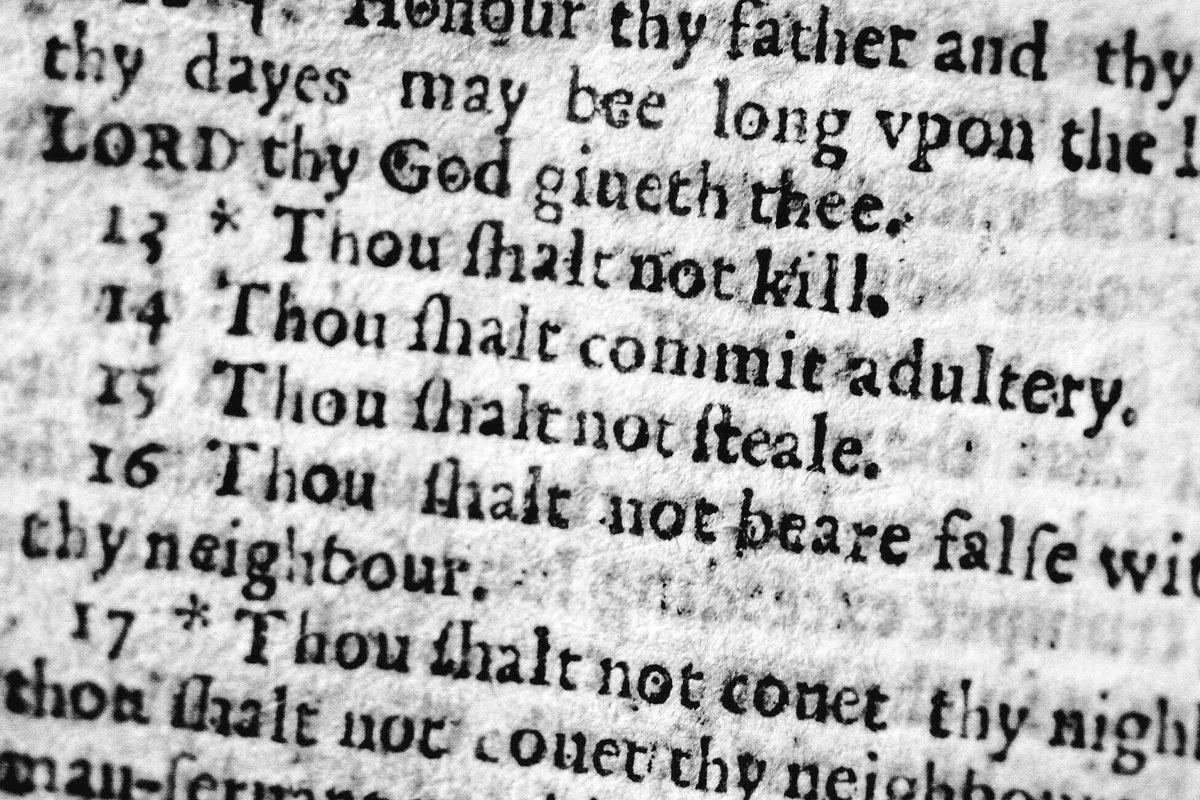
For as long as the written word has been set down on the printed page, typos have existed. One notorious typographical error was found within the so-called Wicked Bible, a 1631 edition of the King James Bible in which pious readers were advised, “Thou shalt commit adultery.” Further examples abound, from Shakespeare’s typo-ridden folios to first editions of Harry Potter and the Philosopher’s Stone in which “one wand” is erroneously included twice in Harry’s school supply list. In the latter case, lucky owners of these highly collectible first editions, of which only 500 were printed, found themselves in possession of a book — typo included — that fetched $90,000 in an auction. But typos don’t always add value — in fact, they can end up being very expensive. From a stray comma that ended up costing millions to a tiny typo that crashed a spacecraft, here are seven small mistakes that carried enormous price tags.

A Not-So-Fruitful Comma
A U.S. tariff act originally drafted in 1870 allowed “fruit plants, tropical and semi-tropical for the purpose of propagation or cultivation” to be exempt from import tariffs. As written here, “fruit plants” referred specifically to the plants that fruits grow on, and not the fruits they produce. Then, in 1872, an updated tariff act was released, with an unfortunate comma that changed everything. The errant comma somehow snuck in between “fruit” and “plants,” and suddenly tropical and semi-tropical fruits — most of which were expensive — could be imported without any charge. This reportedly cost nearly $2 million in lost tariff revenue, the equivalent of $53 million in today’s money.
More from our network





NASA’s Erroneous Equation
In 1962, NASA launched the unmanned Mariner 1 spacecraft from Cape Canaveral, Florida, on a mission to fly by the planet Venus. Shortly after liftoff, however, the rocket veered off course and was almost immediately destroyed. The culprit? A tiny typo. The omission of an overbar for the symbol “R” for radius (a simple “R” instead of “R̅”) in an equation caused a program to not respond as planned, forcing NASA to explode the wayward (and highly expensive) rocket for safety reasons. Mariner 1 had cost NASA about $80 million to build (more than $850 million in today’s money), and its journey lasted mere seconds.

When “Exotic” Became “Erotic”
When Gloria Quinan, owner of Banner Travel Agency in California, placed an advertisement in the 1988 Yellow Pages to promote her “exotic” travel business, she began receiving some strange calls. She soon found out that Pacific Bell, the company behind Yellow Pages, had made a somewhat risqué typo: Instead of “exotic,” they had written “erotic.” Quinan said that answering calls from so many people seeking an erotic travel experience negatively affected her business and her mental health, and she sued Pacific Bell for $10 million. The case was settled quietly out of court but likely ended up being a costly typo for Pacific Bell.

Mizuho Securities’ Expensive Error
The Tokyo Stock Exchange was caught up in a moment of madness in 2005 when a data-entry error caused a trader for Mizuho Securities to accidentally sell 610,000 shares at 1 yen apiece, when he should have been selling just 1 share at 610,000 yen. The Tokyo Stock Exchange refused to reverse the error, costing the company a whopping 27 billion yen — about $225 million.

A Costly Phone Drop
In 2019, a typo erroneously overvalued a single home in Wasatch County, Utah, creating revenue shortfalls in five of the county’s taxing entities. The home was recorded in the tax rolls with a market rate value of $987 million and a taxable value that was $543 million more than what it should have been — which was just $302,000. The numerical typo, which was reportedly caused by an employee dropping his phone on a keyboard, ultimately resulted in a countywide overvaluation of more than $6 million. Innocent taxpayers were soon warned to expect increased tax rates for upwards of three years to pay off the unfortunate error.

A Very Expensive “Son”
Back in 2009, Companies House, a government agency that acts as the registrar for all companies in the U.K., made a grave error. The agency r stated that Taylor & Sons — a Welsh engineering firm that had existed for 124 years — had gone into liquidation. But Companies House had gotten the wrong company. It should have been looking at Taylor & Son, rather than the plural “Sons.” It corrected the error three days later, but the damage had already been done, irrevocably tarnishing the reputation of Taylor & Sons, which collapsed and was eventually dissolved in 2014. Taylor & Sons sued, alleging damages of £8.8 million (over $14 million USD), and a court battle followed. While a judge initially ruled in favor of the slandered engineering firm, the two parties later settled for an undisclosed amount — all because of an errant “s.”

A Plane and Simple Typo
A 5,554-mile flight for just $39 sounds like quite a bargain — and for some lucky travelers, it was exactly that. But for Italy’s Alitalia, it was a huge mistake. Due to a typo, the airline listed a business-class ticket from Toronto to Cyprus in 2006 for $39 instead of $3,900. Within hours, around 2,000 people had purchased the too-good-to-be-true ticket. The airline, fearing a massive PR backlash should it cancel the tickets, decided instead to honor them — at a loss of $7.2 million.