

Anesthesia was invented after a laughing gas party.
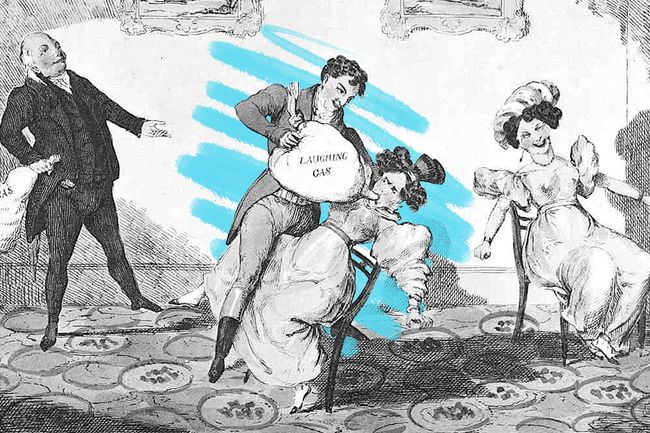
Before modern anesthesia, surgery was an agonizing experience. Procedures were done quickly and often with alcohol, opium, or nothing at all. That began to change in 1799, when 20-year-old English chemist Humphry Davy started experimenting with nitrous oxide — better known as laughing gas.
Davy didn’t experiment alone. He invited friends to inhale the gas during get-togethers in the drawing room above his laboratory. The effects were immediate: laughter, euphoria, and shifts in bodily sensation all around. Davy recorded these findings and published them in 1800.
These parties caught on across the U.K. and the United States, where ether was favored over laughing gas (the effects were similar and it was easier to obtain). Decades later, in 1844, American dentist Horace Wells decided to try nitrous oxide as an anesthetic for a tooth extraction. Though his early attempts weren’t successful, he inspired a colleague to attempt a similar procedure using ether. In 1846, dentist William Morton successfully demonstrated using ether as an anesthetic, ushering in the first widely accepted form of modern anesthesia.


