




Listerine was originally a surgical antiseptic.
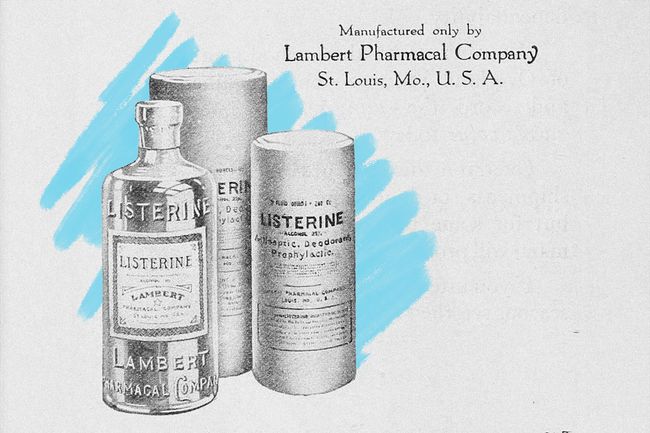
When chemist Joseph Lawrence developed Listerine in 1879, he didn’t have bad breath in mind. Inspired by surgeon Joseph Lister, who pioneered antiseptic medicine, Lawrence formulated and sold the product bearing Lister’s name as a surgical antiseptic. Other applications for his invention that failed to catch on in the marketplace include floor cleaner, hair tonic, dandruff cure, deodorant, and “beneficial remedy” for such diseases as dysentery, diphtheria, smallpox, and gonorrhea. Eventually, Lawrence licensed the product to Jordan Wheat Lambert, a local pharmacist in St. Louis, and it was he who began selling it to dentists in 1895 as a mouthwash and disinfectant.
Listerine first became available as an over-the-counter mouthwash in 1914, but it didn’t achieve widespread popularity until the following decade, and minor changes to the formula were made over time. That was when Lambert’s son began an aggressive marketing campaign that pitched Listerine as the cure for chronic halitosis, better known as bad breath.
Bad breath wasn’t a major social concern at the time, but as authors Steven D. Levitt and Stephen J. Dubner wrote in Freakonomics: “Listerine changed that. As the advertising scholar James B. Twitchell writes, ‘Listerine did not make mouthwash as much as it made halitosis.’ In just seven years, the company’s revenues rose from $115,000 to more than $8 million.” The next time you’re feeling self-conscious about your breath, you can think of mouthwash as both the source of, and solution to, your problem.


