




Why Is the Bride on the Left at a Wedding?
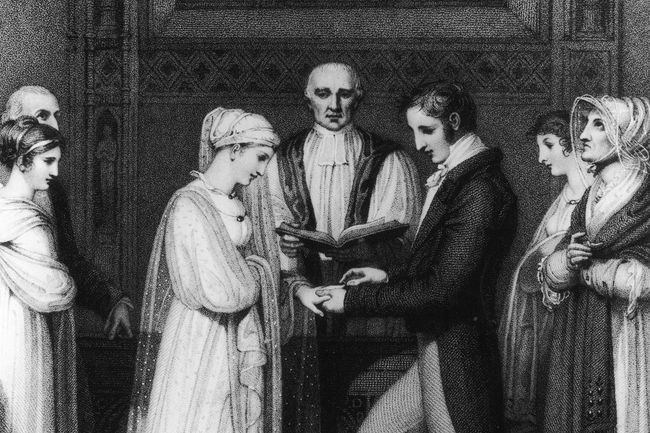
If you’ve been to a traditional (or somewhat traditional) Christian wedding recently, you may have noticed that the bride generally stands on the left and the groom on the right during the ceremony. If somewhere between the vows and the bouquet toss you found yourself wondering about the “why” behind that arrangement, you’re not alone. So how did this tradition emerge?
More from our network






A quick scan of the internet will show you that most explanations for this custom center on the idea of “marriage by capture.” The idea is that in centuries past, men would abduct women to be their brides, either in secret or by slaying the woman’s family. This is said to affect the standing positions during the matrimonial ceremony because grooms needed to keep their sword hand — their dominant hand — free in case anyone came to try to take the bride back. Because most men are right-handed, standing on the right meant that the left hand could be free for wedding duties while the right hand would be ready to pull out a sword if there was trouble.
As swashbuckling and dramatic as that may sound, there’s little evidence to support this theory, and also little evidence that marriage by capture was ever a common occurrence in Europe. Marriage by capture probably did happen on occasion — it’s mentioned in Greek mythology, the Bible, and ancient Hindu legal texts. But if it seems like an unworkable way to conduct society at large, that’s because it is.
The idea of marriage by capture was notably championed by Scottish lawyer and ethnologist John Ferguson McLennan in his 1865 book Primitive Marriage. However, more recent historians and anthropologists have noted that McLennan made no distinction between the ritualized mock battles that take place in a number of cultures before marriage and actual abduction.
Other explanations highlight the sword hand idea but don’t directly tie it to the capture theory. Instead, the groom having his sword hand free was meant to be a general boon to the bride’s protection, in case of impending duels from jilted lovers and the like. But this too lacks evidence. In fact, the sword hand theory seems to have emerged as part of a 19th-century fascination for explaining customs (wedding and otherwise) with reference to a rough, barbaric past, even when actual evidence is thin.

So why does the bride usually stand on the left in Christian weddings? Like many traditions, it probably arose for a bunch of different reasons, rather than one clear one. Wedding customs vary a lot by religion and region, and the standing arrangement isn’t consistent.
In some regions and eras the bride stood on the right instead. (That’s the case in today’s Jewish weddings.) The practice of standing on the left likely arose in Christian Europe thanks to some combination of liturgical symbolism (the right side is associated with honor and authority in Christian tradition) and the practicalities of ritual (the groom sometimes needed to use his right hand to receive the bride from her father or place the ring).
By the 19th century, Western wedding positioning — and many other customs — had become standardized in etiquette manuals. By that time, the original reasons for the custom were unclear.
Today, however, etiquette experts say the people getting married should feel free to stand on whichever side they like. Factors to consider include whether the sun might get in your eyes, showing off your good side, and facing your side of the family (if seating arrangements are split down the aisle). Thankfully, you probably won’t have to worry about which hand can more easily grab your sword.


