




Was Aesop a Real Person?
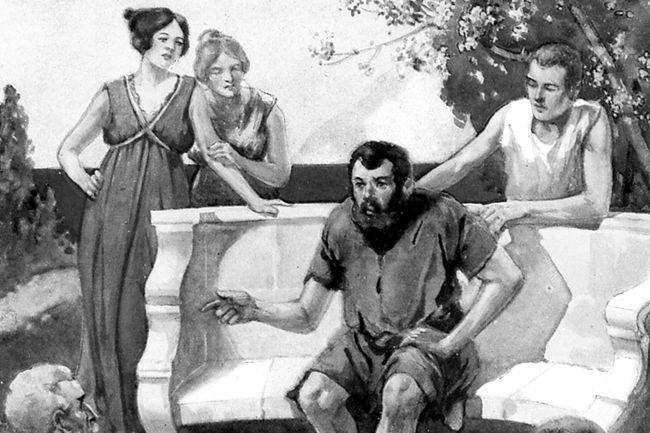
For more than two millennia, readers have enjoyed the brief, morally pointed tales known as Aesop’s fables. For many of us, these stories were among the first we heard as children, alongside Mother Goose rhymes and the fairy tales of the Brothers Grimm. Long before we knew anything about ancient Greece, we learned that a steady pace could win the race, that dishonesty would cost us others’ trust, and that pride often comes before a fall.
Stories such as “The Tortoise and the Hare,” “The Boy Who Cried Wolf,” and “The Lion and the Mouse” have circulated in classrooms, children’s books, and popular culture. Their appeal lies in their simple, short narratives, often featuring animals with human traits, that deliver clear, memorable lessons. And they tend to stay with us — many of us can still recall a favorite fable and the moral it carried.
Yet while the fables themselves are widely known, the figure to whom they are attributed — Aesop — remains uncertain. Was Aesop a real person? And if so, who was this mysterious fabulist?
The First Mentions of Aesop
Ancient sources place Aesop in the Greek world of the late seventh to mid-sixth centuries BCE, often describing him as an enslaved storyteller. But the evidence is limited, indirect, and sometimes contradictory — a mix of early references, later embellishments, and literary tradition, making Aesop one of antiquity’s more elusive figures.
The earliest surviving mentions of Aesop appear in Greek texts written more than a century after he supposedly lived. The fifth-century BCE historian Herodotus refers to Aesop as an enslaved person on the island of Samos and notes that he was killed at Delphi. The account is brief and lacks detail, but it is widely treated as the earliest historical reference.
In the fourth century BCE, Aristotle mentions Aesop in Rhetoric, portraying him as a storyteller whose fables could be used as persuasive examples in political contexts. Aristotle cites a fable attributed to Aesop, involving a fox and a hedgehog, as an example of how storytellers can employ moral tales to persuade or instruct in political contexts. This suggests that by Aristotle’s time, Aesop was already linked with a recognizable body of moral storytelling used for public argument and instruction.
Later ancient writers expand on these details, portraying Aesop as an enslaved man who gained freedom through intelligence and wit and who used fables to comment indirectly on social and political life. However, these accounts vary in detail and reliability, and none provides a verifiable biography.
More from our network






How Aesop’s Life Turned Into Legend
By the early centuries CE, Aesop’s life had become the subject of extended narrative. The most influential example, the Greek text Life of Aesop, likely composed between the first and second centuries CE, presents a dramatic and often comic biography rather than a strictly historical account.
In this version, Aesop is depicted as physically unattractive but exceptionally clever — an enslaved person who rises to prominence through wit and storytelling. The narrative places him in the company of figures such as Solon and Croesus and ends with his execution at Delphi after a conflict with local residents.
Modern scholars generally treat the Life of Aesop as fictional or semifictional, reflecting popular storytelling traditions of the time. While it preserves some elements found in earlier sources — such as Aesop’s status as an enslaved storyteller and his death at Delphi — most of its details are considered later inventions. In this way, Aesop himself became a kind of fable character: a clever underdog, using his words and wit to challenge those in power.

These Famous Fables Weren’t Written Down at First
The stories attributed to Aesop were not recorded during his lifetime. In classical Greece, short fables circulated orally and were commonly used as rhetorical tools in speeches, debates, and instruction. Their brevity and clarity made them easy to remember, repeat, and adapt for different situations. Similar storytelling traditions also existed beyond Greece, particularly in India and the Middle East, where collections of moral tales developed independently and later intersected with Aesop’s stories through translation and cultural exchange.
A written collection of fables attributed to Aesop was probably compiled in the fourth century BCE by Demetrius of Phalerum, though this version has not survived. Over time, other writers helped preserve and reshape the material. The Roman writer Phaedrus, in the first century CE, turned many of the fables into Latin verse, while the Greek poet Babrius produced similar poetic versions.
Because these stories were transmitted across generations and cultures, they evolved. New fables were added, others were adapted, and many were likely never connected to a single original author. As a result, “Aesop” gradually became less a historical voice and more a name attached to a broader storytelling tradition.

How Aesop Became Bigger Than a Single Person
Whether or not Aesop can be identified as a single historical individual, his cultural role is clear. By the classical period, he was already regarded as the archetypal teller of fables — a reputation that only grew in later centuries.
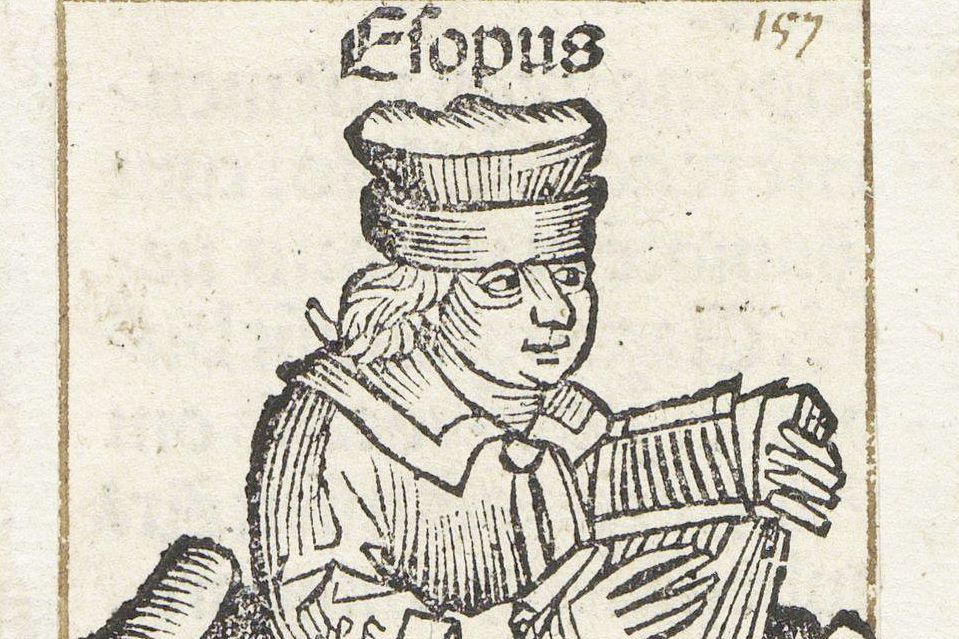
In the medieval and early modern periods, collections of Aesopic fables were translated, adapted, and widely printed across Europe. With the spread of the printing press, they became standard tools of moral and literary education, shaping how generations of readers encountered storytelling and ethical lessons.
So was Aesop real? Modern scholarship takes a cautious view. He may have been a real storyteller in the Greek world of the sixth century BCE, but the details of his life cannot be firmly established. Over time, his name became attached to a growing and evolving body of stories. Like Homer, his life blurs the line between history and legend — a person whose identity has been absorbed into the tradition he represents.


