


Horse-riding librarians delivered books during the Great Depression.
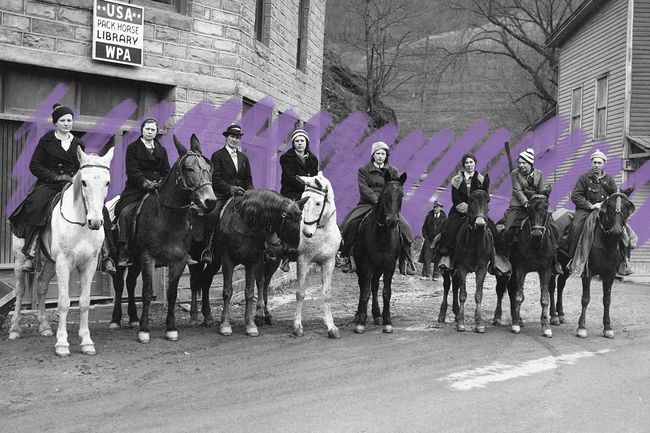
During the Great Depression, the Works Progress Administration, one of the most visible New Deal programs, hired unemployed Americans to develop public works projects. These public works included libraries — and one unique WPA project proved that libraries are so much more than buildings. Starting in 1934, librarians on packhorses rode to remote rural communities in the Appalachian Mountains to deliver much-desired reading material to struggling families.
With coal and railroad companies preparing to expand into the area, many residents were hungry for information to help them navigate the coming changes. But the Appalachian communities in eastern Kentucky rarely had easy access to books, and the location presented a special set of challenges for mobile librarians, including rough terrain, brutal weather, and communities wary of outsiders.
Packhorse librarians offered some significant advantages over previous traveling librarians in the area: They were mostly locals, and the packhorses were better-equipped to travel the rough terrain than book wagons, although some areas required leaving a horse behind and continuing on foot.
Local librarians kept stashes of books in post offices, churches, or wherever else they could set up shop, and loaded up panniers for the horseback librarians. Each route could cover more than 100 miles in a week, and some librarians took a second horse to carry more inventory. Magazines with practical information, such as Popular Mechanics and Woman’s Home Companion, were in high demand. Children’s books were also very popular, both for children and for adults just learning to read. Librarians even crafted new books in cardboard binders, some from books that were worn out and others that were cut-and-pasted from children’s stories in newspapers.
Funding for the Pack Horse Library Project was eliminated in 1943, and most of the librarians went back to farm work or teaching. In 1956, a U.S. representative from Kentucky introduced legislation that provided dedicated federal funding to public libraries; he’d been on one of the packhorse routes as a child. That funding, along with newly paved roads, allowed bookmobiles to fill in the gaps once served by librarians on horseback.


